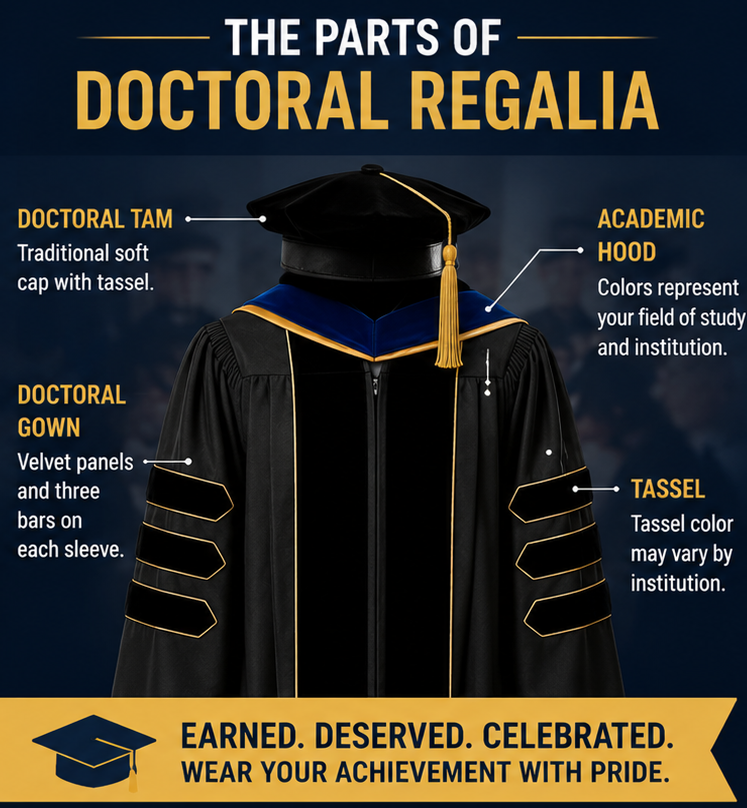
Students are the center of commencement, but professors are an important part of the ceremony as well. Faculty members may process into the venue, sit with academic departments, participate in doctoral hooding, serve as marshals, present graduates or join the platform party.
That creates an important practical question for new and experienced faculty alike: What should a professor wear at commencement?
Academic dress is different from ordinary professional clothing. The gown, hood and academic headwear can reflect an earned academic credential and established institutional traditions rather than the professor’s current job title.
This guide approaches professor commencement attire as a six-decision process. By working through each decision before ordering or renting regalia, faculty members can build an academic ensemble that is appropriate, comfortable and practical for commencement.
Because academic-dress practices vary among institutions, the host university’s current commencement instructions should always take priority over general guidance.
Decision 1: Which Academic Credential Are You Representing?
Before choosing a gown, determine which earned academic degree you will represent during the ceremony.
This matters because academic dress can differ among:
- Bachelor’s degrees
- Master’s degrees
- Doctoral degrees
- Professional degrees
A faculty member’s academic title does not automatically answer this question.
Being a Professor Does Not Automatically Mean Wearing a Doctoral Gown
Professor is an academic position or title. Doctorate is an earned degree level.
A professor whose highest earned degree is a master’s degree should not assume that a faculty position automatically calls for doctoral-level academic dress.
Likewise, titles such as:
- Assistant professor
- Associate professor
- Professor
- Lecturer
- Department chair
- Program director
do not by themselves establish the degree level represented by the academic gown.
What If You Have More Than One Graduate Degree?
Faculty members frequently hold multiple credentials.
For example, a professor might have earned a master’s degree from one university and a doctorate from another.
When representing the doctorate, the faculty member would generally look to the appropriate doctoral academic dress and the relevant degree-granting institution’s hood specification, subject to the ceremony’s requirements.
If the correct choice is unclear, ask the host institution’s commencement, faculty affairs or academic affairs office.
Decision 2: What Does the Host Institution Expect?
Once you know the credential you intend to represent, check the institution where the ceremony will take place.
Faculty commencement instructions may address:
- Whether academic regalia is required
- Faculty arrival time
- Processional order
- Academic-dress expectations
- Headwear
- Faculty seating
- Hooding responsibilities
- Special ceremonial roles
Do Not Assume Every University Uses the Same Faculty Dress Rules
A professor who participates in commencement at several institutions may encounter different practices.
The academic regalia itself may represent the professor’s earned degree, while ceremony procedures are controlled by the institution hosting the event.
Keep those two concepts separate.
Your Degree Institution and Your Employer May Be Different
Suppose a professor earned a doctorate from one university and later joined the faculty of another.
The professor does not necessarily replace the academic hood simply to match the colors of the current employer.
In traditional U.S. academic dress, hood elements can be associated with the degree and degree-granting institution.
Verify the proper configuration instead of selecting colors based on the university where you currently work.
Decision 3: Select the Correct Faculty Gown
After identifying the degree level and host requirements, consider the gown.
Faculty gowns can differ substantially in:
- Sleeve construction
- Fabric
- Color
- Velvet or velvet-like trim
- Decorative details
- Institutional customization
- Weight
- Fit
Bachelor’s Faculty Gown
A faculty member representing a bachelor’s degree would generally use bachelor’s-level academic dress when appropriate for the ceremony.
Bachelor’s gowns typically have simpler construction than advanced-degree gowns.
Master’s Faculty Gown
Master’s gowns have characteristic sleeve construction that distinguishes them from bachelor’s gowns.
A professor representing a master’s credential should verify that the garment is actually designed for the master’s degree level.
Doctoral Faculty Gown
Doctoral gowns are commonly more elaborate.
Many traditional doctoral designs include:
- Full doctoral sleeves
- Velvet or velvet-like front facings
- Three velvet or velvet-like bars on each sleeve
These features are common, but custom institutional doctoral gowns can differ.
Standard Black Doctoral Gown or University-Specific Gown?
This is one of the major purchasing decisions for doctoral faculty.
Black doctoral gowns are widely used, but some degree-granting institutions have distinctive academic dress.
Custom gowns may incorporate:
- Institutional colors
- Contrasting panels
- Special piping
- Embroidery
- Distinctive velvet treatments
- Unique sleeve details
Determine whether a standard doctoral gown is appropriate before purchasing one as a substitute for institution-specific regalia.
Faculty Who Attend Commencement Every Year Should Think Long Term
A graduating doctoral student may initially purchase regalia for one ceremony.
A professor can have a very different use pattern.
Faculty members may wear academic dress for:
- Annual commencement
- Winter commencement
- Convocation
- Doctoral hooding ceremonies
- Faculty installations
- Academic processions
- Special university ceremonies
If you expect frequent use, consider durability and comfort in addition to initial purchase price.
Fabric Weight Matters for Faculty
Commencement ceremonies can last several hours.
A heavy doctoral gown may look substantial but can become warm during an outdoor ceremony.
A lighter fabric may offer advantages for warm-weather use or frequent travel.
Consider:
- Climate
- Indoor versus outdoor ceremonies
- Frequency of use
- Travel
- Storage
- Fabric care
- Personal comfort
Decision 4: Verify the Faculty Academic Hood
The hood should receive as much attention as the gown.
Do not treat it simply as a colorful accessory.
Depending on the academic-dress tradition being followed, a hood can incorporate information associated with:
- Degree level
- Degree-granting institution
- Academic discipline
Master’s Hood vs. Doctoral Hood
Degree level matters.
A master’s hood should not automatically be reused as a doctoral hood simply because the colors look appropriate.
The construction associated with the degree level can differ.
First Hood Question: Which Institution Awarded the Degree?
Under traditional U.S. academic-dress conventions, the hood lining can represent the degree-granting institution.
The lining may use one or more colors arranged in a specified pattern.
That means the correct hood is not necessarily based on the colors of the university where the professor currently teaches.
Second Hood Question: What Is the Correct Academic Field?
The hood’s velvet or similar edging may be associated with an academic discipline under traditional academic-dress conventions.
Examples commonly referenced include:
- Arts, Letters and Humanities: White
- Business, Commerce and Accountancy: Drab
- Education: Light Blue
- Engineering: Orange
- Fine Arts: Brown
- Law: Purple
- Library Science: Lemon
- Medicine: Green
- Music: Pink
- Nursing: Apricot
- Philosophy: Dark Blue
- Physical Education: Sage Green
- Public Administration: Peacock Blue
- Public Health: Salmon Pink
- Science: Golden Yellow
- Social Science: Citron
- Theology and Divinity: Scarlet
This list is a general educational reference rather than a universal ordering specification.
Institutions can interpret and implement academic-dress traditions differently. Verify the correct hood before ordering.
Do Not Choose a Faculty Hood Based on What You Teach
This is an easy mistake for professors to make.
Imagine a professor who currently teaches business analytics but earned a doctorate in a differently classified academic field.
The professor should not automatically choose a hood color based solely on the department where the person currently teaches.
The degree being represented should guide the specification.
Be Especially Careful With Interdisciplinary Degrees
Modern doctoral programs often cross traditional academic boundaries.
Examples might involve:
- Technology and management
- Health and administration
- Education and organizational leadership
- Engineering and business
- Computing and social science
Do not guess the appropriate hood specification from the program title alone.
Ask the degree-granting institution when necessary.
Decision 5: Choose Faculty Headwear
After the gown and hood, determine the appropriate academic headwear.
Depending on degree level and institutional practice, faculty may wear:
- Mortarboard
- Four-sided doctoral tam
- Six-sided doctoral tam
- Eight-sided doctoral tam
- Another institution-specific academic cap
Doctoral Faculty Commonly Wear Tams
The soft doctoral tam is strongly associated with doctoral academic dress, but it should not be treated as universally mandatory.
Some doctoral faculty wear mortarboards or distinctive institution-specific headwear.
Verify what is appropriate for your academic dress and ceremony.
Four, Six or Eight Sides?
The number of sides primarily describes the tam’s construction.
Do not interpret the number of sides as an automatic indication of:
- Faculty rank
- Tenure status
- Academic prestige
- Administrative authority
Choose among permitted options based on institutional requirements, fit, material, appearance and personal preference.
Faculty Tam Fit Is More Important Than It May Seem
Professors can spend hours wearing academic headwear.
A tam that is too tight can become uncomfortable, while one that is too loose may shift during:
- Processions
- Stage movement
- Hooding
- Outdoor ceremonies
- Photography
Measure according to the manufacturer’s sizing instructions rather than estimating.
What About the Tassel?
Academic headwear generally includes or accommodates a tassel.
Gold-colored tassels are frequently seen with doctoral regalia, but practices vary.
Verify the appropriate:
- Color
- Material
- Attachment
- Placement
Faculty Should Not Automatically Follow Student Tassel Instructions
Graduating students may be instructed to move their tassels during commencement.
Faculty members should not assume that the same ritual applies to them.
Follow faculty-specific ceremony instructions.
Decision 6: Prepare the Complete Faculty Outfit
Once you have the gown, hood and headwear, assemble everything before commencement day.
Do not wait until the faculty lineup to open a newly purchased regalia package.
Conduct a Full Faculty Regalia Fitting
Wear the complete ensemble:
- Professional clothing planned for commencement
- Ceremony shoes
- Academic gown
- Academic hood
- Approved headwear
- Tassel
- Any authorized ceremonial accessories
Check the Gown While Standing
Confirm:
- Shoulders fit comfortably
- Gown hangs evenly
- Sleeves are not twisted
- Doctoral facings lie properly
- Hem does not create a walking hazard
Check the Hood From Behind
A mirror often does not provide a good view of the academic hood.
Ask another person to inspect the back or use a photograph or video.
Look for:
- Centered placement
- No obvious twists
- Proper drape
- Lining arranged according to the hood design
Practice Sitting in Faculty Regalia
This is particularly important for professors because faculty may spend much of commencement seated.
When sitting:
- Avoid trapping the hood awkwardly behind you
- Check whether the gown remains comfortable
- Make sure sleeves do not interfere excessively
- Confirm the headwear remains stable
Practice Standing Up
Faculty members often stand repeatedly during commencement.
Practice standing without stepping on the gown or catching the hem on the chair.
Practice Walking in the Procession
Academic processions may involve:
- Long hallways
- Outdoor paths
- Stairs
- Stage ramps
- Uneven outdoor surfaces
Wear the shoes you plan to use and confirm that the gown length allows safe movement.
Special Considerations for Faculty Hooders
Faculty members participating in doctoral hooding should perform an additional mobility check.
Put on your own full regalia and raise your arms as though you were placing a hood over a graduate.
Make sure:
- Your sleeves permit sufficient movement
- Your own hood remains positioned properly
- Your headwear stays secure
- Your tassel remains out of your face
Follow the Hooding Rehearsal
Hooding procedures vary among institutions.
The university may specify:
- Where faculty stand
- Who receives the hood
- Who places it
- How the graduate approaches
- Where the graduate faces
- How faculty exit the hooding position
Follow the local procedure rather than relying on another university’s ceremony.
Faculty Regalia for Outdoor Ceremonies
Outdoor commencement introduces additional practical concerns.
Heat
Academic gowns can retain heat, especially doctoral gowns with substantial fabric and velvet or velvet-like components.
Choose suitable clothing underneath while following institutional expectations.
Wind
Check the fit of the tam or mortarboard before arriving.
Loose headwear can become distracting during a long outdoor ceremony.
Rain
Follow institutional weather procedures and garment-care instructions. Different fabrics and decorative materials may react differently to moisture.
Should Faculty Own Their Academic Regalia?
For professors who participate regularly in commencement, ownership can be worth considering.
Benefits can include:
- Consistent fit
- Regalia available when needed
- No recurring rental coordination
- Ability to use the ensemble at multiple academic events
- Familiarity with the gown and hood
When Faculty Rental Can Still Make Sense
Rental may be practical when:
- You rarely participate in commencement
- The required regalia is highly specialized
- The institution organizes rentals conveniently
- You do not want to store academic garments
Use a Multi-Year Cost Comparison
If you participate every year, compare repeated rental costs with ownership over several ceremonies.
A simple ownership calculation is:
Total purchase cost ÷ expected uses = approximate purchase cost per wear.
This is not the only consideration, but it can help faculty evaluate long-term value.
Faculty Who Travel Should Consider Portability
Professors sometimes participate in ceremonies away from their home campus.
When comparing regalia, consider:
- Garment weight
- Wrinkle resistance
- Garment bag size
- Tam storage
- Hood protection
- Care requirements
How to Store Faculty Academic Regalia
Academic regalia used year after year should be stored according to its care instructions.
General considerations include:
- Allow garments to dry completely before storage
- Avoid crushing velvet or decorative elements
- Protect the hood from excessive creasing
- Store the tam so the crown is not distorted
- Keep tassels from becoming tangled
Always follow the manufacturer’s care instructions for the specific materials.
Create a Faculty Commencement Kit
Professors who participate annually can keep their academic items together.
A faculty commencement kit might contain:
- Academic gown
- Academic hood
- Tam or mortarboard
- Tassel
- Garment bag
- Institution-issued ceremony instructions
Keeping the ensemble together can make annual commencement preparation easier.
Inspect Regalia Several Weeks Before Commencement
Even faculty members who already own their academic dress should inspect it before every ceremony.
Check for:
- Missing tassel
- Loose stitching
- Damaged zipper
- Wrinkled gown
- Crushed tam
- Hood damage
- Missing accessories
Finding a problem early provides more time to address it.
Should Faculty Add Stoles, Cords or Other Accessories?
Do not assume that every accessory appropriate for a graduating student is appropriate for participating faculty.
Institutions may have different practices regarding:
- Stoles
- Cords
- Medallions
- Organizational distinctions
- Special ceremonial items
Follow faculty protocol before adding accessories.
What Should Faculty Wear Under the Gown?
Academic regalia is worn over regular clothing.
Choose clothing appropriate for:
- The formality of commencement
- Weather
- Venue temperature
- Walking requirements
- Length of the event
Comfort matters because faculty may be in academic dress considerably longer than expected.
Faculty Footwear Is Part of Commencement Preparation
Professors may walk farther than students during commencement preparation and processions.
Choose footwear that provides stability and comfort while complementing the formality of the event.
Test the shoes with the gown to ensure the hem does not interfere with walking.
New Faculty: Five Questions to Ask Before Your First Commencement
- Is academic regalia required for participating faculty?
- Which earned degree should I represent?
- Do I need to provide my own gown, hood and headwear?
- Does the institution offer a faculty rental program?
- Are there special instructions for faculty processions, seating or hooding?
Experienced Faculty: Five Questions to Ask Before Replacing Regalia
- Does my existing gown still fit comfortably?
- Is my hood still appropriate for the degree I represent?
- Would a lighter or more durable gown improve repeated use?
- Does my tam still fit securely?
- Would buying upgraded regalia provide meaningful value over future ceremonies?
Common Professor Commencement Attire Mistakes
Choosing Regalia According to Faculty Rank
Assistant, associate and full professor are employment ranks, not separate academic-dress degree levels.
Matching the Hood to the Current Employer
The hood may represent the institution that granted the degree rather than the professor’s current employer.
Using a Master’s Hood With a Doctoral Gown Without Verification
Degree-level construction matters. Verify the appropriate hood.
Ordering Hood Colors From an Online Chart Alone
General charts are useful references but should not replace institution-specific verification.
Assuming Every PhD Uses Identical Regalia
Universities can have distinctive academic-dress traditions and custom doctoral designs.
Buying a Tam Without Measuring
Repeated commencement use makes proper headwear fit especially important.
Ignoring Comfort
Faculty may wear academic dress for several hours. Fit, fabric weight and mobility matter.
Waiting Until Commencement Morning to Inspect Regalia
Annual inspection can identify missing or damaged components before they become an event-day problem.
Professor Commencement Attire Planning Worksheet
- Degree being represented: ______________________________
- Degree-granting institution: ______________________________
- Host institution: ______________________________
- Gown level: Bachelor’s / Master’s / Doctoral
- Standard or institution-specific gown: __________________
- Academic hood verified: Yes / No
- Hood lining verified: Yes / No
- Hood edging verified: Yes / No
- Headwear: Mortarboard / Tam / Other
- Tassel verified: Yes / No
- Faculty role: ______________________________
- Indoor or outdoor ceremony: __________________
- Full fitting completed: Yes / No
Faculty Regalia Buying Checklist
- Verify host institution requirements
- Identify the degree being represented
- Verify gown level
- Confirm whether standard or custom regalia is appropriate
- Verify academic hood specification
- Verify headwear
- Measure for gown size
- Measure for tam size when applicable
- Compare fabric and construction
- Consider annual frequency of use
- Review processing time
- Review shipping time
- Review return or exchange conditions
- Try on the entire ensemble before commencement
Faculty Academic Regalia From Cap and Gown Outlet
Cap and Gown Outlet is an independent academic regalia retailer serving graduates, professors, faculty members and qualifying institutional customers.
Depending on current inventory and available configurations, academic-regalia selections may include:
- Doctoral gowns
- Doctoral academic hoods
- Doctoral tams
- Master’s gowns
- Master’s academic hoods
- Bachelor’s gowns
- Mortarboards
- Graduation tassels
- Academic regalia packages
- Graduation stoles
- Honor and recognition cords
- Diploma covers
Product availability, materials, colors, sizes, hood configurations, headwear styles and package contents can vary.
Faculty purchasing academic regalia independently should verify both the academic-dress specifications associated with the degree being represented and the current requirements of the institution hosting the ceremony.
Independent Retailer Disclosure
Cap and Gown Outlet is an independent academic regalia retailer and is not affiliated with, sponsored by, endorsed by or officially authorized by any college or university unless an actual relationship has been established.
The availability of a faculty gown, academic hood, doctoral tam, mortarboard, tassel or academic-regalia package does not establish that the product is approved by a particular college, university or commencement program.
Frequently Asked Questions About Professor Commencement Attire
What should a professor wear to commencement?
Participating professors commonly wear academic regalia appropriate to the earned degree they are representing, subject to the host institution’s ceremony requirements.
Do all professors wear doctoral regalia?
No. Professor is an academic position rather than a degree level. Faculty members should not assume that their job title automatically calls for doctoral academic dress.
Can a professor with a master’s degree wear master’s regalia?
When representing that earned degree and when consistent with institutional requirements, master’s-level academic dress may be appropriate.
What does a professor with a doctorate typically wear?
Doctoral academic dress can include a doctoral gown, doctoral academic hood, appropriate academic headwear and tassel. Exact designs vary.
Which university’s colors should appear on a professor’s hood?
Under traditional U.S. academic-dress conventions, hood lining can represent the institution that awarded the degree being represented. Verify the actual specification rather than relying only on school colors.
Should professors wear the hood from the university where they work?
Not automatically. The degree-granting institution can be relevant to the academic hood, while the host institution determines ceremony protocol.
Can professors wear doctoral tams?
Doctoral faculty frequently wear tams, but the appropriate headwear depends on the academic-dress tradition and institutional requirements.
Is an eight-sided tam required for professors?
No universal rule makes an eight-sided tam mandatory for professors or doctoral graduates.
Does a full professor wear different academic regalia than an assistant professor?
Faculty rank itself does not create a different academic degree level. The earned degree being represented and institutional requirements are more relevant.
Do professors move their tassels during commencement?
Faculty should follow ceremony-specific instructions rather than automatically following a tassel ritual intended for graduating students.
Can faculty wear honor cords and stoles?
Institutional practices vary. Professors should verify whether additional academic or organizational accessories are appropriate for participating faculty.
Should professors buy their own academic regalia?
Ownership may be practical for professors who participate in academic ceremonies regularly. Occasional participants may also consider suitable rental options where available.
How should faculty store academic regalia?
Follow the garment manufacturer’s care instructions and store gowns, hoods and headwear in a way that avoids unnecessary crushing, moisture and distortion.
Can faculty wear the same regalia at different universities?
Degree-appropriate regalia may be usable at multiple academic ceremonies, but the host institution’s requirements should be checked before each event.
How early should professors prepare for commencement?
Existing regalia should be inspected well before the ceremony. New or replacement regalia should be ordered with enough time for processing, delivery, fitting and any permitted exchanges or corrections.
A Practical Faculty Rule: Credential First, Ceremony Second
Choosing professor commencement attire becomes much easier when the process is divided into two questions.
First: What academic credential are you representing?
That question helps determine the appropriate degree level of the gown and the academic hood that may accompany it.
Second: What does the host institution require for this ceremony?
That determines how the faculty member participates, what ceremony-specific protocol applies and whether there are additional academic-dress expectations.
From there, choose a gown that fits comfortably, verify the hood carefully, select appropriate headwear and test the complete ensemble before commencement.
For professors who participate year after year, academic regalia is more than a one-day graduation purchase. A properly selected ensemble can become part of an academic career and may be worn at commencements, convocations, hooding ceremonies and other formal university events for years to come.