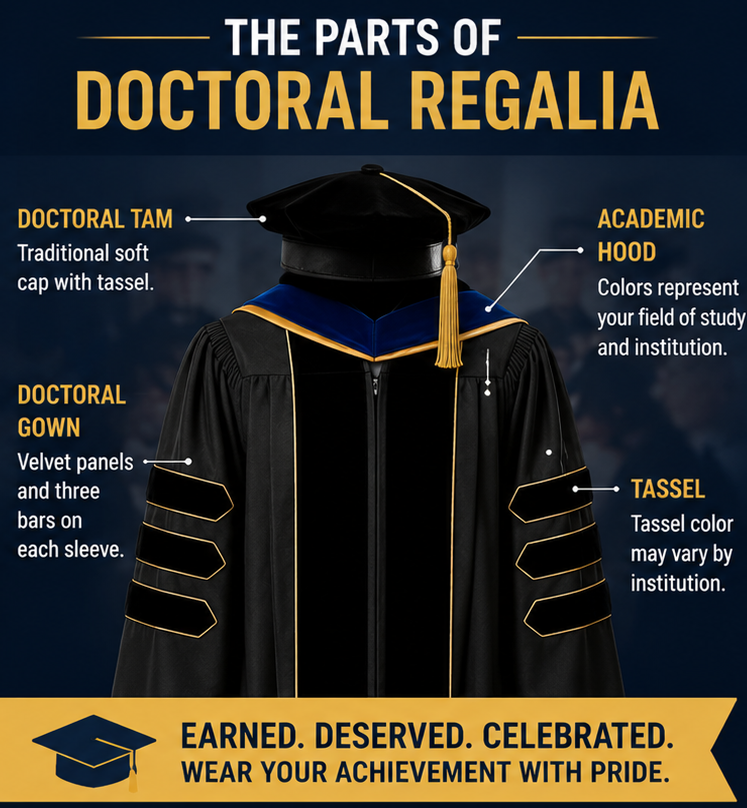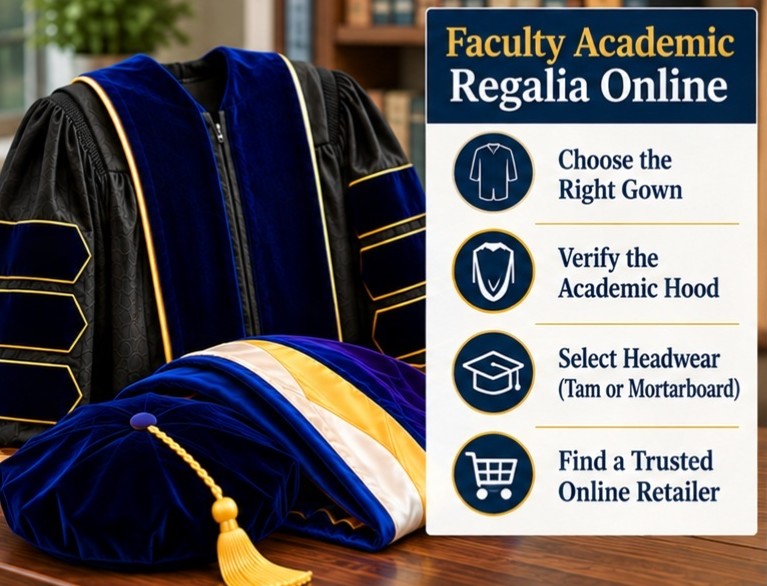
For many professors, academic regalia becomes part of professional life long after their own graduation ceremony.
Faculty members may wear academic dress at commencement, convocation, doctoral hooding ceremonies, academic installations and other formal university events. A professor who participates regularly may eventually decide that owning a personal set of academic regalia is more convenient than arranging appropriate attire before every ceremony.
Buying faculty regalia online, however, is not as simple as selecting a gown in your favorite university colors.
The gown should be appropriate for the academic degree being represented. The academic hood may require specific institutional and degree-related details. The headwear should be appropriate for the academic dress and ceremony. Fit, fabric and durability also become especially important when the ensemble may be worn repeatedly.
This guide explains how to buy academic regalia for professors online by building the ensemble one component at a time.
Start by Auditing the Academic Regalia You Already Own
Before purchasing a complete new faculty regalia package, determine whether you already own usable components. Many professors still have academic dress from their own graduation. Take inventory of:- Academic gown
- Academic hood
- Mortarboard
- Doctoral tam
- Tassel
- Garment bag
- Other academic accessories
Build a Keep, Replace and Verify List
A simple three-column system can make faculty regalia shopping much easier.Keep
Place components here when you have confirmed they are appropriate and still usable.Replace
Place damaged, poorly fitting or inappropriate components here.Verify
Use this category for anything you are unsure about, particularly academic hoods and institution-specific regalia. This approach can prevent the unnecessary purchase of an entire ensemble when only one or two pieces need attention.Identify the Degree You Will Represent
Faculty members should distinguish between their professional position and their academic credentials. A title such as professor, associate professor, assistant professor, lecturer or department chair does not by itself determine the academic gown. Identify:- The degree being represented
- The degree level
- The institution that awarded the degree
- The applicable academic field when relevant
Why Faculty Rank Is Not the Starting Point
Academic regalia generally distinguishes academic credentials rather than employment seniority. For example, a full professor should not assume that an eight-sided doctoral tam or doctoral gown is required simply because of faculty rank. Likewise, a newly appointed assistant professor who has earned a doctorate may wear doctoral-level academic dress when appropriate. The credential and institutional requirements matter more than the employment title.Check the Host University’s Faculty Instructions
Before buying anything, review the current commencement instructions for participating faculty. Look for information about:- Whether faculty regalia is required
- Whether faculty may wear personally owned regalia
- Whether rental regalia is available
- Any special academic-dress requirements
- Faculty procession procedures
- Hooding responsibilities
- Academic headwear
- Authorized ceremonial accessories
Build the Faculty Ensemble From the Gown Outward
Once the requirements are clear, evaluate each component separately. A typical faculty academic ensemble may involve:- Degree-appropriate gown
- Academic hood when appropriate
- Academic headwear
- Tassel
- Authorized ceremonial accessories
Choosing a Bachelor’s Faculty Gown
Faculty members representing a bachelor’s degree should look for a gown designed for that academic level. Bachelor’s gowns generally have relatively simple construction and traditional bachelor-style sleeves. Do not select an advanced-degree gown solely because it appears more elaborate.Choosing a Master’s Faculty Gown
Master’s gowns have distinctive sleeve construction that differentiates them from bachelor’s gowns. When buying online, verify that the product description clearly identifies the garment as master’s-level academic dress. Faculty members should not assume that all black academic gowns are interchangeable.Choosing a Doctoral Faculty Gown
Professors with earned doctorates may use doctoral-level academic dress when appropriate for the ceremony. Many traditional doctoral gowns include:- Distinctive doctoral sleeves
- Velvet or velvet-like front facings
- Three velvet or velvet-like sleeve bars
Should Faculty Buy a Standard or Custom Doctoral Gown?
This can be one of the largest decisions in a faculty regalia purchase.Standard Doctoral Regalia
Standard academic dress may be appropriate when the degree and institution do not require a distinctive custom design for the ceremony.Custom Doctoral Regalia
Institution-specific doctoral gowns can include:- Distinctive gown colors
- Contrasting panels
- Colored velvet
- Piping
- Embroidery
- Special sleeve designs
- Other institution-specific features
Think About Ten Years of Use, Not Just This Year’s Commencement
A faculty member buying academic regalia may wear the same ensemble many times. Consider potential use at:- Spring commencement
- Winter commencement
- Convocation
- Doctoral hooding ceremonies
- Academic installations
- Faculty processions
- Special academic events
Evaluate Faculty Gown Fabric for Repeated Wear
When comparing faculty gowns online, examine more than photographs. Review available information about:- Fabric composition
- Weight
- Drape
- Breathability
- Wrinkle resistance
- Care requirements
- Construction
Lightweight vs. Heavier Faculty Gowns
Neither option is automatically better. A lighter gown may appeal to professors participating in warm-weather or outdoor ceremonies. A heavier fabric may provide a different drape or appearance. The appropriate choice depends on institutional requirements, climate, personal preference and expected use.Inspect the Velvet or Velvet-Like Trim
Doctoral gown listings may describe decorative elements using different material terms. Look specifically at:- Front facings
- Sleeve bars
- Material description
- Color
- Construction
The Academic Hood Requires Its Own Verification Process
For many faculty members, selecting the gown is easier than selecting the hood. The academic hood should not be treated as a decorative accessory chosen simply to coordinate with the gown. Verify:- Degree level
- Degree-granting institution
- Institutional lining
- Lining arrangement
- Academic field or discipline specification when applicable
Your Current University May Not Determine Your Hood
Consider a professor who earned a doctorate from one institution and teaches at another. Under traditional U.S. academic-dress conventions, the hood lining can represent the institution that awarded the degree being represented. Therefore, simply matching the hood to the colors of the professor’s current employer may produce the wrong configuration.Understand Institutional Hood Lining
Academic hood lining can involve more than choosing two school colors. Specifications may involve:- One color
- Two colors
- A chevron
- Multiple chevrons
- A particular arrangement
Understand Hood Edging
Traditional academic-dress conventions associate colors with fields of learning. Commonly referenced examples include:- Arts, Letters and Humanities: White
- Business, Commerce and Accountancy: Drab
- Education: Light Blue
- Engineering: Orange
- Fine Arts: Brown
- Law: Purple
- Library Science: Lemon
- Medicine: Green
- Music: Pink
- Nursing: Apricot
- Philosophy: Dark Blue
- Physical Education: Sage Green
- Public Administration: Peacock Blue
- Public Health: Salmon Pink
- Science: Golden Yellow
- Social Science: Citron
- Theology and Divinity: Scarlet
Do Not Select a Hood According to the Department Where You Work
A professor’s current department does not necessarily determine the hood specification. A faculty member might teach in a business school after earning a doctorate classified differently for academic-dress purposes. Likewise, professors may change departments or universities during their careers without changing the degree they earned.Interdisciplinary Degrees Need Extra Attention
Modern academic programs do not always fit neatly into traditional discipline categories. Examples can combine:- Technology and business
- Healthcare and management
- Education and leadership
- Engineering and policy
- Computing and social science
Choosing Faculty Academic Headwear
After confirming the gown and hood, select appropriate headwear. Depending on degree and institutional practice, options can include:- Mortarboard
- Four-sided doctoral tam
- Six-sided doctoral tam
- Eight-sided doctoral tam
- Institution-specific academic cap
Should Every Doctoral Professor Buy a Tam?
No universal rule requires every doctoral faculty member to wear a tam. Doctoral tams are common, but some institutions or academic-dress traditions may use mortarboards or another style. Check before purchasing.Choosing Between Four, Six and Eight Sides
The number of sides primarily describes tam construction. It should not automatically be interpreted as a measure of:- Academic rank
- Tenure
- Faculty seniority
- Academic prestige
Measure Your Head Before Ordering
A properly fitting tam is especially important for professors who may wear it for several hours. Do not estimate based on ordinary hat size unless the product’s sizing instructions specifically use that measurement. Follow the manufacturer’s measuring method.Do Not Forget the Tassel
Some academic caps and tams include a tassel while others may not. Verify:- Whether the tassel is included
- Appropriate color
- Material
- Attachment style
Should Faculty Buy a Complete Regalia Package?
A package can simplify the process when you need every component. However, the word “complete” should not replace careful inspection of the product listing. Determine whether the package actually includes:- Gown
- Academic hood
- Tam or mortarboard
- Tassel
When Building the Ensemble Piece by Piece Makes More Sense
Individual purchasing can be useful when:- Your existing gown remains appropriate
- You only need a new hood
- Your tam needs replacement
- You need a specialized hood configuration
- You want to upgrade the gown but retain existing accessories
Create a Faculty Regalia Compatibility Sheet
Before ordering, write down:- Degree: __________________________
- Degree level: ____________________
- Degree-granting institution: ____________________
- Gown specification: __________________________
- Hood lining: _________________________________
- Hood edging: _________________________________
- Headwear: ___________________________________
- Tassel: _____________________________________
How to Evaluate an Online Faculty Regalia Product Page
A useful product listing should answer important questions without forcing you to make assumptions. Look for:- Clear product title
- Degree level
- Detailed photographs
- Fabric description
- Sleeve information
- Velvet or trim information
- Size chart
- Package contents
- Hood configuration options
- Headwear information
- Processing information
- Return or exchange terms
Product Photos Are Helpful—but Specifications Matter More
Lighting, screens and photography can affect how fabric and colors appear online. Do not use photographs alone to determine whether a gown or hood matches your requirements. Written specifications and institutional verification are more important.Online Faculty Regalia Warning Signs
Consider obtaining additional information when a listing:- Does not identify the gown’s academic level
- Provides no sizing method
- Does not explain the fabric
- Does not show what the package contains
- Treats one hood as appropriate for every university
- Suggests one tam design is universally required
- Provides no processing information
- Has unclear customization terms
Compare the Complete Cost, Not Just the Gown Price
Two faculty regalia offers cannot be compared accurately unless they contain equivalent components. Calculate: Gown + hood + headwear + tassel + customization + shipping = total delivered cost.Example of an Incomplete Price Comparison
Suppose one gown appears substantially less expensive than another. After reviewing the listings, you discover the lower-priced option does not include the academic hood or tam. The higher-priced package includes both. Until the missing components are added, the two advertised prices do not represent equivalent purchases.Check Processing Before Shipping
This is especially important for faculty regalia because academic hoods and custom gowns may require configuration or production. Your timeline should include:- Order processing
- Customization or production when applicable
- Carrier transit
- Time for inspection
- Time for any permitted correction or exchange
Do Not Wait Until Commencement Week
Professors who participate every year may know the ceremony date months in advance. Use that advantage. Ordering early can provide more time to:- Verify academic specifications
- Compare products
- Measure correctly
- Avoid unnecessary rush delivery
- Inspect the regalia
- Conduct a full fitting
Understand Return Conditions Before Ordering Custom Items
Standard and customized academic apparel may have different return or exchange policies. Before purchasing, review:- Return window
- Exchange window
- Condition requirements
- Custom-item restrictions
- Shipping responsibilities
- Any applicable fees
Should a New Professor Buy or Rent Faculty Regalia?
There is no universal answer. Consider expected use.Rental May Be Worth Considering If:
- You participate only occasionally
- Your institution provides convenient rentals
- The required design is highly specialized
- You do not want to store regalia
Buying May Be Worth Considering If:
- You participate every year
- You attend multiple ceremonies
- You want consistent sizing
- You participate at several institutions
- You want the regalia available whenever needed
Build a Five-Year Faculty Regalia Plan
Rather than considering only the upcoming ceremony, estimate your likely academic participation over several years. Ask:- How many commencements will I attend?
- Will I participate in doctoral hooding?
- Will I attend convocations?
- Will I travel to other universities?
- Will my academic role require additional ceremonies?
Calculate Approximate Cost Per Ceremony
For purchased regalia: Total purchase cost ÷ estimated number of uses = approximate purchase cost per use. This is only a planning tool, but it can help compare long-term ownership with repeated rentals.Consider Comfort as Part of Long-Term Value
Faculty members can spend hours in academic dress. A professor may process across campus, climb stairs, sit through speeches, stand for degree conferral and participate in hooding. Consider:- Gown weight
- Shoulder fit
- Sleeve mobility
- Hem length
- Tam comfort
- Hood stability
Faculty Hooders Need Extra Mobility
If you participate in doctoral hooding, test your gown before commencement. Raise both arms while wearing:- Your gown
- Your hood
- Your tam
Faculty Who Travel Should Consider Packability
Academic regalia may accompany professors to conferences, visiting appointments, honorary ceremonies or commencement at another institution. Frequent travelers may want to consider:- Garment weight
- Wrinkle behavior
- Storage size
- Tam protection
- Hood packing
- Care requirements
Try Everything on When the Order Arrives
Do not place new faculty regalia directly into storage. Inspect it first.Check the Faculty Gown
- Correct academic level
- Correct color
- Correct size
- Expected fabric
- Expected trim
- Working closure
- No obvious damage
Check the Academic Hood
- Correct degree level
- Correct institutional lining
- Correct lining arrangement
- Correct edging
- Proper construction
Check the Headwear
- Correct style
- Correct size
- Comfortable fit
- Tassel present when expected
Perform the Sit-Walk-Stand Test
Faculty regalia should work while you are moving, not merely while standing in front of a mirror. Wear the complete outfit and:- Walk across the room
- Walk up and down a few safe steps if appropriate
- Sit in a chair
- Stand again
- Raise your arms
- Turn your head
Store Faculty Regalia as a Complete Ensemble
Once the correct set is assembled, keeping the pieces together can make future commencement preparation easier. A faculty regalia storage system might include:- Gown
- Hood
- Tam or mortarboard
- Tassel
- Garment bag
- Written regalia specifications
Keep Your Regalia Specifications With the Garments
This is especially useful if you later need to replace only one item. Keep a record of:- Degree level
- Gown size
- Gown design
- Hood lining
- Hood edging
- Tam size
- Tassel specification
Inspect Your Faculty Regalia Every Year
Several weeks before commencement, inspect the ensemble. Look for:- Loose stitching
- Damaged zipper
- Wrinkles
- Damaged velvet
- Missing tassel
- Crushed tam
- Hood damage
- Fit changes
Faculty Regalia Online Shopping Checklist
- Identify the degree being represented
- Confirm the degree-granting institution
- Check host institution requirements
- Inventory existing regalia
- Determine what needs replacement
- Select the correct gown level
- Verify standard or custom gown requirements
- Verify academic hood construction
- Verify hood lining
- Verify hood edging
- Choose approved academic headwear
- Verify tassel
- Measure for gown size
- Measure for headwear
- Compare package contents
- Calculate delivered cost
- Review processing time
- Review shipping time
- Review return and exchange terms
- Conduct a complete fitting
Academic Regalia for Professors From Cap and Gown Outlet
Cap and Gown Outlet is an independent academic regalia retailer serving graduates, professors, faculty members and qualifying group and institutional customers. Depending on current inventory and available product configurations, academic apparel selections may include:- Doctoral gowns
- Doctoral academic hoods
- Doctoral tams
- Master’s gowns
- Master’s academic hoods
- Bachelor’s gowns
- Graduation caps
- Academic tassels
- Faculty regalia packages
- Graduation stoles
- Honor and recognition cords
- Diploma covers