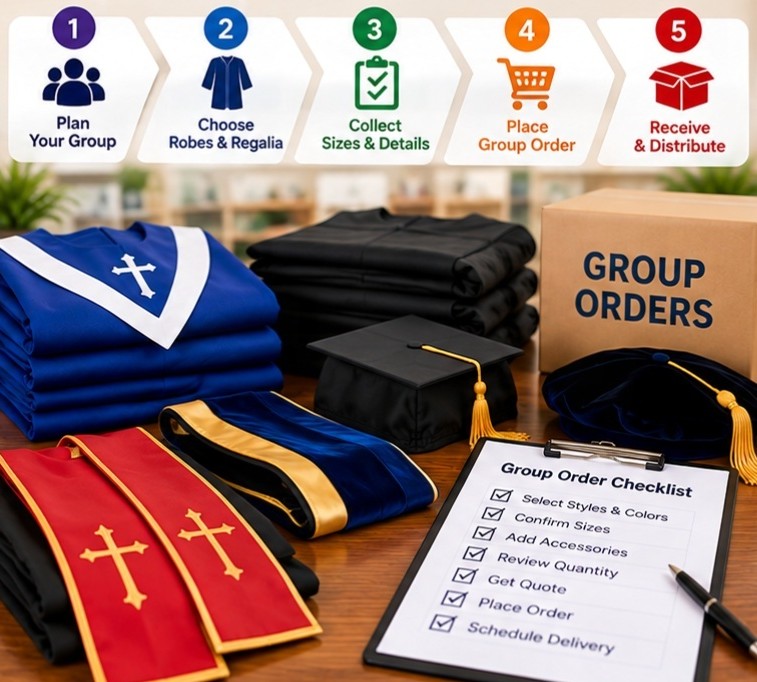
Religious institutions use ceremonial clothing for many different occasions, from weekly choir performances to theological graduation ceremonies and academic processions. While these events may share a sense of tradition and formality, the garments required for each can be very different.
A church choir may need matching robes that can be used repeatedly throughout the year. A theological seminary may need degree-specific academic gowns and hoods for its graduating students. Faculty members may require doctoral academic regalia associated with their earned degrees, while clergy members may need entirely different garments for religious services.
For administrators and purchasing committees, the challenge is not simply finding attractive apparel. It is developing a purchasing system that provides appropriate garments, supports accurate sizing, controls expenses, and makes future orders easier to manage.
This guide explores how to purchase church choir robes and seminary regalia using a structured institutional approach, including inventory management, garment selection, supplier evaluation, budgeting, and recurring order planning.
Begin With a Ceremonial Apparel Needs Assessment
Before requesting supplier quotations, organizations should identify the different events for which apparel is required.
This prevents the common mistake of treating all ceremonial garments as interchangeable.
Four Questions to Ask First
- What event will the garment be used for?
- Who will wear it?
- What religious or academic requirements apply?
- Will the garment be purchased for individual ownership or institutional reuse?
These questions help determine whether the organization needs choir robes, academic gowns, academic hoods, or another category of ceremonial clothing.
Three Distinct Apparel Programs Religious Institutions May Manage
1. Church Choir Apparel Program
Choir apparel programs often focus on consistent appearance, appropriate sizing, garment durability, and repeat use.
A church may maintain a shared inventory of robes or assign garments to individual choir members.
2. Seminary Graduation Apparel Program
Seminary graduation programs focus on academic degree requirements, graduating student quantities, approved gown designs, academic hoods, and commencement schedules.
3. Faculty and Clergy Academic Dress Program
Faculty and clergy members participating in academic ceremonies may require regalia appropriate to their earned degrees and the institution’s requirements.
Academic dress is distinct from clergy vestments and other religious garments used in worship.
Church Choir Robes vs. Seminary Academic Gowns
| Feature | Church Choir Robes | Seminary Academic Gowns |
|---|---|---|
| Primary Purpose | Choir performances and approved worship activities | Academic graduation and commencement ceremonies |
| Design Requirements | Church or choir preferences | Institution and degree requirements |
| Accessories | Approved choir accessories where applicable | Caps, hoods, tams or other required academic items |
| Size Selection | Manufacturer-specific garment chart | Manufacturer and academic garment specifications |
| Purchasing Frequency | Initial purchases and periodic replacements | Graduation-cycle or individual purchases |
| Inventory Model | Often reusable when appropriate | Institution-owned or graduate-owned, depending on policy |
Although some garments may look similar, organizations should purchase products specifically suited to their intended use.
Build a Church Choir Robe Inventory Before Purchasing More
One of the most useful ways to control choir apparel expenses is to understand what the church already owns.
Without an inventory, organizations may purchase unnecessary replacement robes while overlooking shortages in commonly needed sizes.
Recommended Inventory Categories
- Garment identification number
- Manufacturer and product style
- Approved robe color
- Manufacturer size
- Assigned member or storage location
- Condition
- Availability for reuse
- Replacement requirement
- Last inspection date
A simple spreadsheet may be sufficient for a small choir. Larger organizations may benefit from a centralized inventory system.
How to Identify Choir Robes That Need Replacement
Churches should review existing garments before ordering new apparel.
Consider Replacing a Robe When:
- The fabric is damaged beyond practical repair.
- The garment no longer fits appropriately.
- Color fading creates a visibly inconsistent appearance.
- Closures or seams are damaged.
- The garment no longer meets approved choir requirements.
- The product cannot be maintained according to its care instructions.
Replacement decisions should consider garment condition, repair options, and the organization’s budget.
Plan Choir Robe Quantities Using an Inventory Gap Analysis
Instead of purchasing one new robe for every active member, churches can compare current needs with usable inventory.
Illustrative Inventory Review
Consider a hypothetical congregation with 110 active choir members.
| Inventory Category | Quantity |
|---|---|
| Active Choir Members | 110 |
| Members Covered by Suitable Existing Robes | 74 |
| Members Requiring New Robes | 36 |
| Approved Additional Spare Robes | 4 |
| Total New Robes to Purchase | 40 |
These quantities are hypothetical.
Under this example, the church would purchase 40 robes rather than automatically ordering 110 new garments.
The actual quantity should be calculated using verified inventory, measurements, and approved spare requirements.
Choosing Robe Styles for Adult, Youth and Mixed-Age Choirs
Some congregations have separate adult and children’s choirs, while others include members of different ages in one group.
A mixed-age choir may require more than one garment size range or product category.
Adult Choirs
Adult choir garments should be selected using the manufacturer’s size chart and approved choir styling requirements.
Youth Choirs
Youth choir apparel may require different size ranges and careful attention to garment length.
Children’s Choirs
Children’s garments should allow safe movement and use age-appropriate accessories.
Mixed-Age Choirs
Organizations should verify whether one product line can accommodate the full group or whether separate approved styles are necessary.
When purchasing for children, adult supervision and product-specific safety instructions are particularly important.
How to Maintain Consistent Choir Robe Colors
Matching new robes to existing garments can be more complicated than selecting a color name.
Different manufacturers may use different shades of navy, royal blue, maroon, white, or other colors.
Fabric finish and lighting can also influence how colors appear.
Color Matching Checklist
- Identify the original manufacturer if known.
- Record the existing garment style.
- Confirm the approved color designation.
- Review current product photographs and specifications.
- Request or review available samples when appropriate.
- Confirm consistency before placing a large order.
Organizations should not assume that garments with the same general color name will match perfectly.
How to Collect Choir Robe Sizes Efficiently
Accurate sizing reduces unnecessary exchanges and helps maintain a consistent appearance.
Because garment sizing varies by manufacturer, organizations should collect measurements only after identifying the intended product.
Recommended Measurement Workflow
- Confirm the selected robe model.
- Obtain the official size chart.
- Identify required measurements.
- Distribute measurement instructions.
- Collect responses using one approved form.
- Review incomplete or inconsistent entries.
- Assign manufacturer sizes.
- Verify quantities by size.
- Approve the final order summary.
Illustrative Size Distribution
| Manufacturer Size Group | Required Robes |
|---|---|
| Size Group A | 5 |
| Size Group B | 9 |
| Size Group C | 12 |
| Size Group D | 10 |
| Size Group E | 4 |
| Total | 40 |
These size groups and quantities are hypothetical. They are not a universal sizing chart.
Should Churches Purchase or Reuse Choir Robes?
The best approach depends on garment condition, frequency of use, storage, and institutional policies.
Institution-Owned Reusable Robes
Churches may purchase garments that remain organizational property and are assigned to members as needed.
Individually Owned Robes
Members may purchase approved robes for personal use.
Hybrid Inventory
Some organizations may maintain a shared inventory while allowing members to purchase their own approved garments.
Each approach has different implications for costs, maintenance, replacement, and storage.
Understanding the Long-Term Cost of Choir Robes
The lowest initial purchase price is not always the lowest long-term cost.
For reusable choir apparel, purchasing committees should consider how frequently garments will be used and whether they can be maintained appropriately.
Illustrative Cost-Per-Use Calculation
Suppose a hypothetical robe costs $50 and is used 25 times per year for four years.
Total estimated uses:
25 uses per year × 4 years = 100 uses
Illustrative purchase cost per use:
$50 ÷ 100 uses = $0.50 per use
This calculation excludes cleaning, maintenance, repairs, storage, and replacement expenses.
The example illustrates how reusable garments can be evaluated over time rather than only by purchase price.
How to Create an Annual Choir Apparel Replacement Budget
Churches may find it helpful to establish an annual budget for replacing worn garments and accommodating new members.
Illustrative Annual Replacement Budget
| Expense | Hypothetical Amount |
|---|---|
| 12 Replacement Robes at $48 Each | $576 |
| 5 Additional Robes at $48 Each | $240 |
| Shipping | $65 |
| Total Before Applicable Taxes | $881 |
These figures are hypothetical and do not represent current supplier quotations.
Actual costs depend on product specifications, supplier pricing, and shipping arrangements.
Academic Regalia Purchasing for Theological Seminaries
Theological seminaries and religious colleges may need a separate purchasing process for commencement apparel.
Unlike choir robes, academic regalia is associated with educational degree requirements.
Seminary administrators should confirm the specifications approved for each degree program before organizing purchases.
Possible Academic Regalia Components
- Bachelor’s academic gowns
- Master’s academic gowns
- Doctoral academic gowns
- Academic hoods
- Mortarboards
- Doctoral tams
- Tassels
- Faculty academic regalia
Requirements vary by institution and degree.
How to Organize Seminary Graduation Orders by Degree Level
Seminary commencement coordinators should avoid combining different degree requirements into one undifferentiated product order.
A bachelor’s graduate, master’s graduate, and doctoral graduate may require different academic apparel.
Illustrative Seminary Commencement Forecast
| Degree Group | Expected Graduates | Using Approved Existing Regalia | New Sets Required |
|---|---|---|---|
| Bachelor’s | 55 | 8 | 47 |
| Master’s | 95 | 15 | 80 |
| Doctoral | 30 | 10 | 20 |
| Total | 180 | 33 | 147 |
These figures are hypothetical and assume all listed graduates are participating and require the stated purchasing arrangements.
In this example, the seminary would initially plan for 147 new academic regalia sets, with separate specifications for each degree group.
Why Academic Hood Specifications Matter
Academic hoods are important components of many graduate degree regalia systems.
However, hood styles and colors should not be selected through guesswork.
The correct hood may depend on:
- Degree awarded
- Institutional requirements
- Applicable academic dress conventions
- Approved hood shape
- Required lining
- Authorized degree or discipline colors
Seminary buyers should request official specifications from the institution’s commencement or academic affairs office.
Faculty Academic Regalia for Religious Colleges
Faculty members may participate in commencement processions while wearing academic regalia associated with their earned degrees.
Some institutions may also have approved faculty regalia options.
Faculty Purchasing Considerations
- Highest earned degree
- Degree-granting institution
- Approved gown style
- Academic hood specifications
- Headwear requirements
- Institutional dress rules
- Individual ownership or institutional reuse
Faculty buyers should confirm requirements before selecting doctoral gowns, tams, or academic hoods.
Clergy Members With Academic Degrees: Choosing Appropriate Regalia
Some clergy members hold master’s or doctoral degrees from seminaries, universities, or other educational institutions.
They may require academic regalia when participating in formal academic ceremonies.
However, academic gowns are not substitutes for religious vestments or garments prescribed by a denomination.
Before Ordering Academic Dress, Confirm:
- The academic event
- The earned degree
- The awarding institution
- The required gown style
- Academic hood specifications
- Approved headwear
- Applicable ceremony rules
Religious vestments should be selected separately according to the relevant tradition and event.
Centralized Purchasing vs. Individual Seminary Orders
Seminaries may use different purchasing arrangements for graduation apparel.
Institutional Group Purchasing
The institution purchases approved regalia for students or faculty.
Student-Managed Purchasing
Graduates purchase required apparel individually according to institutional specifications.
Coordinated Purchasing Program
The seminary establishes approved requirements and coordinates a group order.
Rental or Reuse Program
Some institutions may maintain reusable regalia or arrange rentals through an approved provider.
Each approach should be evaluated based on actual costs, administrative requirements, and institutional policies.
How to Evaluate Suppliers for Religious Institution Apparel
Religious institutions may need suppliers capable of meeting different product requirements.
A choir robe supplier may not necessarily offer appropriate degree-specific academic regalia, and an academic regalia supplier may not provide specialized clergy vestments.
Supplier Evaluation Scorecard
| Evaluation Category | Illustrative Weight |
|---|---|
| Product Suitability and Specifications | 30% |
| Complete Delivered Cost | 25% |
| Size and Color Availability | 20% |
| Fulfillment and Delivery Planning | 15% |
| Customer Service and Purchasing Support | 10% |
| Total | 100% |
These weights are illustrative and may be adjusted to reflect institutional priorities.
Organizations should use actual supplier information when evaluating quotations.
Compare the Complete Delivered Cost
When evaluating supplier quotations, compare all required charges.
The total may include:
- Garment unit price
- Accessories
- Customization
- Artwork setup
- Shipping
- Applicable taxes
- Other agreed purchasing charges
A lower garment price does not necessarily produce a lower total order cost.
Illustrative Supplier Comparison for 40 Robes
| Expense | Supplier A | Supplier B |
|---|---|---|
| 40 Robes | $1,920 | $2,000 |
| Accessories | $120 | Included |
| Shipping | $95 | $70 |
| Total Before Applicable Taxes | $2,135 | $2,070 |
These prices are hypothetical.
Supplier B has a lower illustrative delivered cost despite the higher robe subtotal.
Actual supplier selection should also consider product suitability, quality, sizing, and fulfillment requirements.
How to Request an Institutional Regalia Quotation
A clear quotation request can help suppliers provide accurate information.
Recommended Information
- Institution or organization name
- Purchasing contact
- Type of event
- Required garment categories
- Product specifications
- Quantities by size
- Approved colors
- Degree-specific requirements where applicable
- Academic hood specifications
- Accessories
- Customization details
- Required delivery date
- Shipping location
- Applicable purchasing documentation
Request itemized pricing and confirmation of current availability and fulfillment estimates.
Develop a Repeatable Annual Purchasing Calendar
Churches and seminaries may benefit from maintaining a recurring apparel review schedule.
Illustrative Annual Planning Cycle
| Planning Stage | Activity |
|---|---|
| Inventory Review | Inspect existing robes and identify replacement needs |
| Participation Forecast | Estimate choir membership or graduating students |
| Specification Review | Confirm styles, colors and academic requirements |
| Measurement Collection | Collect required size information |
| Budget Approval | Confirm available funding |
| Supplier Evaluation | Review quotations and purchasing terms |
| Order Submission | Purchase according to confirmed supplier lead times |
| Receiving and Distribution | Inspect and assign garments |
| Post-Event Review | Update inventory and document future needs |
Actual deadlines should be based on the event date and confirmed supplier processing and shipping requirements.
Coordinate Apparel Across Multiple Congregations or Seminary Campuses
Organizations with several locations may consider consolidated purchasing.
However, centralized purchasing works best when product specifications and responsibilities are clearly documented.
Recommended Multi-Location Process
- Identify participating locations.
- Confirm each location’s apparel requirements.
- Review existing inventory.
- Collect sizes using consistent forms.
- Separate different garment categories.
- Calculate quantities by location.
- Determine centralized or individual shipping.
- Review the consolidated quotation.
- Obtain required approvals.
- Track deliveries by location.
Locations with different religious or academic requirements should not be forced into unsuitable garment specifications merely to combine orders.
How to Receive and Inspect Institutional Apparel Orders
Apparel should be inspected before distribution or use.
Receiving Checklist
- Confirm carton quantities.
- Match products to the purchase order.
- Verify garment styles.
- Check sizes and colors.
- Inspect construction and condition.
- Verify accessories.
- Check academic hoods where applicable.
- Review customization details.
- Document shortages or damage.
- Contact the supplier promptly about discrepancies.
Create a Garment Assignment and Distribution System
Churches maintaining reusable apparel should record garment assignments.
Seminaries distributing graduate-owned regalia should track student collection or delivery.
Recommended Distribution Fields
- Member or student identifier
- Garment identification
- Manufacturer size
- Required accessories
- Assigned location
- Distribution date
- Return requirement, if applicable
- Return status, if applicable
These records can reduce misplaced garments and simplify future inventory reviews.
Care and Storage for Reusable Choir Robes
Proper garment maintenance can help organizations protect their apparel investment.
Recommended Maintenance Practices
- Follow the manufacturer’s cleaning instructions.
- Inspect garments after use.
- Address stains and damage appropriately.
- Store robes in suitable conditions.
- Keep garments organized by size.
- Record repairs and replacements.
- Review inventory periodically.
Care requirements vary by fabric and garment construction.
Measure the Success of Your Institutional Apparel Program
After a major event, purchasing coordinators can review the results and identify improvements.
Useful Performance Measures
- Percentage of garments delivered as ordered
- Number of sizing issues
- Number of missing accessories
- Quantity of unused inventory
- Total delivered purchasing cost
- Number of garments requiring replacement
- Distribution completion rate
- Member or graduate feedback
Maintaining these records can help improve future orders and budgets.
Common Institutional Regalia Purchasing Problems
Buying Before Reviewing Existing Inventory
Inspect reusable garments before calculating replacement quantities.
Using One Product for Different Ceremonial Purposes
Verify whether choir apparel, academic regalia, or another garment is required.
Ordering Without Confirmed Sizes
Use manufacturer-specific size charts.
Failing to Match Existing Colors
Confirm product specifications before purchasing replacements.
Mixing Academic Degree Requirements
Maintain separate records for bachelor’s, master’s, and doctoral regalia.
Guessing Academic Hood Colors
Verify official institutional specifications.
Comparing Only Unit Prices
Evaluate complete delivered costs and product suitability.
Ignoring Reuse and Storage Requirements
Plan for garment maintenance and inventory tracking.
Waiting Too Long to Place Orders
Use confirmed supplier fulfillment estimates.
Not Recording Post-Event Results
Document purchasing and distribution issues to improve future planning.
Church, Choir and Seminary Graduation Apparel From Cap and Gown Outlet
Cap and Gown Outlet is an independent graduation apparel supplier serving individual graduates, families, schools, colleges, universities, faculty members, and educational organizations.
Depending on current product availability, relevant apparel categories may include:
- Church and choir apparel
- Bachelor’s academic regalia
- Master’s academic regalia
- Doctoral academic regalia
- Faculty academic regalia
- Academic hoods
- Graduation caps and tassels
- Doctoral tams
- Graduation stoles and sashes
- Honor cords
- Diploma and certificate covers
- Bulk graduation apparel
Churches, seminaries, religious colleges, choir directors, and ministry education programs preparing group purchases should organize requirements by garment category, size, approved color, quantity, accessories, and required delivery date.
Buyers should verify current product availability, sizing specifications, degree requirements, applicable quantity pricing, customization options, fulfillment estimates, shipping arrangements, and purchasing terms before ordering.
Independent Supplier Disclosure
Cap and Gown Outlet is an independent graduation apparel supplier and is not affiliated with, sponsored by, endorsed by or officially authorized by any church, denomination, religious organization, theological seminary, college, university, educational institution or government agency unless an actual relationship exists.
Frequently Asked Questions About Church Choir Robes and Seminary Regalia
Can churches purchase choir robes in bulk?
Yes. Churches can request group quotations from suppliers offering suitable choir apparel.
Should churches buy new choir robes every year?
Not necessarily. Organizations may reuse suitable garments and replace items based on condition, fit, and approved requirements.
How can churches track choir robe inventory?
Use a spreadsheet or inventory system recording garment size, color, condition, assignment, and availability.
Are church choir robes the same as academic gowns?
No. They are intended for different purposes and may have different specifications.
How should choir members be measured?
Follow the manufacturer’s size chart and measurement instructions.
Can youth and adult choirs use the same robe style?
Possibly, depending on available sizes and product specifications. Organizations should verify suitability.
How do churches match replacement robe colors?
Review existing garment details and compare current manufacturer specifications or samples where available.
Can churches maintain spare choir robes?
Yes. Spare inventory may be appropriate when supported by membership needs and budget.
What academic regalia do seminary graduates need?
Requirements depend on the degree and institution. Students should confirm official commencement specifications.
Do master’s seminary graduates need academic hoods?
Many graduate programs use academic hoods, but exact requirements must be verified with the institution.
Are doctoral gowns appropriate for clergy members?
Doctoral academic gowns may be appropriate for certain academic ceremonies, but they are not substitutes for religious vestments.
Can seminary faculty order academic regalia?
Faculty may purchase regalia appropriate to their earned degrees and institutional requirements.
Can religious colleges combine different degree-level orders?
Yes, provided the specifications and quantities for each degree level are maintained separately.
Are bulk choir robe orders always cheaper?
No. Organizations should compare actual supplier quotations and total delivered costs.
How can churches estimate annual robe replacement costs?
Review historical replacements, membership changes, current inventory condition, and supplier quotations.
Can multiple church campuses combine apparel purchases?
Yes, when garment specifications and purchasing responsibilities are clearly established.
How early should seminaries order graduation regalia?
Begin planning well before commencement and confirm actual supplier lead times.
What should be included in a church robe quotation request?
Include garment type, sizes, colors, quantities, required accessories, delivery date, and purchasing requirements.
How should reusable choir robes be stored?
Follow the manufacturer’s care instructions and maintain an organized inventory.
What is the best way to reduce institutional regalia purchasing mistakes?
Verify garment requirements, review inventory, collect accurate measurements, compare suppliers, and inspect deliveries.
Final Institutional Apparel Purchasing Checklist
- Identify all required ceremonial apparel programs.
- Separate choir robes from academic regalia.
- Confirm religious or academic requirements.
- Appoint an apparel purchasing coordinator.
- Review existing garment inventory.
- Inspect garment condition.
- Identify replacement needs.
- Estimate new membership or graduating student demand.
- Confirm approved garment styles.
- Verify colors and fabric specifications.
- Obtain manufacturer size charts.
- Collect required measurements.
- Assign sizes.
- Calculate quantities by size and location.
- Confirm degree-specific academic regalia requirements.
- Verify academic hood specifications.
- Determine appropriate spare inventory.
- Prepare the institutional budget.
- Compare purchase, reuse, and other approved options.
- Request itemized supplier quotations.
- Evaluate complete delivered costs.
- Confirm product availability.
- Verify customization requirements.
- Confirm production and shipping estimates.
- Obtain purchasing approvals.
- Submit the approved order.
- Inspect delivered products.
- Organize garment assignments.
- Distribute apparel.
- Conduct fittings where appropriate.
- Resolve discrepancies.
- Prepare garments for the event.
- Update inventory records.
- Document post-event purchasing results.
- Plan future replacement needs.
Build a Reliable Apparel Purchasing Program for Your Religious Institution
Churches, choirs, theological seminaries, and religious colleges often manage ceremonial apparel needs that continue from one year to the next.
Rather than treating each purchase as an isolated event, organizations can benefit from maintaining accurate inventory records, standardizing approved garment specifications, and establishing a repeatable ordering process.
For choir programs, this may mean tracking reusable robes and purchasing replacements when needed. For seminaries, it may mean coordinating degree-specific academic regalia and preparing for commencement each year.
By combining accurate sizing, realistic budgeting, supplier evaluation, and organized distribution, religious institutions can reduce avoidable expenses and purchasing problems.
Build a more organized church, choir, and seminary apparel program with clear specifications, dependable inventory records, and thoughtful group purchasing.