Government agencies and public-sector education programs purchasing graduation merchandise in quantity need more than a list of Bachelors caps and gowns. A successful institutional order begins with a clearly defined requirement that identifies the participants, ceremony type, merchandise specifications, quantities, sizes, delivery locations and required arrival date.
Government graduation regalia procurement may involve standard graduation gowns, mortarboards, tassels, certificate covers, diploma covers, recognition cords, graduation stoles and degree-specific academic regalia.
Creating a repeatable purchasing process can help agencies obtain comparable quotations, reduce sizing problems, control unnecessary customization and maintain better inventory records for future ceremonies.
Start With the Government Program, Not the Product Catalog
Before selecting merchandise, identify the program conducting the recognition event and the achievement being recognized.
A government or public-sector ceremony might recognize:
- Adult education completion
- High school or equivalency completion
- Career and technical education
- Vocational training
- Workforce development
- Occupational skills training
- Apprenticeship completion
- Professional training
- Employee development
- College or university degrees
- Reentry education
- Other approved education or training milestones
The accomplishment should determine the appropriate merchandise.
Separate Academic Credentials From Training Completion
A college degree and a workforce-training certificate are not interchangeable credentials.
Degree recipients should follow the academic-regalia requirements established by the degree-granting institution.
Non-degree programs may instead use a standard cap-and-gown package, certificate presentation or another organization-approved recognition format.
Create a Merchandise Requirement for Each Program
For every participating program, identify the products actually required.
A planning worksheet can include:
- Program name
- Achievement or credential
- Number of participants
- Graduation gown required
- Mortarboard required
- Tassel required
- Certificate cover required
- Diploma cover required
- Stole eligibility
- Cord eligibility
- Academic hood requirement
- Customization requirement
- Delivery location
- Required arrival date
Build the Requirement From Individual Products
A common bulk-ordering mistake is multiplying the number of participants by an identical graduation package.
That approach can overstate quantities because participants may have different requirements.
Instead, calculate each item separately.
For example, a public agency recognizing 400 participants might determine that it requires:
- 340 graduation gowns
- 340 mortarboards
- 340 tassels
- 400 certificate covers
- 85 recognition cords
- 55 approved stoles
- Degree-specific academic regalia only for applicable graduates
The actual requirement should be based on the organization’s ceremony plan.
Develop a Standard Graduation Gown Specification
Government purchasers ordering gowns in quantity can create a standard product specification before requesting quotations.
The specification may identify:
- Gown type
- Color
- Fabric or material requirements
- Matte or shiny finish
- Closure style
- Required size range
- Extended-size availability
- Individual or bulk packaging requirements
Standardize Compatible Programs
When appropriate under program requirements, one standard gown may be used across several non-degree recognition programs.
This can make it easier to maintain inventory and coordinate:
- Purchasing
- Sizing
- Distribution
- Replacement merchandise
- Future ceremonies
Create a Formal Gown Sizing Process
Large orders should use the sizing chart associated with the exact gown selected.
A centralized process can include:
- Obtaining the current supplier size chart
- Establishing a participant sizing deadline
- Collecting the information required by that chart
- Assigning appropriate gown sizes
- Identifying extended sizes
- Reviewing incomplete records
- Producing final quantities by size
Do Not Substitute Ordinary Clothing Sizes
Graduation gowns may use sizing systems based on height and other product-specific criteria rather than ordinary clothing labels.
Use the manufacturer’s or supplier’s current sizing guidance for the selected product.
Include Extended Sizes in the Original Requirement
Extended-size needs should be identified during the regular sizing process.
Before an organization standardizes one gown for a large program, it should verify that the available size range can accommodate expected participants.
Protect Participant Information
A supplier may not need participant names or other personal information to fulfill a bulk gown order.
When individual information is unnecessary, the purchasing organization can maintain participant records internally and provide aggregate quantities such as:
- Size A: 35 gowns
- Size B: 62 gowns
- Size C: 48 gowns
- Size D: 29 gowns
- Extended sizes: 12 gowns
The actual categories should correspond to the selected gown’s size chart.
Specify Mortarboards Separately
Determine whether participants require mortarboards and whether the selected cap is sold separately or as part of a graduation package.
Specify:
- Cap style
- Color
- Fit or adjustability
- Quantity
- Whether tassels are included
Create a Tassel Specification
A tassel requirement can identify:
- Color
- Dated or undated style
- Year charm if required
- Quantity
Recurring programs may consider undated tassels when their ceremony requirements permit them.
Specify Certificate Covers by Document Size
Government education and training programs frequently issue certificates that differ in size and orientation.
The purchasing requirement should specify:
- Document width
- Document height
- Portrait or landscape orientation
- Cover dimensions
- Cover color
- Quantity
- Customization if required
Separate Certificate Covers From Diploma Covers
Do not assume that every certificate or diploma uses the same dimensions.
If several credentials are being presented, verify each document before calculating cover quantities.
Define Graduation Stole Eligibility
A stole should have an identified purpose rather than automatically being included in every participant package.
An organization may establish approved stoles for:
- Program completion
- Leadership
- Academic achievement
- Technical training
- Another defined recognition category
Plain Stoles vs. Customized Stoles
Plain stoles can provide visual recognition without the additional production steps associated with customization.
If customized stoles are required, the purchasing specification should identify:
- Stole color
- Approved wording
- Authorized artwork
- Decoration method where applicable
- Quantity
- Proof requirements
Build a Recognition Cord Key
If cords are used, document their meanings internally.
The recognition key can identify:
- Cord color
- Achievement represented
- Eligibility criteria
- Approving authority
Commercial cord colors do not have one universal meaning across government programs.
Handle Academic Regalia as a Separate Requirement
Academic regalia should be ordered according to the specifications of the degree-granting institution.
Bachelor’s Degree Recipients
Bachelor’s regalia commonly includes a bachelor’s gown, mortarboard and tassel, subject to institutional requirements.
Do not automatically include an academic hood unless the institution requires or permits one.
Master’s Degree Recipients
Master’s regalia generally includes a master’s gown and commonly an academic hood according to institutional specifications.
Doctoral Degree Recipients
Doctoral requirements may include a doctoral gown, academic hood and institution-approved doctoral headwear.
Conduct an Inventory Audit Before Soliciting Prices
Recurring programs should determine what usable merchandise is already available.
Inventory can be recorded by:
- Product
- Color
- Size
- Quantity
- Condition
- Location
- Whether the product is reusable
- Whether the product is year-specific
Calculate the Net Purchase Requirement
The purchasing requirement should reflect usable inventory already available.
If a program needs 250 standard gowns and has 30 suitable gowns in the required sizes, the new requirement may be reduced after those existing gowns are inspected and verified.
Repeat the calculation independently for caps, tassels, covers, stoles and cords.
Separate Standard Inventory From Customized Inventory
Standard gowns, mortarboards and undated accessories may be useful across future cohorts.
Customized products containing a year, program name or approved artwork may have more limited future use.
Track these categories separately.
Forecast Future Bulk Requirements
Organizations with recurring graduation programs can use historical information to improve purchasing forecasts.
Useful information may include:
- Projected participants
- Actual participants
- Gown-size distribution
- Extended-size usage
- Size exchanges
- Late additions
- Unused merchandise
- Supplemental purchases
Historical data can help estimate quantities, but current participants should still be sized according to the selected gown’s current specifications.
Prepare a Graduation Regalia RFQ
A detailed request for quotation can help government buyers obtain more comparable responses.
The RFQ or quotation request can identify:
- Product descriptions
- Required specifications
- Quantities
- Gown quantities by size
- Extended-size requirements
- Colors
- Certificate-cover dimensions
- Stole specifications
- Cord specifications
- Customization requirements
- Packaging requirements
- Ship-to locations
- Required arrival date
- Other purchasing requirements established by the organization
Request Itemized Quotations
Itemized pricing can make supplier responses easier to evaluate.
Where applicable, request separate pricing for:
- Graduation gowns
- Mortarboards
- Tassels
- Cap, gown and tassel sets
- Certificate covers
- Diploma covers
- Plain stoles
- Customized stoles
- Recognition cords
- Academic regalia
- Customization charges
- Packaging
- Freight
Evaluate Product Equivalency Before Comparing Prices
A lower-priced quotation may describe a materially different product.
Compare:
- Material
- Construction
- Finish
- Color
- Size range
- Extended sizes
- Included accessories
- Customization
- Processing requirements
- Delivery terms
Calculate Total Delivered Cost
Total delivered cost can include:
- Merchandise
- Customization
- Setup charges
- Packaging
- Shipping
- Multiple-location freight
Evaluating the complete requirement provides a more useful comparison than evaluating the gown unit price alone.
Consider Cost Per Participant
Organizations can also calculate an approximate delivered merchandise cost per participant after the complete requirement is known.
This can help compare alternative ceremony packages, provided the packages represent equivalent program requirements.
Evaluate Supplier Fulfillment Capability
For a large institutional order, purchasers may want to verify whether the supplier can support:
- The required total quantity
- The required size distribution
- Extended sizes
- Specified colors
- Multiple products
- Authorized customization
- Required packaging
- Multiple delivery destinations
- The required arrival date
Government Procurement Requirements Still Control
Federal, state, local and Tribal organizations may have different purchasing rules.
Depending on the transaction and jurisdiction, purchasing may involve:
- Authorized purchase cards
- Direct purchasing where permitted
- Requests for quotation
- Purchase orders
- Competitive solicitations
- Existing contracts
- Required purchasing sources
- Other authorized procurement methods
The responsible purchasing organization should determine the requirements applicable to its transaction.
Federal Simplified Acquisition Rules
Federal acquisition procedures provide simplified methods for qualifying purchases. However, those procedures do not automatically authorize an agency to purchase from any particular graduation supplier.
Required sources, existing contracts, competition requirements and other applicable acquisition rules can affect the purchasing process.
Government Purchase Cards
Federal acquisition rules provide for Governmentwide commercial purchase cards to be used by authorized personnel for qualifying transactions.
The existence of purchase-card authority does not establish that a particular graduation merchandise purchase is authorized. The underlying purchase must comply with applicable law, regulation and agency procedures.
Purchase Orders for Graduation Supplies
If the purchasing organization intends to issue a purchase order, supplier PO acceptance and applicable payment terms should be confirmed before issuance.
Purchase-order acceptance alone does not establish government endorsement, contract status or approved-vendor designation.
Supplier Registration Requirements May Vary
The purchasing organization should determine whether vendor registration or other supplier documentation is required for its procurement method.
Federal, state and local requirements should not be assumed to be identical.
Do Not Assume Government Funding Covers Graduation Merchandise
The fact that an education or training program receives public funding does not automatically make graduation gowns, caps, stoles, cords or certificate covers an allowable expense.
The responsible organization should verify applicable law, regulations, award or grant terms, cost requirements, agency policy and program guidance before charging ceremony merchandise to a particular funding source.
Review Government Branding Before Customization
Customized merchandise involving government seals, agency logos, insignia or other protected artwork should only be produced when the purchaser has appropriate authorization.
A supplier’s ability to reproduce artwork does not establish permission to use it.
Plan Customized Merchandise Separately
Customized products may require:
- Final approved wording
- Authorized artwork
- Artwork preparation
- Proof creation
- Purchaser review
- Proof approval
- Production
- Shipping
These steps should be incorporated into the purchasing schedule.
Establish a Required Arrival Date
The merchandise arrival date should generally precede the ceremony date.
The organization needs time for:
- Receiving
- Inspection
- Inventory verification
- Sorting
- Participant distribution
- Fit checks
- Approved corrections
Use a Reverse Ordering Calendar
Work backward from the ceremony date and identify:
- Ceremony date
- Distribution date
- Inspection period
- Required arrival date
- Shipping period
- Production period
- Customization period
- Proof approval deadline
- Purchase authorization date
- Final quantity deadline
- Participant sizing deadline
Develop a Receiving Procedure for Large Orders
Bulk shipments should be checked promptly after arrival.
Verify:
- Number of cartons
- Products received
- Total quantities
- Gown quantities by size
- Extended sizes
- Mortarboards
- Tassels
- Certificate covers
- Diploma covers
- Stoles
- Cords
- Customized merchandise
- Visible shipping damage
Pre-Pack Participant Regalia Sets
Large programs may find it useful to organize merchandise before distribution.
Packages can be grouped by:
- Participant identifier
- Program
- Gown size
- Location
- Recognition category
This can make distribution more organized and help identify missing merchandise before the ceremony.
Maintain a Chain of Inventory Between Locations
When one purchasing office distributes merchandise to multiple facilities or programs, maintain an allocation record showing what was sent to each destination.
This is particularly useful when several locations share the same standard gown inventory.
Record Unused Merchandise After the Ceremony
Remaining standard products can be counted and evaluated for future use.
Record:
- Unused gowns by size
- Unused caps
- Unused undated tassels
- Unused dated tassels
- Certificate covers
- Stoles
- Cords
- Customized merchandise
Create a Repeatable Annual Purchasing File
Organizations with recurring ceremonies can maintain a central purchasing record containing:
- Approved product specifications
- Historical quantities
- Historical gown-size distributions
- Inventory records
- Recognition criteria
- Certificate dimensions
- Authorized artwork records
- Previous delivery locations
- Prior ordering timelines
This information can make future procurement planning more efficient without replacing current sizing, purchasing or program review.
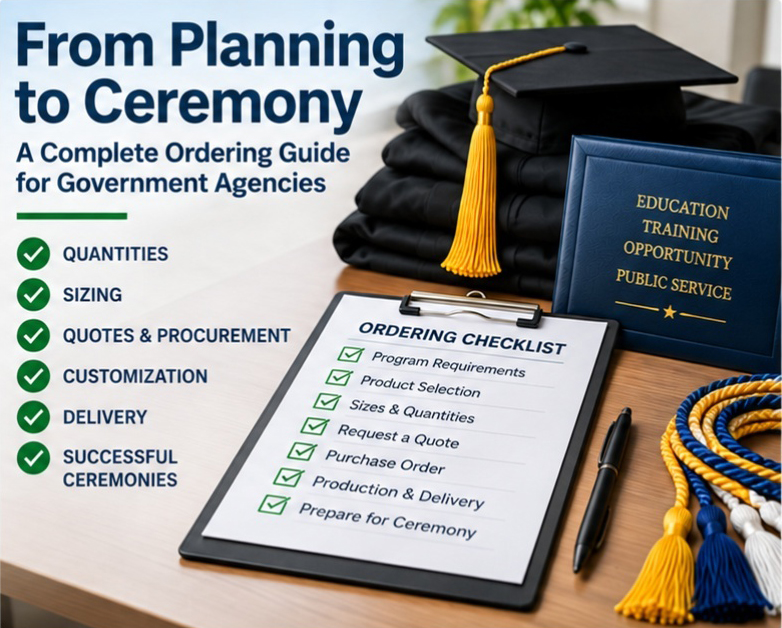
Government Graduation Regalia Procurement Checklist
- Identify the program and achievement
- Determine the ceremony format
- Separate academic credentials from training completion
- Create a merchandise requirement by program
- Calculate individual product quantities
- Establish gown specifications
- Obtain the current gown sizing chart
- Collect participant sizes
- Include extended sizes
- Protect unnecessary participant information
- Specify caps and tassels
- Measure certificates and diplomas
- Define stole eligibility
- Define cord eligibility
- Separate academic regalia requirements
- Audit existing inventory
- Calculate net quantities to purchase
- Separate reusable and customized inventory
- Create location allocations
- Prepare supplier-ready specifications
- Request itemized quotations
- Compare equivalent products
- Calculate total delivered cost
- Evaluate supplier fulfillment capability
- Follow applicable procurement requirements
- Confirm supplier PO acceptance when applicable
- Verify funding allowability
- Verify branding authorization
- Establish the required arrival date
- Build a reverse ordering calendar
- Inspect incoming merchandise
- Pre-pack participant orders
- Record unused inventory
- Maintain records for future ceremonies
Bulk Graduation Supplies for Public-Sector Organizations
Cap and Gown Outlet is an independent academic regalia supplier serving individual customers and qualifying institutional purchasers.
Depending on program requirements and current product availability, organizations may consider:
- Standard graduation gowns
- Mortarboard caps
- Graduation tassels
- Cap, gown and tassel packages
- Certificate covers
- Diploma covers
- Plain graduation stoles
- Customized stoles where available and appropriately authorized
- Recognition and honor cords
- Bachelor’s regalia
- Master’s regalia
- Doctoral regalia
- Academic hoods when applicable
- Related graduation accessories
Institutional Graduation Regalia Quotes
Government agencies, public education organizations, workforce programs, vocational programs, training providers and other qualifying institutional purchasers can request formal quotations based on defined merchandise requirements.
Providing product specifications, quantities, gown sizes, extended sizes, colors, certificate dimensions, customization requirements, delivery destinations and the required arrival date can help produce a more useful institutional quotation.
Quantity-based institutional pricing may be available depending on the merchandise and order requirements. Product availability, applicable minimum quantities and customization requirements vary by product.
Nationwide U.S. shipping is available. Purchasers should verify inventory, processing schedules, customization requirements, freight and available expedited options for the specific order.
Organizations planning to use a purchase order should confirm PO acceptance and applicable payment terms before issuance.
Independent Supplier and Non-Affiliation Disclosure
Cap and Gown Outlet is an independent academic regalia supplier. It is not affiliated with, endorsed by, sponsored by, authorized by or acting on behalf of any federal, state, local or Tribal government, government agency, public institution or publicly funded program unless an actual official relationship has been established.
References to government agencies, public education, workforce development, vocational education, correctional education, employee training or other government programs are descriptive. They do not establish government endorsement, approved-vendor status, contract status, preferred-supplier designation, funding eligibility or authorization to reproduce government seals, logos or protected marks.
Frequently Asked Questions
What should a government agency include in a graduation regalia RFQ?
A useful request should identify product specifications, quantities, gown sizes, extended sizes, colors, accessories, certificate-cover dimensions, customization, delivery destinations and the required arrival date.
Should a bulk graduation order use one package for every participant?
Not necessarily. Product quantities should be calculated separately because participants may have different ceremony and recognition requirements.
How can an agency reduce unnecessary graduation regalia purchases?
Review existing inventory, calculate product-level quantities, standardize compatible merchandise where appropriate and purchase accessories only for participants who require them.
Can government agencies request formal quotes for graduation supplies?
Qualifying institutional purchasers can request quotations based on defined merchandise requirements, subject to supplier terms and product availability.
Can government agencies issue purchase orders for graduation regalia?
The purchasing organization should follow its applicable procurement procedures. Supplier PO acceptance and applicable payment terms should be confirmed before issuance.
Can government purchase cards be used for graduation supplies?
Authorized federal personnel may use Governmentwide commercial purchase cards for transactions permitted under applicable acquisition and agency rules. Other government entities may have their own purchasing-card policies.
Does accepting a government purchase order make a company an approved government vendor?
No. PO acceptance alone does not establish agency endorsement, government contract status or preferred-vendor designation.
Can government funding automatically be used for graduation gowns?
No. The responsible organization should verify whether graduation merchandise is allowable under the specific funding source and applicable requirements.
Can agency logos be added to graduation stoles?
Protected government seals, logos and artwork should only be reproduced when appropriate authorization exists.
Can multiple government programs share graduation gown inventory?
When their program requirements permit the same merchandise, standard Bachelors gown inventory may be coordinated across compatible programs. Size availability, condition and current program requirements should be verified before reuse.
Build a Repeatable Government Graduation Purchasing Process
Government bulk graduation purchasing becomes easier when organizations move from one-time product shopping to a documented procurement process. Clear specifications, accurate sizing, product-level quantities, inventory controls and realistic delivery schedules can improve each future order.
By maintaining reusable specifications and historical purchasing records while reviewing current participant and program requirements each year, organizations can manage government graduation regalia procurement more consistently across recurring education and training ceremonies.