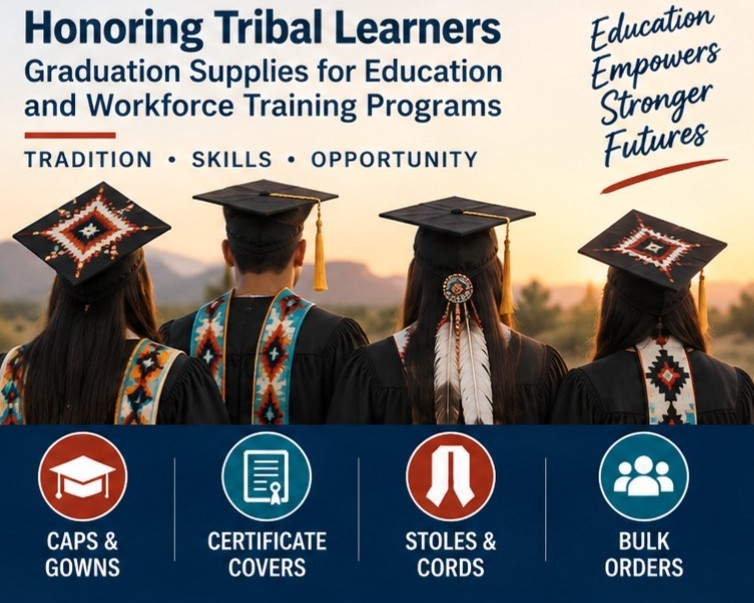
Education and workforce achievement can take many forms across Tribal communities. Participants may complete GED programs, college education, career and technical instruction, vocational training, apprenticeships, occupational skills programs or other locally established education and employment pathways.
When a Tribal Nation, Tribal organization, educational institution or training provider chooses to hold a formal recognition event, Tribal workforce graduation regalia can help create a coordinated ceremony while keeping attention on the actual accomplishment.
Possible products include graduation Faculty gowns, mortarboards, tassels, certificate covers, diploma covers, stoles, recognition cords and degree-specific academic regalia. The appropriate products should be selected by the organization conducting the ceremony rather than based on assumptions about Tribal identity or culture.
Build the Ceremony Around the Achievement
A useful planning approach is to identify the accomplishment first and choose graduation merchandise second.
Participants may be recognized for:
- GED or high school equivalency completion
- High school graduation
- College degrees
- College certificates
- Career and technical education
- Vocational training
- Occupational skills development
- Apprenticeship completion
- On-the-job training
- Workforce-development milestones
- Adult education
- Professional training
- Other locally defined achievements
Each accomplishment can require a different recognition approach.
Create a Recognition System for Multiple Programs
Organizations operating several education or workforce programs can develop a consistent recognition framework instead of planning each ceremony from the beginning.
A practical framework can separate participants into four broad groups.
Academic Degree Recipients
Participants earning degrees from colleges or universities should follow the commencement and academic-dress requirements established by the degree-granting institution.
GED and Secondary Education Completers
Programs may choose a traditional graduation format using gowns, mortarboards, tassels and certificate or diploma covers.
Workforce and Technical Training Completers
When appropriate, workforce and technical programs may use standardized graduation apparel together with certificates and approved recognition accessories.
Certificate and Skills Recognition
Some programs may be better represented through a formal certificate presentation rather than full graduation apparel.
Tribal Communities Determine Their Own Ceremony Practices
Tribal Nations and communities are distinct. There is no universal set of graduation colors, accessories, designs or cultural practices that applies to every Tribal education program.
The relevant Tribe, Tribal organization, educational institution or authorized ceremony organizer should determine the appropriate recognition practices for its event.
Commercial suppliers should not assign cultural meanings to products or present generic merchandise as representing all Native or Tribal communities.
Separate Academic Regalia From Workforce Recognition
Academic regalia and workforce recognition apparel can look similar, but they serve different purposes.
An academic degree may require specific gown construction, academic hoods or institution-approved accessories. Completion of occupational or technical training does not automatically create those same requirements.
Traditional Graduation Apparel for GED Recognition
A GED or high school equivalency ceremony may use a familiar commencement presentation.
An organization might select:
- Graduation gown
- Mortarboard cap
- Tassel
- Certificate or diploma cover
- Approved stole
- Approved recognition cord
The organization should determine the exact products appropriate for its ceremony.
Graduation Supplies for Tribal Workforce Programs
Workforce-development programs may prepare participants for employment, career advancement, occupational credentials or additional education.
When formal recognition is appropriate, organizations can select products that reflect completion without presenting the achievement as something it is not.
A workforce recognition package might include:
- Standard graduation gown
- Mortarboard
- Tassel
- Certificate cover
- Approved stole or cord
Career and Technical Education Recognition
Career and technical education can involve practical instruction connected with occupations, trades and skilled careers.
A formal recognition event can highlight completion using graduation apparel or a certificate-centered format according to the program’s requirements.
Vocational Training Graduation Supplies
Vocational training participants may complete instruction designed to build skills for a recognized occupation or trade.
Recognition products can be selected according to the credential or completion milestone rather than trying to imitate college degree regalia.
Apprenticeship Completion Ceremonies
Apprenticeship completion can represent a substantial career milestone.
When an organization chooses a graduation-style ceremony, possible products can include:
- Graduation gown
- Mortarboard and tassel
- Certificate cover
- Approved stole
- Recognition cord
The ceremony language should accurately describe the apprenticeship accomplishment.
On-the-Job Training Recognition
Structured on-the-job training may also lead to important occupational achievements.
A certificate presentation can provide formal recognition without implying that participants earned an academic degree.
Make Certificates Central to Workforce Recognition
For many workforce, technical and vocational programs, the completion certificate may be the most important ceremony item.
A coordinated certificate cover can provide a professional presentation while keeping the focus on the actual achievement.
Choose Certificate Covers by Document Size
Before ordering covers, determine:
- Certificate width
- Certificate height
- Portrait or landscape orientation
- Cover dimensions
- Cover color
- Quantity
- Customization requirements
Do not assume that certificates issued by different schools, training organizations or credential providers use identical dimensions.
Tribal College and University Graduates
Students graduating from Tribal colleges and universities should verify their institution’s current commencement requirements before purchasing academic Faculty regalia.
Requirements may address:
- Degree-specific gown
- Headwear
- Tassel
- Academic hood
- Approved stoles
- Honor cords
- Other commencement accessories
Bachelor’s Regalia
Bachelor’s graduates commonly use a bachelor’s gown, mortarboard and tassel, but exact requirements are determined by the institution.
Students should not assume an academic hood is required unless their institution specifies one.
Master’s Regalia
Master’s academic dress typically differs from bachelor’s apparel and commonly includes an academic hood.
The degree-granting institution should provide the applicable specifications.
Doctoral Regalia
Doctoral apparel may include a doctoral gown, academic hood and approved doctoral headwear.
Because institutional requirements can differ, buyers should verify specifications before ordering.
Academic Hoods Are Not General Training Accessories
An academic hood should not automatically be used because a workforce or technical program is advanced or demanding.
Academic hoods generally correspond to academic credentials and institutional requirements.
Use a Standard Base Gown for Appropriate Recurring Programs
Organizations conducting several non-degree recognition events may benefit from adopting one approved base gown.
Standardization can simplify:
- Product selection
- Participant sizing
- Bulk purchasing
- Inventory management
- Distribution
- Supplemental orders
- Planning for future cohorts
Differentiate Programs Without Buying Different Gowns
When appropriate, several workforce programs can use the same base gown while the participant’s actual achievement is identified through certificates, ceremony programs and organization-approved accessories.
This approach may reduce the amount of program-specific inventory remaining after the event.
Graduation Stoles for Tribal Education Programs
Stoles can be used when approved by the organization conducting the ceremony.
They may identify organization-defined distinctions such as:
- Program completion
- Leadership
- Academic achievement
- Technical achievement
- Workforce accomplishment
- Other approved recognition
Avoid Inventing Cultural Meanings for Stoles
Colors, patterns and designs should not be marketed as having a universal Tribal or Native meaning.
If a stole incorporates culturally significant elements, those decisions should come from the relevant Tribal community or authorized organization.
Recognition and Honor Cords
Organizations may establish cords for specific distinctions.
A written recognition system can document:
- Cord color
- Meaning
- Eligibility criteria
- Approving authority
A generic cord color should not automatically be assigned a Tribal, cultural or academic meaning.
Customized Graduation Products
Customized stoles and other products can help distinguish programs when appropriate and authorized.
Custom merchandise may require:
- Final wording
- Approved artwork
- Authorization to use protected marks
- Proof preparation
- Proof review
- Production
- Shipping
Tribal Seals and Cultural Artwork Require Authorization
Tribal seals, logos, organizational marks and culturally significant artwork should only be reproduced with appropriate authorization.
The ability of a supplier to customize a product does not grant permission to use protected or culturally significant imagery.
Do Not Use Generic “Native” Artwork as a Substitute
Organizations should avoid adding generic imagery intended to appear Native or Tribal when it has not been selected or authorized by the relevant community.
For commercial graduation products, a simple neutral design may be preferable unless approved artwork has been supplied.
Graduation Gown Sizing for Group Orders
Bulk orders should be built around a size distribution rather than only the total number of participants.
A sizing workflow can include:
- Select the exact gown product
- Obtain the current sizing chart
- Set a participant sizing deadline
- Collect required measurements
- Assign sizes
- Identify extended sizes
- Review incomplete information
- Calculate quantities by size
Use the Selected Gown’s Sizing Instructions
Graduation gown sizing may not correspond directly to everyday clothing sizes.
Use the product-specific sizing chart for the selected gown.
Plan Extended Sizes Before Ordering
Extended-size requirements should be included in the main sizing process.
Before standardizing one gown across a large program, confirm that its available size range is appropriate for expected participants.
Limit Participant Information Shared With Suppliers
If participant names are not required for fulfillment, an organization can retain individual records internally and submit aggregate quantities by size.
Create a Recurring-Cohort Inventory System
Education and workforce programs that recognize several cohorts each year can maintain an inventory record rather than starting from zero before every ceremony.
Track:
- Gowns by size
- Extended-size gowns
- Mortarboards
- Undated tassels
- Dated tassels
- Certificate covers
- Diploma covers
- Plain stoles
- Customized stoles
- Recognition cords
- Academic hoods where applicable
Separate Reusable Products From Cohort-Specific Products
Standard gowns and undated accessories may be more useful as future inventory than products printed with a particular year, program or participant name.
Understanding this difference can improve backup-quantity planning.
Use Historical Size Data Carefully
Previous size distributions can help with preliminary planning, but they should not replace current participant sizing.
Each cohort should still be sized according to the selected product’s current sizing instructions.
Plan Multi-Location Recognition Programs
Some organizations coordinate education or workforce programs across several communities or training locations.
A centralized purchasing worksheet can maintain separate allocations for each destination.
Track:
- Location
- Program
- Participant count
- Gown sizes
- Caps
- Tassels
- Certificate covers
- Stoles
- Cords
- Required arrival date
Account for Delivery Requirements Early
Shipping requirements can vary considerably by destination.
Provide the supplier with the actual delivery location when requesting a quotation and establish a required arrival date that leaves enough time for receiving, inspection and distribution.
Build a Product-Level Quantity Worksheet
Do not automatically order every product in the same quantity as the participant count.
For example, an event involving 250 participants could require:
- 190 gowns
- 190 mortarboards
- 190 tassels
- 250 certificate or diploma covers
- 85 approved stoles
- 50 recognition cords
- Academic hoods only for applicable degree recipients
The actual quantities should be determined by the approved ceremony plan.
Prepare a Supplier-Ready Request
A detailed specification can help institutional purchasers obtain comparable quotations.
Include:
- Product type
- Gown style
- Gown color
- Finish
- Quantities by size
- Extended-size requirements
- Mortarboard specifications
- Tassel specifications
- Certificate-cover dimensions
- Diploma-cover dimensions
- Academic hood specifications when applicable
- Stole specifications
- Cord specifications
- Authorized customization
- Ship-to destination
- Required arrival date
Request Itemized Pricing
Instead of requesting only one package price, institutional buyers can ask for separate pricing for:
- Graduation gowns
- Mortarboards
- Tassels
- Cap, gown and tassel sets
- Bachelor’s regalia
- Master’s regalia
- Doctoral regalia
- Academic hoods
- Certificate covers
- Diploma covers
- Plain stoles
- Customized stoles
- Recognition cords
- Customization charges
- Shipping or freight
Compare Products, Not Just Prices
When reviewing quotations, compare:
- Fabric
- Construction
- Color
- Finish
- Size range
- Extended-size availability
- Included products
- Customization
- Processing requirements
- Delivery terms
Evaluate Total Delivered Cost
Total institutional cost can include merchandise, customization, setup charges, packaging and freight.
For multi-location orders, delivery requirements can also affect the complete cost.
Identify the Purchasing Organization
A Tribal education or workforce program can involve several organizations.
The purchaser could be:
- A Tribal government
- A Tribal organization
- A school
- A Tribal college or university
- A workforce-development organization
- A nonprofit organization
- A training provider
- Another authorized entity
Determine which entity is legally making the purchase before beginning procurement.
Follow the Purchaser’s Applicable Procurement Requirements
The applicable purchasing process can depend on the organization, funding source and transaction.
Depending on those requirements, a purchase may involve:
- Authorized direct purchasing
- Price quotations
- Requests for quotation
- Competitive solicitation
- Purchase orders
- Purchasing cards
- Existing contracts
- Other authorized purchasing methods
Purchase Orders Should Be Confirmed in Advance
If the purchasing organization intends to use a purchase order, verify that the supplier accepts POs for that transaction and confirm applicable payment terms before issuance.
Purchase-order acceptance does not itself establish Tribal endorsement, federal approval or preferred-vendor status.
Federal Program Participation Does Not Automatically Fund Regalia
A program’s participation in a federal employment, education or workforce initiative does not automatically mean graduation gowns, certificate covers, stoles, cords or other ceremony products are allowable expenses.
The responsible organization should verify applicable Tribal requirements, federal program rules, grant or contract terms, cost requirements and other funding restrictions before charging graduation merchandise to a particular source.
Public Law 102-477 Requires Program-Specific Review
Participating Tribes can integrate eligible federal employment and training programs through an approved 477 Plan. However, the existence of a 477 Plan should not be interpreted as blanket authorization for every type of ceremony merchandise.
The purchasing organization should determine whether a proposed expense is permitted under its applicable plan, integrated programs, budget and purchasing requirements.
Funding Status and Supplier Status Are Separate
Receiving federal funding or operating an approved program does not make a commercial graduation supplier an official, endorsed or approved supplier of the Tribe or federal government.
Create a Reverse Ceremony Timeline
Work backward from the event date using milestones such as:
- Ceremony date
- Participant distribution
- Inspection period
- Required arrival date
- Carrier transit
- Supplier processing
- Custom production
- Artwork approval
- Purchasing authorization
- Final quantities
- Participant sizing deadline
Separate Standard and Custom Product Deadlines
Customized stoles or other personalized merchandise may require more preparation than standard stocked products.
Plan custom items early enough for authorization, artwork review, proof approval, production and delivery.
Inspect the Shipment When It Arrives
Verify:
- Number of cartons
- Total quantities
- Gown styles
- Gown sizes
- Extended sizes
- Mortarboards
- Tassels
- Academic hoods
- Certificate covers
- Diploma covers
- Stoles
- Cords
- Customized products
- Visible shipping damage
Pre-Sort Merchandise Before Distribution
Large institutional orders can be organized by participant, program, gown size or location before distribution.
Certificates and presentation covers can be managed separately if they will be presented during the ceremony.
Record What Happened After the Ceremony
Maintain information such as:
- Projected participants
- Confirmed completers
- Actual attendees
- Gown sizes used
- Extended-size demand
- Size exchanges
- Late additions
- Supplemental orders
- Unused standard products
- Unused customized products
- Remaining inventory
This information can improve purchasing for the next cohort.
Tribal Workforce and Education Recognition Checklist
- Identify the achievement being recognized
- Identify the credential issuer
- Determine the appropriate ceremony format
- Follow Tribal and institutional requirements
- Separate academic degrees from workforce training
- Select the appropriate gown
- Obtain the current gown sizing chart
- Collect participant sizing information
- Include extended sizes
- Select caps and tassels
- Determine whether academic hoods apply
- Measure certificates and diplomas
- Select appropriate covers
- Define stole eligibility
- Define recognition-cord criteria
- Verify authorization for Tribal seals, logos and cultural artwork
- Count existing inventory
- Identify reusable products
- Calculate quantities by product
- Allocate merchandise by location when necessary
- Identify the legal purchaser
- Review applicable procurement requirements
- Verify applicable funding requirements
- Prepare detailed supplier specifications
- Request itemized pricing
- Compare equivalent products
- Calculate total delivered cost
- Confirm PO acceptance when applicable
- Verify bulk availability
- Plan customized products early
- Set the required arrival date
- Inspect delivered merchandise
- Pre-sort the order
- Distribute products before the ceremony
- Document remaining inventory
Graduation Regalia for Tribal Workforce and Education Recognition
Cap and Gown Outlet is an independent academic regalia supplier serving individual customers and qualifying institutional purchasers.
Depending on the achievement and ceremony requirements, organizations may consider:
- Standard graduation gowns
- Mortarboard caps
- Graduation tassels
- Cap, gown and tassel sets
- Bachelor’s regalia
- Master’s regalia
- Doctoral regalia
- Academic hoods when appropriate
- Certificate covers
- Diploma covers
- Plain graduation stoles
- Customized stoles where available and properly authorized
- Recognition and honor cords
- Related graduation accessories
Bulk Graduation Supplies for Tribal Programs
Tribal governments, Tribal organizations, schools, colleges, workforce-development organizations, training providers and other qualifying institutional purchasers can inquire about individual and bulk quantities based on their defined ceremony requirements.
Formal quotations and quantity-based institutional pricing can be requested for specified merchandise. Product availability, sizes, extended sizes, colors, customization options and applicable minimum quantities depend on the merchandise selected.
Nationwide U.S. shipping is available. Organizations should provide the actual delivery destination and verify current inventory, processing requirements, customization timelines and expedited options for their specific order.
Organizations intending to use a purchase order should confirm PO acceptance and applicable payment terms before issuing the PO.
Independent Supplier and Non-Affiliation Disclosure
Cap and Gown Outlet is an independent academic regalia supplier. It is not affiliated with, endorsed by, sponsored by, authorized by or acting on behalf of any Tribal Nation, Tribal government, Tribal organization, Tribal college or university, the Bureau of Indian Affairs, Bureau of Indian Education, U.S. Department of the Interior or another federal, state, Tribal or local government entity unless an actual official relationship has been established.
References to Tribal education, Tribal workforce development, Tribal colleges, Native education, Public Law 102-477 or federally supported programs are descriptive. They do not establish Tribal or federal endorsement, contract status, approved-vendor status, preferred-supplier status, funding eligibility or authorization to reproduce Tribal seals, cultural artwork, government marks or organizational logos.
Frequently Asked Questions
Can Tribal workforce programs use graduation caps and gowns?
Organizations may choose graduation-style apparel when appropriate for the achievement and ceremony. The responsible Tribal organization or ceremony organizer should determine the requirements.
Is there one standard style of Tribal graduation regalia?
No. Tribal Nations and communities are distinct, and a generic commercial gown, stole, color or design should not be represented as universally Tribal or Native.
Can GED completers wear graduation gowns?
A GED or high school equivalency program may choose a traditional cap-and-gown recognition ceremony when appropriate.
Can workforce and vocational graduates wear the same gown?
When approved by the ceremony organizer, one standard gown may be used across multiple non-degree programs while certificates and other approved recognition elements identify each achievement.
Should apprenticeship graduates wear academic hoods?
Not automatically. Academic hoods generally correspond to academic credentials and institutional requirements rather than apprenticeship or occupational training completion.
Can certificate covers be ordered without gowns?
Yes. A certificate-centered ceremony can provide formal recognition without using full graduation apparel.
Can Tribal seals or cultural designs be added to stoles?
Only when the purchaser has appropriate authorization or permission to reproduce the particular seal, logo, artwork or culturally significant design.
Can Tribal organizations order graduation supplies in bulk?
Qualifying institutional purchasers can request quotations based on defined merchandise, quantities, sizes, customization and delivery requirements, subject to availability and applicable terms.
Can purchase orders be used?
PO acceptance and applicable payment terms should be confirmed for the particular transaction before the purchase order is issued.
Does Public Law 102-477 automatically pay for graduation supplies?
No. Participation in a 477 Plan does not by itself establish that graduation or ceremony merchandise is an allowable expense. The responsible organization should determine whether the proposed purchase complies with its applicable programs, plan, budget, funding requirements and purchasing policies.
Does selling graduation products to a Tribal organization make a supplier Tribal approved?
No. A transaction does not by itself establish Tribal endorsement, preferred-vendor designation, federal approval or official supplier status.
How should culturally significant graduation elements be selected?
The relevant Tribal community, institution or authorized ceremony organizers should determine culturally significant colors, symbols, artwork, clothing and traditions. A commercial supplier should not assign those meanings independently.
Creating a Repeatable Recognition Program
A strong recognition program does more than purchase Bachelors caps and gowns. It identifies what participants accomplished, respects locally determined ceremony practices, separates academic credentials from workforce achievements, manages inventory carefully and establishes a repeatable purchasing process.
With clear product specifications, accurate sizing, appropriate recognition criteria and sufficient delivery planning, Tribal workforce graduation regalia can support GED, academic, technical, vocational, apprenticeship and workforce achievements while respecting the authority of each Tribal community to determine how its participants should be recognized.