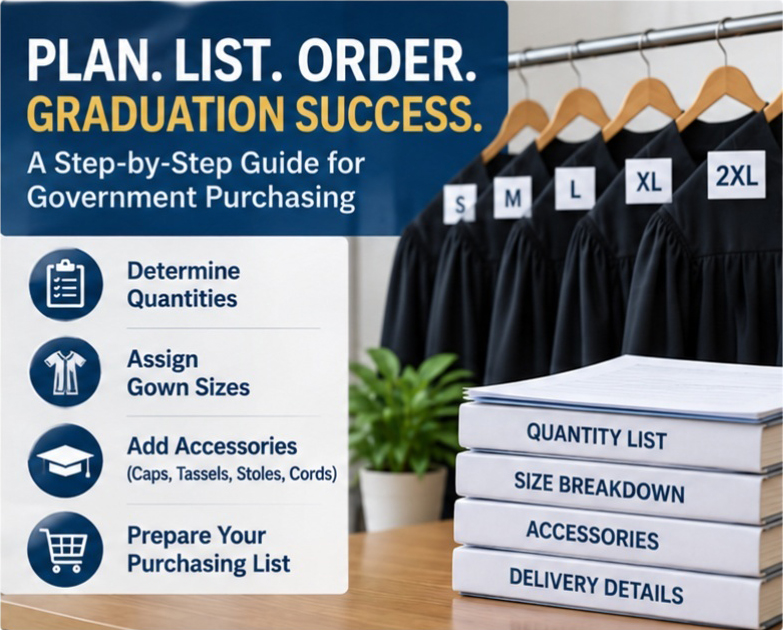
A government education program may know how many people are expected to complete a program, but that number alone is not enough to prepare a graduation merchandise purchase.
The purchasing office needs a structured list showing exactly what is required: graduation Bachelors gowns by size, caps, tassels, certificate covers, stoles, cords, academic regalia when applicable, delivery locations and required arrival dates.
A well-designed government graduation regalia order worksheet can turn program information into a clearer purchasing requirement that can be used for internal approvals, quote requests, supplier discussions, receiving and inventory control.
Start With a Master Order Worksheet
Instead of maintaining separate informal emails, handwritten lists and participant messages, create one controlled master worksheet for the purchase.
The worksheet can include columns for:
- Program or department
- Delivery location
- Product category
- Product description
- Color
- Size
- Gross quantity required
- Usable inventory available
- Net quantity to purchase
- Customization requirement
- Required arrival date
- Internal notes
Separate Participant Demand From Purchasing Quantity
One of the most important distinctions is the difference between what participants require and what the organization actually needs to purchase.
For example, a program may need 60 gowns for participants but already have eight suitable gowns in usable inventory.
The worksheet should show both numbers rather than replacing one with the other.
A simple structure is:
- Participant requirement: 60 gowns
- Usable existing inventory: 8 gowns
- Net new purchase: 52 gowns
The same calculation should then be performed by gown size.
Do Not Begin With a Supplier Catalog
Begin with the program’s legitimate ceremony requirement.
First determine:
- What achievement is being recognized?
- How many participants are expected?
- Which participants require gowns?
- Which participants require caps and tassels?
- Will certificates be presented?
- Are stoles or cords part of the approved recognition plan?
- Are any participants receiving academic degrees?
Once those questions are answered, the organization can match appropriate merchandise to the requirement.
Create a Separate Section for Each Program
A centralized government purchase may support several different education or training programs.
For example, one organization might purchase for:
- Adult education
- GED or equivalency completion
- Career and technical education
- Vocational training
- Workforce development
- Occupational skills training
- Apprenticeship recognition
- Public employee training
- Reentry education
- Other approved education programs
Maintain each program’s requirements separately until the quantities have been verified.
Use a Product Matrix
A product matrix can help determine which merchandise applies to which program.
For example:
- Program A — gown, mortarboard, tassel and certificate cover
- Program B — certificate cover and recognition cord
- Program C — gown, cap, tassel, stole and certificate cover
- Program D — academic regalia specified by the degree-granting institution
This approach prevents every participant from automatically being assigned every available graduation product.
Establish a Participant Cutoff Date
Graduation lists can change as participants complete program requirements.
The purchasing plan should therefore distinguish between:
- Early planning estimate
- Projected participant count
- Confirmed participant count
- Final purchasing count
- Late additions
Establishing an internal cutoff date can help determine when the main purchasing quantity becomes sufficiently stable for ordering.
Create a Separate Sizing File
The master purchasing worksheet does not necessarily need to contain every piece of participant-level information.
A separate internal sizing file can contain the information needed to assign the appropriate gown size.
Depending on the selected product, the sizing file may contain:
- Participant ID
- Program
- Location
- Information required by the gown’s size chart
- Assigned gown size
- Extended-size designation where applicable
- Verification status
Select the Gown Before Assigning Sizes
Graduation gown sizing is product-specific.
Select the intended gown and obtain its current size chart before converting participant information into gown sizes.
Do not assume that ordinary clothing sizes or the size chart from a different gown can be used.
Convert Individual Sizes Into Purchasing Quantities
Once participants have been assigned sizes, summarize the results.
For example:
- Gown Size A — 12 participants
- Gown Size B — 25 participants
- Gown Size C — 31 participants
- Gown Size D — 19 participants
- Gown Size E — 8 participants
- Applicable extended-size options — 5 participants
The size names above are examples. The actual worksheet should use the selected gown’s size designations.
Verify That Every Participant Has Been Counted Once
Before moving the gown quantities into the purchasing worksheet, reconcile the size list.
If 100 confirmed participants require gowns, the participant sizing file should account for 100 gown assignments.
Check for:
- Missing participants
- Duplicate participants
- Participants without assigned sizes
- Incorrect program assignments
- Late additions
Include Extended Sizes From the Beginning
Extended-size requirements should be part of the initial product-selection and sizing process.
Before standardizing one gown across a program, verify that its available size range is appropriate for expected participants.
Follow the current instructions for the selected gown rather than creating an unofficial sizing method.
Build an Inventory Credit Column
One useful feature of the purchasing worksheet is an inventory-credit column.
For each gown size, record:
- Gross participant requirement
- Existing usable quantity
- Net quantity to purchase
For example:
- Size B required — 25
- Usable Size B inventory — 4
- Net Size B purchase — 21
Inventory Must Match the Current Requirement
Do not deduct a gown from the purchase simply because it exists in storage.
Verify:
- Style
- Color
- Size
- Condition
- Compatibility with current ceremony requirements
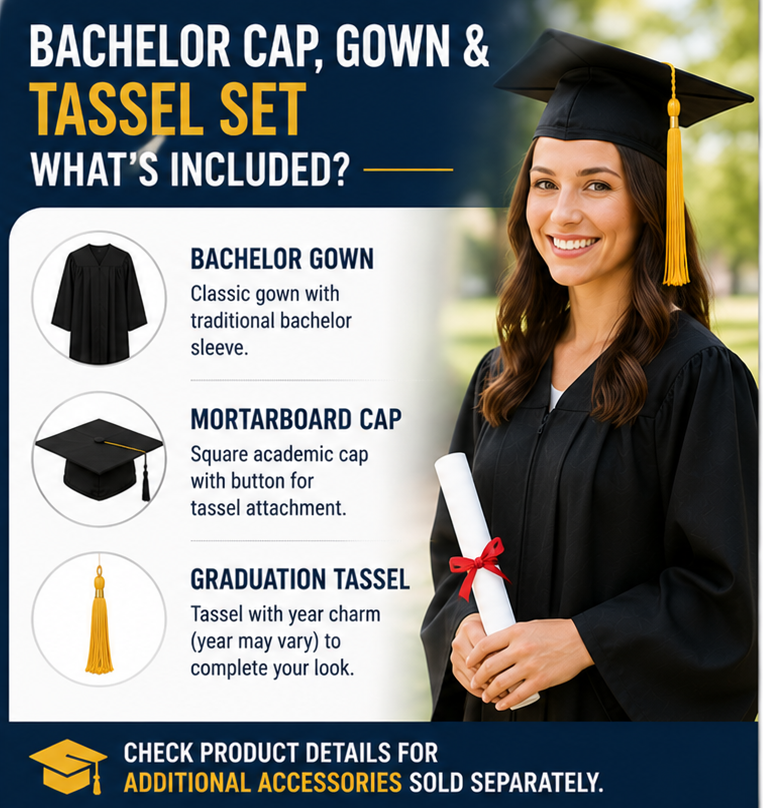
Create Separate Lines for Caps and Mortarboards
Even when caps are packaged with gowns, it can be useful for internal planning to identify the cap requirement.
Record:
- Cap style
- Color
- Quantity
- Whether a tassel is included
Build the Tassel Requirement Separately
Tassels should have their own specifications.
Record:
- Tassel color
- Dated or undated style
- Year charm if required
- Quantity
Programs with rolling completion dates may consider undated merchandise when it satisfies their ceremony requirements.
Add Certificate and Diploma Covers
Certificate-cover quantities may be different from gown quantities.
A program may recognize 80 participants with certificates while only 60 wear gowns.
The worksheet should therefore calculate certificate covers independently.
Include:
- Document dimensions
- Portrait or landscape orientation
- Cover dimensions
- Color
- Quantity
- Customization requirement
Measure the Document Before Selecting the Cover
Certificate and diploma dimensions can vary.
Measure the actual document or verify its specifications before selecting a cover.
Add Stoles Only Where Required
Graduation stoles should not automatically be assigned to every participant simply because they are available.
The worksheet can identify:
- Stole style
- Color
- Plain or customized
- Eligible participant group
- Quantity
Separate Customized Stoles From Plain Stoles
Customized merchandise may involve different minimum quantities, artwork requirements, proof approval and processing schedules.
Keep custom merchandise on separate purchasing lines so those requirements remain visible.
Create a Recognition Cord Schedule
If the organization uses cords to recognize different achievements, maintain a separate schedule.
For each cord, identify:
- Color
- Internal recognition meaning
- Eligibility criteria
- Number of eligible participants
- Quantity required
Commercial cord colors should not be represented as having one universal meaning across all government programs.
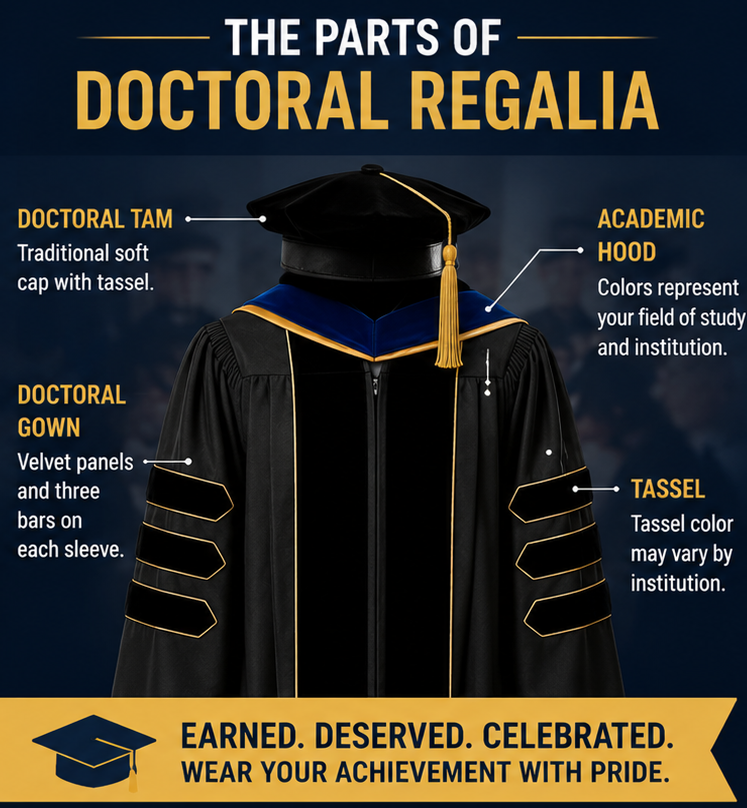
Keep Academic Regalia in a Separate Section
Participants earning academic degrees may require institution-specific regalia.
Do not assume that a standard training-program gown satisfies a college or university’s academic dress requirements.
Bachelor’s Degree Participants
Verify the required bachelor’s gown, headwear, tassel and any other institution-specific requirements.
An academic hood should not automatically be added for every bachelor’s graduate unless the degree-granting institution requires or permits it.
Master’s Degree Participants
Verify the master’s gown and academic hood requirements with the degree-granting institution.
Doctoral Degree Participants
Verify the doctoral gown, academic hood and approved doctoral headwear.
Add a Specification Column
A product name alone may not provide enough information for a purchasing request.
A specification column can identify:
- Gown material or style
- Matte or shiny finish
- Color
- Size
- Tassel color
- Certificate-cover dimensions
- Stole dimensions or style where necessary
- Customization details
Use Separate Line Items When Specifications Differ
If two groups require different products, do not combine them into one line merely because both products are graduation gowns.
Separate line items improve clarity for both purchasing personnel and suppliers.
Prepare a Multi-Location Allocation Sheet
Some public-sector organizations purchase centrally for several locations.
Create a distribution sheet showing how the master quantity will be allocated.
For example:
- Site A — 38 participants
- Site B — 27 participants
- Site C — 19 participants
- Site D — 31 participants
Break Every Site Down by Size
Do not allocate only total gown quantities.
Each location should have its own size breakdown so that the correct overall quantity does not result in the wrong sizes being delivered to individual sites.
Use a Master Quantity Reconciliation
After all sites have submitted verified lists, confirm:
Total of Location Allocations = Master Program Requirement
If the numbers do not match, resolve the discrepancy before the purchase is finalized.
Add the Required Arrival Date to Every Relevant Line
The ceremony date and the required delivery date are not the same thing.
Merchandise may need to arrive early enough for:
- Receiving
- Inspection
- Inventory verification
- Location sorting
- Internal distribution
- Participant distribution
- Approved size corrections
Create an Internal Purchasing Summary
After the detailed worksheet is complete, create a concise summary for review.
It might show:
- Total confirmed participants
- Total participants requiring gowns
- Total new gowns to purchase
- Total caps
- Total tassels
- Total certificate covers
- Total stoles
- Total cords
- Total degree-specific regalia sets
- Number of delivery locations
- Required arrival date
Create a Supplier-Facing Version
The supplier-facing worksheet can remove internal administrative information that is not necessary to fulfill the purchase.
Useful supplier information can include:
- Line-item number
- Product description
- Specifications
- Color
- Size
- Quantity
- Customization
- Delivery destination
- Required arrival date
Avoid Sending Unnecessary Personal Information
Participant names and other individual information may not be necessary for a standard institutional graduation order.
Where appropriate, keep detailed participant records within the organization and provide aggregate quantities to the supplier.
Government organizations should follow applicable privacy, records-management and information-security requirements.
Example Supplier-Ready Order Structure
A simplified supplier list could look like:
- Line 1 — Standard matte graduation gown / approved color / Size A / quantity 16
- Line 2 — Standard matte graduation gown / approved color / Size B / quantity 29
- Line 3 — Standard matte graduation gown / approved color / Size C / quantity 37
- Line 4 — Applicable extended-size gown / quantity 6
- Line 5 — Mortarboard / approved color / quantity 88
- Line 6 — Tassel / approved color / undated / quantity 88
- Line 7 — Certificate cover / specified dimensions / quantity 94
- Line 8 — Plain stole / approved color / quantity 22
- Line 9 — Recognition cord / approved color / quantity 14
These numbers are examples only. Actual quantities and specifications should be determined by the purchasing organization.
Request Pricing by Line Item
An itemized quotation can make it easier to understand the components of the proposed purchase.
Where appropriate, request separate pricing for:
- Gowns
- Caps
- Tassels
- Certificate covers
- Stoles
- Cords
- Academic hoods
- Customization
- Packaging
- Shipping or freight
Evaluate Total Delivered Cost
Unit price alone may not represent the complete purchasing cost.
When comparing appropriate quotations, consider the complete requirement, including:
- Merchandise
- Required quantities
- Size availability
- Customization
- Packaging
- Shipping
- Delivery requirements
Compare Equivalent Specifications
Before comparing prices, confirm that proposed products satisfy substantially the same required specifications.
A lower-priced quotation for a materially different product is not necessarily a like-for-like comparison.
Use the Worksheet During Receiving
The final approved worksheet can become a receiving document after the order arrives.
Receiving personnel can verify:
- Gown quantities by size
- Extended-size quantities
- Caps
- Tassels
- Certificate covers
- Stoles
- Cords
- Academic regalia
- Customized products
- Location allocations
Record Discrepancies Promptly
If the received quantities differ from the approved order, document the discrepancy promptly according to the organization’s receiving and purchasing procedures.
Use the Worksheet During Distribution
The same information can help program staff track how merchandise is distributed.
For gowns, record:
- Size distributed
- Approved size exchanges
- Returned unused gowns
- Late additions
- Supplemental requirements
Close the Purchasing Cycle With Inventory Reconciliation
After the ceremony, update the remaining inventory.
Record unused:
- Gowns by size
- Caps
- Undated tassels
- Certificate covers
- Plain stoles
- Recognition cords
This creates a more reliable starting point for the next ceremony.
Build a Historical Purchasing Record
Recurring programs can use completed worksheets to evaluate previous purchasing patterns.
Historical information may help identify:
- Typical participant counts
- Frequently used gown sizes
- Size exchanges
- Late additions
- Unused inventory
- Recurring accessory quantities
- Typical delivery schedules
Historical information can support planning, but current participant requirements should still determine the actual purchase.
Do Not Automatically Add a Fixed Percentage of Extra Merchandise
There is no universal percentage of additional gowns or accessories appropriate for every public-sector program.
Consider the organization’s own:
- Historical exchanges
- Late-addition patterns
- Existing inventory
- Program frequency
- Storage capacity
- Supplier availability
- Budget
- Applicable purchasing requirements
Government Procurement Procedures Remain Separate
The worksheet identifies the merchandise requirement. It does not determine which procurement method the government organization is authorized to use.
Federal, state, local and Tribal organizations should follow the purchasing procedures, required sources, approval processes and competition requirements applicable to the particular transaction.
Federal Purchasing Considerations
Federal simplified acquisition procedures include rules governing micro-purchases and other simplified acquisitions. Required sources can still apply, and authorized purchasers must follow applicable agency procedures.
The commercial availability of graduation merchandise from a supplier does not by itself establish authority for a federal agency to purchase from that supplier.
Do Not Artificially Divide a Known Requirement
A known larger requirement should not be separated into multiple smaller transactions merely to avoid procurement requirements or applicable acquisition thresholds.
If an organization knows its consolidated requirement, the responsible purchasing office should evaluate that requirement under the applicable acquisition procedures.
Purchase Cards and Purchase Orders Are Different Issues
A government purchase card is a purchasing or payment mechanism available under applicable rules and agency authority. A supplier’s acceptance of commercial payment methods does not establish that a particular government transaction is authorized.
Similarly, if an organization intends to use a purchase order, confirm supplier PO acceptance and applicable payment terms before issuance.
Verify Funding Allowability Separately
The fact that graduation merchandise supports an education or training ceremony does not automatically make the expense allowable under a government grant, program or funding stream.
The responsible organization should verify applicable law, regulations, award terms, cost principles, program guidance and agency policy before charging graduation merchandise to a particular source of funds.
Government Regalia Worksheet Checklist
- Identify the programs included in the purchase
- Confirm the achievements being recognized
- Establish projected and confirmed participant counts
- Determine which products each program requires
- Select the graduation gown
- Obtain the current gown size chart
- Collect required sizing information
- Assign participant gown sizes
- Include applicable extended sizes
- Create the gown size distribution
- Reconcile the participant total
- Inspect existing inventory
- Record inventory by size
- Calculate net quantities to purchase
- Calculate caps separately
- Calculate tassels separately
- Measure certificates and calculate covers
- Calculate stoles according to eligibility
- Calculate recognition cords separately
- Separate degree-specific academic regalia
- Separate standard and customized products
- Create location allocations
- Establish the required arrival date
- Create the supplier-facing worksheet
- Remove unnecessary participant information
- Request itemized pricing where appropriate
- Verify equivalent specifications when comparing quotes
- Follow applicable procurement procedures
- Verify funding allowability
- Use the worksheet during receiving
- Update inventory after distribution
Graduation Regalia for Institutional Purchasing
Cap and Gown Outlet is an independent academic regalia supplier serving individual customers and qualifying institutional purchasers.
Depending on current product availability and program requirements, organizations may consider:
- Graduation gowns
- Mortarboard caps
- Graduation tassels
- Cap, gown and tassel packages
- Extended-size gown options where available
- Certificate and diploma covers
- Plain graduation stoles
- Customized products where available and appropriately authorized
- Honor and recognition cords
- Bachelor’s regalia
- Master’s regalia
- Doctoral regalia
- Academic hoods where applicable
Requesting an Institutional Graduation Regalia Quote
A completed purchasing worksheet can help government education programs, public training organizations, GED programs, vocational programs, workforce programs and other qualifying institutional purchasers communicate their requirements more clearly.
A quote request can include:
- Product specifications
- Color
- Quantity by gown size
- Extended-size requirements
- Accessory quantities
- Certificate-cover dimensions
- Customization requirements
- Delivery destination or destinations
- Required arrival date
Formal quotations and quantity-based institutional pricing may be available depending on the selected merchandise and order requirements. Product availability, size ranges, minimum quantities and customization requirements vary by product.
Nationwide U.S. shipping is available. Purchasers should verify current inventory, processing schedules, shipping costs and available expedited options for the specific order.
Independent Supplier and Non-Affiliation Disclosure
Cap and Gown Outlet is an independent academic regalia supplier. It is not affiliated with, endorsed by, sponsored by, authorized by or acting on behalf of any federal, state, local or Tribal government, government agency, public institution or government-funded program unless an actual official relationship has been established.
References to government education, workforce, vocational, GED, correctional and other public-sector programs are descriptive. They do not establish government endorsement, approved-vendor status, contract status, preferred-supplier designation, funding eligibility or authorization to reproduce government seals, logos or protected marks.
Frequently Asked Questions
What is the difference between a participant roster and a purchasing worksheet?
A participant roster tracks individuals. A purchasing worksheet converts those requirements into products, sizes, quantities, specifications and delivery information needed for purchasing.
Should existing inventory appear on the worksheet?
Yes. Showing gross requirements, usable inventory and net purchasing quantities can make the calculation easier to verify.
Should gowns be listed by size?
Yes. A total gown quantity alone is generally insufficient for fulfillment. Use the size categories of the exact gown being purchased.
Should every graduate receive the same products?
Not necessarily. Merchandise should reflect the program’s ceremony and recognition requirements. Calculate gowns, caps, covers, stoles and cords independently.
Can several program locations use one master worksheet?
Yes. Maintain location-level requirements and combine them into a master purchasing summary when centralized purchasing is appropriate.
Should participant names be included in a supplier quote request?
Not necessarily. For standard merchandise, aggregate size and quantity information may be sufficient when individual information is not required for fulfillment.
How should academic degree regalia be listed?
Keep degree-specific regalia separate and follow the requirements of the degree-granting institution for bachelor’s, master’s and doctoral participants.
Should extra gowns automatically be added to the worksheet?
No universal extra percentage applies to every program. Use actual historical experience, existing inventory, late-addition patterns and operational needs to determine whether additional inventory is appropriate.
Can a purchasing worksheet be used to request supplier pricing?
Yes. A verified worksheet can provide the product, specification, size, quantity and delivery information needed to request a more precise quotation.
Does a completed worksheet authorize a government purchase?
No. It documents the merchandise requirement. The responsible government organization must separately determine the authorized procurement method, purchasing authority and funding allowability.
From Graduation Planning to a Supplier-Ready Requirement
A useful government graduation regalia order worksheet does more than count Faculty gowns. It connects participant demand, gown sizes, existing inventory, accessories, delivery locations and ceremony deadlines into one organized purchasing record.
By maintaining separate internal and supplier-facing versions, public-sector education and training programs can provide suppliers with the information needed for a quotation while retaining participant-level administrative information within the organization when it is not required for fulfillment.