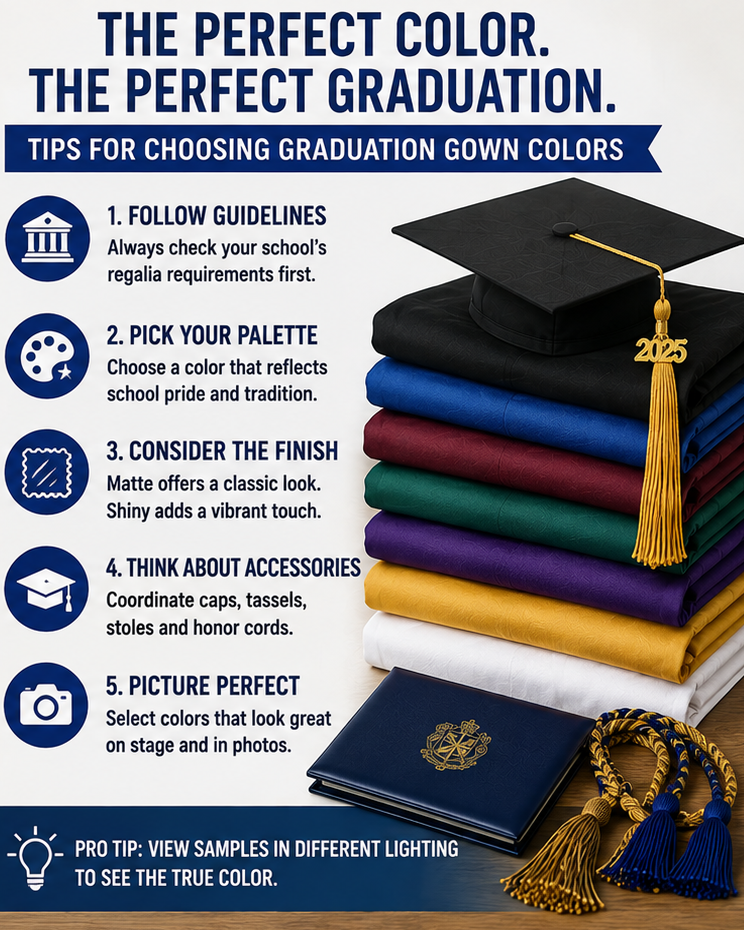
Graduation gowns create one of the most recognizable visual elements of commencement. Whether you are organizing a high school ceremony, college graduation, homeschool commencement, preschool celebration, or student organization event, selecting the right graduation gown color requires more than simply choosing a favorite shade. School traditions, academic requirements, fabric finish, accessories, photography, and class consistency can all influence the final decision.
Begin With the Graduation Ceremony Requirements
Before comparing colors, determine whether the institution already has established graduation regalia standards. Colleges and universities in particular may require students to wear a specific gown design, color, cap, tassel, or academic hood.
If requirements already exist, those specifications should guide the purchase.
Ask These Questions First
- Is a specific gown color required?
- Does the school require matte or shiny fabric?
- Is there a specific gown style?
- Must the cap match the gown?
- Is a particular tassel required?
- Do master’s or doctoral graduates need academic hoods?
- Which stoles and honor cords are permitted?
What If Your School Can Choose Its Own Gown Color?
Schools and organizations with flexibility should consider the entire commencement appearance rather than selecting the gown color in isolation.
Think about school colors, the stage backdrop, banners, tassels, diploma covers, stoles, cords, venue lighting, and graduation photography.
Traditional Black Graduation Gowns
Black graduation gowns offer a classic academic appearance and are easy to coordinate with a wide variety of school colors.
Black can provide strong contrast for gold, silver, white, red, blue, green, purple, and other approved graduation accessories.
Royal Blue Graduation Gowns
Royal blue produces a brighter appearance than navy and can stand out clearly in large ceremonies and group photographs.
It can be paired with contrasting tassels or other approved accessories when the school’s colors include blue.
Navy Graduation Gowns
Navy provides a darker, understated alternative to royal blue. Under some indoor lighting, very dark navy can appear close to black, while outdoor daylight may make the blue more visible.
This is one reason schools should consider how gowns will appear in the actual ceremony environment.
White Graduation Gowns
White creates a bright and distinctive commencement appearance. When considering white gowns, organizers should evaluate the fabric, opacity, and the clothing that may be visible underneath.
A consistent dress recommendation for garments worn beneath lighter gowns may help create a more uniform presentation.
Red and Maroon Graduation Gowns
Red gowns create a bold visual statement, while maroon provides a deeper and more subdued alternative.
Either can work effectively when it coordinates with established school colors and commencement traditions.
Purple Graduation Gowns
Purple can provide a distinctive ceremonial appearance and can coordinate well with gold, white, silver, or other contrasting accessories.
The exact shade should be confirmed because manufacturers may use different interpretations of terms such as purple, dark purple, or royal purple.
Green Graduation Gowns
Green gowns are another option for schools and organizations whose branding or traditions include green.
As with other colors, the actual shade can vary among product lines, so consistency is particularly important when students purchase individually.
Gold Graduation Gowns
Gold provides a highly visible, celebratory appearance. Because it is already a strong visual color, organizers may want to keep accompanying tassels and accessories relatively coordinated rather than introducing too many competing colors.
Should Graduation Gowns Be the Same as School Colors?
Not necessarily. A school can incorporate its colors without using one of them as the gown itself.
For example, a school with blue and gold colors could select black gowns and introduce blue and gold through approved tassels, cords, stoles, diploma covers, stage decorations, or signage.
Use the Gown as the Foundation of the Color Scheme
A useful way to plan commencement colors is to start with the gown as the largest visual element. Then select supporting colors for the smaller accessories.
A Simple Color Planning Sequence
- Select the gown color.
- Select the gown finish.
- Choose the cap color.
- Choose the tassel.
- Review permitted stoles.
- Review honor cord colors.
- Coordinate diploma covers when applicable.
- Compare everything with the ceremony backdrop.
Matte Graduation Gowns vs. Shiny Graduation Gowns
Choosing a color is only half of the decision. The same color can appear quite different depending on whether the gown has a matte or shiny finish.
Matte Finish
Matte gowns have less surface reflection and provide a softer appearance. They may also produce less glare under certain lighting conditions.
Shiny Finish
Shiny graduation gowns reflect more light, which can make some colors appear brighter and more vivid.
Consistency Matters More Than Which Finish You Choose
Both finishes can work well. For a graduating class, however, using one consistent finish is generally preferable to accidentally mixing matte and shiny gowns.
Why Two Gowns With the Same Color Name May Not Match
A color name is not necessarily a universal color specification. One manufacturer’s royal blue may differ from another manufacturer’s royal blue.
Fabric type and finish can create additional differences.
For Large Groups, Standardize the Product
If a school wants graduates to match closely, provide students with the exact gown specifications rather than simply saying, for example, “buy a navy graduation gown.”
Consider the Graduation Stage and Backdrop
The stage environment can influence how graduation colors appear.
A dark gown against a very dark curtain may create less visual separation, while a brighter gown may stand out strongly. Similarly, a light gown against a white or very pale background may provide less contrast.
Consider the complete setting when the school has flexibility in choosing its colors.
Think About Graduation Photography
Graduation attire will appear in thousands of family photographs, school images, social posts, and class pictures.
Lighting can change the perceived color of a gown. Indoor stage lighting, outdoor sunlight, cloudy conditions, and camera flash can each produce a somewhat different appearance.
Group Photographs Benefit From Consistency
Using the same gown style, color, and finish across a graduating class generally produces a more coordinated group photograph.
Graduation Gown Colors for High Schools
High schools often have established commencement traditions, but schools creating or updating their regalia program can use their institutional colors as a starting point.
A High School Can Consider
- Traditional school colors
- One gown color for the entire class
- Contrasting tassel colors
- Approved honor cords
- Approved graduation stoles
- Matching diploma covers
Should High Schools Use Different Colors for Different Students?
Many schools can simplify graduation attire by selecting one common gown color for the graduating class.
If different gown colors are being considered, the school should have a clear, appropriate, and consistently applied reason for the distinction. Avoid assigning graduation gown colors according to gender.
Graduation Gown Colors for Colleges and Universities
College and university students usually have less flexibility because academic dress may follow institutional traditions and degree requirements.
Before independently purchasing college graduation regalia, students should confirm the exact approved specifications.
Bachelor’s Gown Color Selection
Bachelor’s gowns are available in many colors, but students participating in an official commencement should wear the color and style required by their institution.
The cap and tassel requirements should be verified at the same time.
Master’s Gown Color Selection
A master’s gown differs structurally from a bachelor’s gown. Selecting the correct color without selecting the correct degree-level design is not sufficient.
Master’s graduates should also verify their academic hood specifications.
Doctoral Gown Color Selection
Doctoral academic attire can include velvet panels, sleeve bars, distinctive gown construction, an academic hood, and doctoral headwear.
Because institutions may establish specific doctoral regalia requirements, graduates should verify the entire outfit rather than focusing only on gown color.
Graduation Colors for Preschool and Kindergarten
Preschool and kindergarten programs generally have more creative flexibility than university commencement ceremonies.
Programs may choose bright school colors, traditional black or white, or another coordinated color that complements the celebration.
Keep the Class Coordinated
Even for younger graduates, selecting one consistent gown style and finish can make class photographs and ceremonies look more organized.
Graduation Gown Colors for Homeschool Ceremonies
Homeschool families and organizations can create their own graduation color scheme when no outside institution establishes the regalia requirements.
For a group ceremony, decide on the exact color, finish, cap, and tassel before families begin purchasing.
Choosing Gown Colors for Student Organizations
Student organizations may coordinate graduation attire or accessories for their members, but official university requirements should always be checked first.
When the university gown is predetermined, the organization may be able to introduce approved colors through stoles or honor cords instead.
How to Coordinate Graduation Tassels
A tassel can either blend with the gown or provide a deliberate contrast.
Common Approaches Include
- Gown-matching tassels
- Contrasting tassels
- Two-color school tassels
- Degree- or institution-specified tassels
Some tassels also include graduation-year charms.
How to Coordinate Graduation Stoles
A stole is positioned directly against the front of the gown, making color contrast particularly noticeable.
If the school has flexibility, compare the stole and gown together before finalizing a large order. A stole that looks attractive by itself may have insufficient contrast against a similarly colored gown.
How to Coordinate Honor Cords
Honor cords may represent institution-defined academic achievement, organizations, leadership, service, or other approved distinctions.
When several cords are used, the overall appearance can become colorful quickly. Schools should prioritize established recognition meanings rather than choosing cord colors solely for decoration.
Do Academic Hood Colors Need to Match the Gown?
Academic hoods should not be selected simply to coordinate visually with a graduation gown.
For master’s and doctoral graduates, hood specifications can have academic meaning and should follow institutional requirements.
How Schools Can Choose Colors for a New Graduation Program
A school establishing commencement regalia for the first time can use a simple selection process.
Step 1: Review School Branding
Identify the primary and secondary institutional colors.
Step 2: Review Ceremony Traditions
Determine whether the school already has academic dress practices that should be maintained.
Step 3: Select the Gown Color
Choose a shade that supports the desired ceremony appearance.
Step 4: Choose Matte or Shiny
Select one finish for consistency.
Step 5: Select the Cap and Tassel
Determine how these pieces coordinate with the gown.
Step 6: Review Recognition Accessories
Consider how approved stoles and honor cords will appear against the gown.
Step 7: Review a Sample When Practical
For a large order, an actual sample can provide a better understanding of color and fabric appearance than a screen alone.
How to Manage Graduation Gown Colors for a Large Class
Schools coordinating bulk graduation gown orders should document the selected specifications clearly.
Create a Master Regalia Specification
- Gown product or style
- Degree level
- Exact color
- Matte or shiny finish
- Cap style and color
- Tassel specifications
- Academic hood requirements when applicable
- Approved accessories
What If Students Purchase Their Gowns Individually?
Give every graduate the same detailed purchasing instructions. Simply providing a color name may not produce a matching graduating class.
When possible, specify the approved product, shade, fabric finish, and degree-level gown style.
Check the Colors When the Order Arrives
For a group shipment, open the cartons and inspect the gowns before distribution.
Verify
- All gowns are the intended color
- The finish is consistent
- Degree-level styles are correct
- Caps coordinate correctly
- Tassels are correct
- Accessories match the order
Common Graduation Color Selection Mistakes
- Ordering before confirming school rules
- Selecting color while ignoring gown style
- Mixing matte and shiny fabrics
- Assuming every manufacturer’s color is identical
- Allowing individual purchases without detailed specifications
- Forgetting about the ceremony backdrop
- Ignoring graduation photography
- Choosing stoles without considering gown contrast
- Selecting academic hoods for appearance instead of requirements
- Waiting until late in the ordering process to finalize colors
Graduation Gown Color Checklist
Before Ordering
- Verify institutional requirements
- Confirm degree-level gown style
- Select the exact gown color
- Select matte or shiny finish
- Confirm cap style and color
- Choose the correct tassel
- Verify academic hood requirements
- Review approved stoles and cords
- Consider stage and backdrop colors
- Consider indoor and outdoor photography
- Use consistent specifications across the class
Frequently Asked Questions About Graduation Gown Colors
Does every school use black graduation gowns?
No. Black is widely used, but graduation gowns are available in many colors, and schools may establish different academic dress traditions.
What graduation gown color should I buy?
If you are participating in a school or university ceremony, check the institution’s requirements before purchasing. If you are organizing a ceremony with no predetermined requirement, select a color appropriate for the event and use it consistently.
Can the cap be a different color from the gown?
That depends on the ceremony’s academic dress requirements. Matching caps and gowns are common, but students should follow their institution’s specifications.
Which looks better: matte or shiny graduation gowns?
Neither finish is universally better. Matte provides a lower-reflection appearance, while shiny fabric creates more surface reflection. The appropriate choice depends on the ceremony’s desired look and any existing requirements.
Can a school order graduation gowns in multiple colors?
Multiple colors may be possible depending on the school’s policies and ceremony plan. However, organizers should have a clear reason for the distinction and consider how the entire class will look together.
Do graduation gown colors represent a student’s major?
Not necessarily. Academic disciplines may be represented through other elements of academic dress, particularly hoods in some degree programs. The gown itself should follow the institution’s requirements.
Create a Coordinated Graduation Look
The best graduation gown color is one that satisfies the ceremony’s requirements while working well with the rest of the academic attire. Color, gown style, fabric finish, caps, tassels, stoles, cords, academic hoods, and the ceremony environment should all be considered together.
For individual graduates, always verify the exact regalia requirements before purchasing. For schools and organizations ordering for an entire class, standardizing the gown style, color, and finish early can simplify ordering and help create a consistent, polished commencement appearance.