Government purchasing departments sourcing graduation apparel for education, training or recognition programs may need to evaluate much more than the advertised price of a Masters cap and gown package.
A supplier may offer an attractive unit price but have a limited gown size range, insufficient inventory, incompatible certificate covers, longer custom-production schedules or shipping terms that do not fit the ceremony timeline.
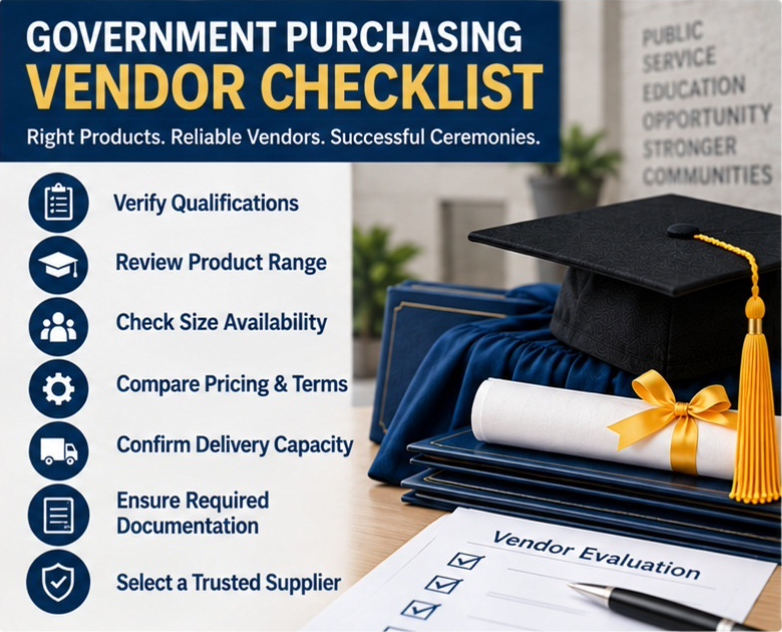
A structured government graduation regalia supplier evaluation helps purchasing personnel document the requirement first and then review supplier responses against that requirement.
This guide provides a practical framework for evaluating graduation regalia suppliers while leaving procurement decisions, evaluation criteria and purchasing authority with the responsible government organization.
Phase 1: Build the Requirement Before Reviewing Suppliers
The purchasing process should begin with the organization’s actual merchandise requirement.
Before comparing vendors, determine:
- Which program needs graduation merchandise
- What type of achievement is being recognized
- Expected and confirmed participant quantities
- Products required for each participant group
- Required gown color and style
- Gown quantities by size
- Extended-size requirements
- Required accessories
- Customization requirements
- Delivery destination or destinations
- Required arrival date
Create a Requirement Sheet
A standardized requirement sheet gives suppliers the same basic purchasing information.
Useful columns may include:
- Line number
- Product
- Specification
- Color
- Size
- Quantity
- Customization
- Delivery location
- Required arrival date
Separate Essential Requirements From Optional Features
Identify which specifications are mandatory and which are preferences or optional additions.
For example, the organization may require a specific gown color and minimum size range while allowing suppliers to propose different packaging methods.
Making this distinction before requesting quotations can reduce confusion later.
Phase 2: Determine Whether the Supplier Offers the Required Products
Review the supplier’s product assortment against the actual requirement.
A government program may need some combination of:
- Graduation gowns
- Mortarboard caps
- Tassels
- Cap, gown and tassel packages
- Certificate covers
- Diploma covers
- Graduation stoles
- Recognition cords
- Bachelor’s regalia
- Master’s regalia
- Doctoral regalia
- Academic hoods
- Doctoral tams
A supplier does not necessarily need to offer every possible graduation product. It needs to be able to satisfy the requirement being purchased.
Verify Exactly What Is Included in Each Package
Terms such as “graduation set” or “graduation package” are not sufficiently specific by themselves.
Ask whether the quoted package contains:
- Gown
- Mortarboard
- Tassel
- Year charm
- Stole
- Certificate cover
- Other accessories
This helps prevent price comparisons between packages containing different products.
Phase 3: Evaluate the Graduation Gown
The gown specification is a central part of the purchase.
Review characteristics relevant to the organization’s requirement, including:
- Gown style
- Material
- Finish
- Color
- Sleeve construction
- Closure
- Academic level where applicable
- Available sizes
- Extended-size availability
Do Not Treat Similar Product Names as Equivalent Specifications
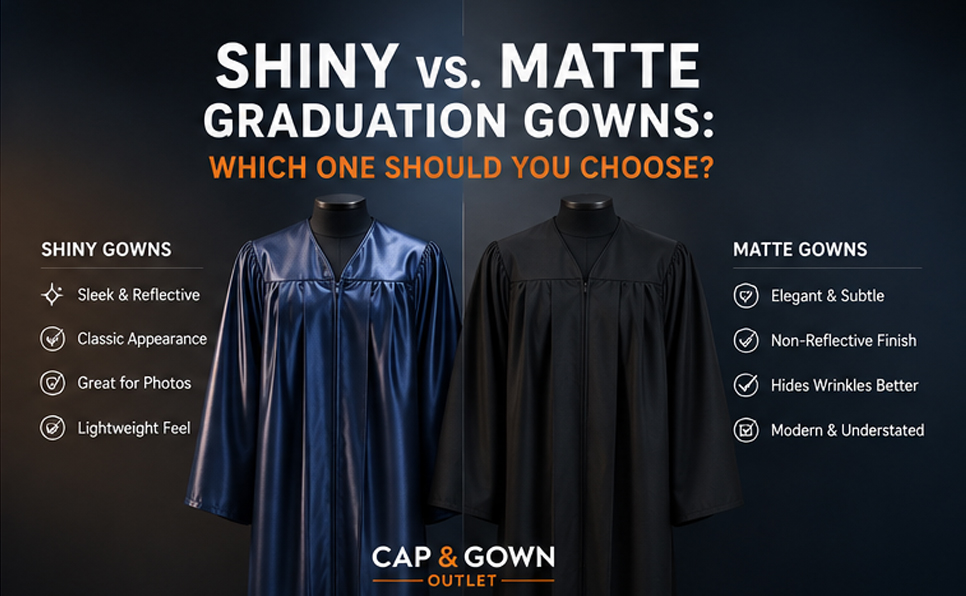
Two suppliers may both describe a product as a “matte graduation gown,” but the products can still differ.
Compare the actual specifications supplied in response to the purchasing requirement.
Use Samples When the Purchasing Process Calls for Them
A physical sample may be useful when the solicitation or authorized purchasing process includes product evaluation.
Depending on the requirement, reviewers might examine:
- Color
- Fabric appearance
- Construction
- Closures
- Sleeves
- Cap construction
- Tassels
- Certificate covers
- Stoles
If samples are part of the formal evaluation, the purchasing organization should establish the applicable submission and evaluation requirements in advance.
Phase 4: Evaluate the Gown Size System
Graduation gown sizing should be evaluated at the product level.
Ask the supplier for the current size chart for the gown being proposed.
Review:
- Information needed to select a size
- Standard size range
- Extended-size options
- Availability by required color
- Any special sizing instructions
Avoid Generic Clothing-Size Assumptions
Do not assume a participant’s everyday Small, Medium, Large or XL clothing size corresponds to the selected graduation gown unless the gown itself uses that sizing system.
Use the product-specific instructions supplied for the gown.
Evaluate the Size Range Before Standardizing a Gown
A product that works for most participants may still be unsuitable if its available size range cannot reasonably serve the full expected group.
Extended-size availability should therefore be reviewed before the product is selected, not after the final participant roster is completed.
Phase 5: Evaluate Inventory and Quantity Capacity
A catalog listing does not establish that the required quantity is available for the ceremony.
For significant or time-sensitive orders, ask about availability for:
- Total gowns
- Individual gown sizes
- Extended sizes
- Mortarboards
- Tassels
- Certificate covers
- Stoles
- Cords
- Degree-specific regalia
Pay Attention to Size-Level Availability
A supplier might have enough gowns in total while lacking enough units in one required size.
For example, an order for 200 gowns is not fully supported merely because the vendor has 200 gowns in inventory if the available size distribution does not match the purchaser’s requirement.
Ask How Long Availability Can Be Relied Upon
Inventory can change between quotation and order placement.
The purchasing department can ask whether quoted availability is:
- Current inventory information
- Reserved inventory
- Projected availability
- Subject to reconfirmation when ordered
Phase 6: Evaluate Graduation Accessories
Accessories should be evaluated independently instead of assuming that every supplier’s package contains equivalent merchandise.
Mortarboards
Confirm:
- Style
- Color
- Quantity
- Whether a tassel is included
Tassels
Confirm:
- Color
- Dated or undated style
- Year charm if required
- Quantity
Certificate Covers
Confirm:
- Document dimensions
- Orientation
- Cover dimensions
- Color
- Quantity
- Plain or customized configuration
Graduation Stoles
Confirm:
- Color
- Dimensions or style where relevant
- Quantity
- Plain or customized configuration
Recognition Cords
Confirm:
- Color or color combination
- Quantity
- Required construction where applicable
Commercial stole and cord colors should not be treated as having one universal meaning across government programs.
Phase 7: Review Degree-Specific Regalia Separately
When a government program includes participants earning degrees through a college or university, the degree-granting institution should determine the applicable academic-regalia requirements.
Verify separately:
- Bachelor’s gown requirements
- Master’s gown requirements
- Doctoral gown requirements
- Academic hood requirements
- Headwear requirements
- Tassel requirements
- Institution-specific specifications
Do not automatically include an academic hood with bachelor’s regalia unless the degree-granting institution requires or permits one.
Phase 8: Evaluate Customization
Customized merchandise may involve different quantities, pricing and production schedules from standard stocked merchandise.
Ask the supplier to identify:
- Customizable products
- Minimum quantities
- Artwork specifications
- Proof procedures
- Setup charges
- Production schedules
- Revision procedures
- Reorder requirements
Separate Custom Products From Stock Products
Keeping them on separate quotation lines makes it easier to understand differences in pricing and production schedules.
Confirm Rights to Use Logos, Seals and Artwork
The purchaser should ensure it has appropriate authorization before requesting reproduction of government seals, agency logos, school marks, Tribal marks or other protected artwork.
The supplier’s technical ability to reproduce a design does not establish authorization to use it.
Phase 9: Review the Supplier’s Price Structure
A useful quotation should make the proposed cost understandable.
Where appropriate, request:
- Product description
- Quantity
- Unit price
- Extended price
- Customization charges
- Setup charges
- Packaging charges
- Shipping or freight
- Total quoted amount
Compare Like With Like
Before comparing two prices, determine whether the vendors are proposing substantially comparable products and commercial requirements.
Review differences in:
- Gown specifications
- Package contents
- Size range
- Extended sizes
- Accessories
- Customization
- Packaging
- Shipping
- Delivery requirements
Review Shipping as Part of the Commercial Requirement
Determine whether the supplier’s quotation:
- Includes shipping
- Lists shipping separately
- Uses an estimated freight amount
- Includes multiple-destination charges
- Includes expedited shipping if requested
Phase 10: Evaluate the Delivery Plan
Graduation merchandise is tied to a scheduled event, so delivery planning can be operationally important.
Evaluate:
- Stock processing time
- Custom production time
- Shipping method
- Estimated transit time
- Required arrival date
- Expedited options
Use the Required Arrival Date, Not Only the Ceremony Date
The purchasing department may need the merchandise before the ceremony for:
- Receiving
- Inspection
- Counting
- Sorting
- Distribution to program sites
- Participant distribution
- Approved corrections
Evaluate Multi-Site Fulfillment
If several locations are involved, determine whether the requirement calls for centralized or distributed delivery.
Possible arrangements include:
- One shipment to central receiving
- Products separated by location within a central shipment
- Cartons labeled by program
- Cartons labeled by gown size
- Direct shipment to multiple locations
Phase 11: Evaluate Packaging
Packaging can affect how efficiently a large order is received and distributed.
Ask whether the vendor can provide:
- Gowns grouped by size
- Clearly labeled cartons
- Separate program allocations
- Separate site allocations
- Detailed packing lists
Phase 12: Review Exchange, Return and Discrepancy Procedures
Understand what happens if an issue is discovered after delivery.
Size Exchanges
Review:
- Eligibility
- Condition requirements
- Time limits
- Return shipping
- Replacement shipping
Shortages
Ask how missing quantities should be reported.
Incorrect Merchandise
Understand the procedure for incorrect products, colors or sizes.
Damaged Merchandise
Determine what documentation and notification are required.
Unused Merchandise
Review whether unused standard products are returnable and under what conditions.
Custom products may have different restrictions.
Phase 13: Review Purchase-Order Capability When Needed
If the purchasing organization expects to use a purchase order, verify supplier acceptance before issuing it.
Ask:
- Are purchase orders accepted?
- Does acceptance require prior approval?
- What payment terms apply?
- Is there an order minimum?
- What supporting documentation is required?
Purchase-order acceptance is a commercial capability. It does not by itself establish approved-vendor or government-contract status.
Phase 14: Review Vendor Documentation
Government organizations can have different vendor-onboarding requirements.
The purchasing office should identify the documentation required for the actual transaction.
Examples may include:
- Tax documentation
- Vendor registration forms
- Applicable business certifications
- Insurance documentation when required
- Representations or certifications required by the solicitation
- Other agency-specific documentation
Verify Certifications Instead of Relying on Marketing Claims
If a supplier’s claimed certification is relevant to the procurement, verify the applicable certification through the appropriate issuing or government source.
This may apply to state-certified small businesses and other procurement-related classifications.
Phase 15: Understand Federal SAM and Unique Entity ID Requirements
For federal procurement, a Unique Entity ID and an active SAM registration are not the same thing.
SAM.gov allows an organization to obtain only a Unique Entity ID without completing a full entity registration. An organization seeking to bid directly on federal awards generally needs registration, subject to applicable rules and exceptions.
When SAM registration is required for the acquisition, federal contracting personnel should verify the registration through the authorized federal process rather than treating possession of a Unique Entity ID as sufficient.
Phase 16: Review Past Performance Only When Relevant
If experience or past performance is part of the established evaluation method, purchasing personnel may review appropriate information such as:
- Comparable institutional orders
- Comparable quantities
- References
- Delivery performance
- Relevant quality information
Do not introduce new evaluation factors after supplier responses have been received.
Phase 17: Require Exceptions to Be Clearly Identified
A supplier response should make differences from the requirement easy to identify.
Ask vendors to disclose exceptions involving:
- Products
- Specifications
- Colors
- Sizes
- Quantities
- Customization
- Delivery
- Packaging
- Commercial terms
Require Proposed Substitutions to Be Identified
If alternatives are permitted, require the supplier to identify any substitute product and provide sufficient specifications for evaluation.
This reduces the risk of unknowingly comparing the requested product with a materially different substitute.
Phase 18: Review Backorders and Partial Shipments
Ask whether any required merchandise is unavailable at the time of quotation.
For backordered products, useful information may include:
- Quantity currently available
- Quantity unavailable
- Expected replenishment
- Proposed alternative
Also determine whether partial shipments are permitted or whether the complete requirement must arrive together.
Phase 19: Build a Supplier Response Matrix
A purchasing team can organize responses in a consistent structure without turning the worksheet into an unauthorized scoring system.
Potential fields include:
- Requirement
- Supplier response
- Product proposed
- Specification
- Size availability
- Quantity availability
- Unit price
- Extended price
- Shipping
- Total delivered amount
- Processing time
- Expected delivery
- Quote expiration
- Exceptions
Use the Evaluation Method Established for the Purchase
The comparison worksheet is an administrative tool. It should not create a new evaluation method.
Supplier responses should be evaluated according to the solicitation and procurement procedures governing the transaction.
Phase 20: Check Required Sources and Existing Purchasing Vehicles
Before making a commercial purchase, determine whether an applicable required source, existing contract, cooperative arrangement or other purchasing vehicle must or may be used.
For federal agencies, required sources and existing contracts can affect whether simplified acquisition procedures are the appropriate purchasing route.
Do Not Artificially Divide a Known Requirement
If a purchasing department knows the complete requirement, it should not divide that requirement into smaller transactions merely to avoid procurement requirements or applicable thresholds.
Phase 21: Verify Funding Allowability Separately
Graduation merchandise being useful to an education or training ceremony does not automatically establish that the expense is allowable under a particular government funding source.
The responsible organization should review applicable:
- Law
- Regulations
- Grant or award terms
- Cost requirements
- Program guidance
- Agency policies
Phase 22: Use the Purchase Requirement During Receiving
Vendor evaluation should not end when the order is placed.
When merchandise arrives, compare the shipment with the authorized purchasing documents.
Verify:
- Product received
- Quantity received
- Gown quantities by size
- Extended-size quantities
- Caps
- Tassels
- Certificate covers
- Stoles
- Cords
- Customized products
- Location allocations
Document Discrepancies
Record shortages, incorrect products, damage or other discrepancies according to the organization’s receiving procedures and applicable supplier terms.
Phase 23: Maintain a Post-Order Supplier Record
After the ceremony, purchasing and program personnel can retain appropriate factual information about the transaction for future planning.
Useful records may include:
- Products ordered
- Final quantities
- Delivery date
- Documented shortages
- Documented damage
- Size exchanges
- Unused inventory
- Supplemental orders
Where past performance is relevant to a future procurement, use the information in accordance with the applicable purchasing procedures.
Government Graduation Regalia Supplier Review Checklist
- Program requirement documented
- Product specifications established
- Mandatory and optional features distinguished
- Gown style reviewed
- Gown color verified
- Product-specific size chart obtained
- Standard size range reviewed
- Extended sizes reviewed
- Quantity capacity reviewed
- Size-level inventory considered
- Caps reviewed
- Tassels reviewed
- Certificate covers reviewed
- Stoles reviewed
- Cords reviewed
- Degree-specific regalia verified where applicable
- Custom merchandise separated
- Artwork authorization verified where applicable
- Unit pricing reviewed
- Extended pricing reviewed
- Package contents confirmed
- Shipping treatment identified
- Required arrival date provided
- Processing schedule reviewed
- Multi-site delivery requirements reviewed
- Packaging requirements reviewed
- Exchange procedures reviewed
- Return procedures reviewed
- Shortage procedures reviewed
- Damage procedures reviewed
- Purchase-order acceptance confirmed if required
- Required vendor documentation identified
- Relevant certifications verified
- SAM registration verified when applicable
- Exceptions identified
- Substitutions identified
- Backorders identified
- Partial-shipment terms identified
- Required sources or existing contracts considered
- Funding allowability verified
- Receiving process established
Graduation Regalia for Public-Sector and Institutional Buyers
Cap and Gown Outlet is an independent academic regalia supplier serving individual customers and qualifying institutional purchasers.
Depending on current product availability and purchasing requirements, organizations may request information or quotations for:
- Graduation gowns
- Mortarboard caps
- Graduation tassels
- Cap, gown and tassel packages
- Extended-size gown options where available
- Certificate and diploma covers
- Graduation stoles
- Honor and recognition cords
- Bachelor’s regalia
- Master’s regalia
- Doctoral regalia
- Academic hoods where applicable
Formal quotations and quantity-based institutional pricing may be available depending on merchandise and order requirements. Product availability, size ranges, minimum quantities, customization requirements and processing schedules vary by product.
Nationwide U.S. shipping is available. Institutional purchasers should verify inventory, processing schedules, shipping charges and available expedited options for the specific order.
If the purchaser expects to use a purchase order, supplier PO acceptance and applicable terms should be confirmed before issuance.
Information to Prepare Before Contacting a Graduation Regalia Supplier
- Program or ceremony type
- Required products
- Gown specifications
- Gown color
- Quantity by gown size
- Extended-size requirements
- Cap and tassel quantities
- Certificate-cover dimensions
- Stole and cord quantities
- Customization requirements
- Delivery destination or destinations
- Required arrival date
- Purchasing method when known
Independent Supplier and Non-Affiliation Disclosure
Cap and Gown Outlet is an independent academic regalia supplier. It is not affiliated with, endorsed by, sponsored by, authorized by or acting on behalf of any federal, state, local or Tribal government, government agency, public institution or government-funded program unless an actual official relationship has been established.
References to government agencies, public-sector education programs and government purchasing are descriptive. They do not establish approved-vendor status, government endorsement, contract status, preferred-supplier designation, purchasing eligibility or funding allowability.
Frequently Asked Questions
What should government buyers evaluate first when reviewing a graduation regalia supplier?
Start with the purchasing requirement. Establish the products, specifications, gown sizes, quantities, delivery locations and required arrival date before comparing supplier responses.
Is the lowest gown unit price enough to compare suppliers?
No single comparison method applies to every government purchase. The purchasing organization should use the evaluation basis established for the acquisition and consider the commercial information required by that process.
Why should size availability be reviewed separately from total inventory?
A supplier can have enough gowns in total while lacking sufficient quantities in one or more sizes required by the participant group.
Should a government purchaser ask for a product sample?
A sample may be useful when the purchasing process permits or requires physical product evaluation. If samples affect award or supplier selection, the organization should establish the applicable requirements in advance.
Does a Unique Entity ID prove that a supplier has an active SAM registration?
No. An entity can obtain a Unique Entity ID without completing full SAM registration. When SAM registration is required for the acquisition, it should be verified separately.
Should shipping be considered when evaluating a federal simplified-acquisition quotation?
Under the current FAR simplified-acquisition evaluation rule, quotations or offers are evaluated inclusive of transportation charges from the supplier’s shipping point to the delivery destination.
Can a government agency use a supplier that accepts purchase orders?
Purchase-order acceptance is one supplier capability. The government organization must still determine whether purchasing from that supplier is authorized under the applicable procurement process.
Can custom graduation stoles display a government logo?
Only when the organization has appropriate authority to reproduce the requested logo or protected mark and the customization otherwise complies with its requirements.
Should a supplier disclose proposed substitutions?
When alternatives are permitted, requiring proposed substitutions to be clearly identified helps the purchaser determine whether the proposed product satisfies the requirement.
Does this supplier checklist determine which vendor should receive an award?
No. The checklist organizes supplier and product information. The responsible purchasing organization should apply the evaluation basis and procurement procedures established for the acquisition.
Evaluate the Complete Graduation Regalia Requirement
An effective government graduation regalia supplier evaluation considers the entire requirement rather than one product price. Masters Gown specifications, sizing, inventory, accessories, customization, shipping, delivery schedules, commercial terms and required documentation can all affect whether a supplier response matches what the organization requested.
By documenting the requirement before requesting quotations and maintaining the same basic information structure throughout supplier review, ordering and receiving, purchasing departments can create a clearer and more consistent graduation regalia procurement record.