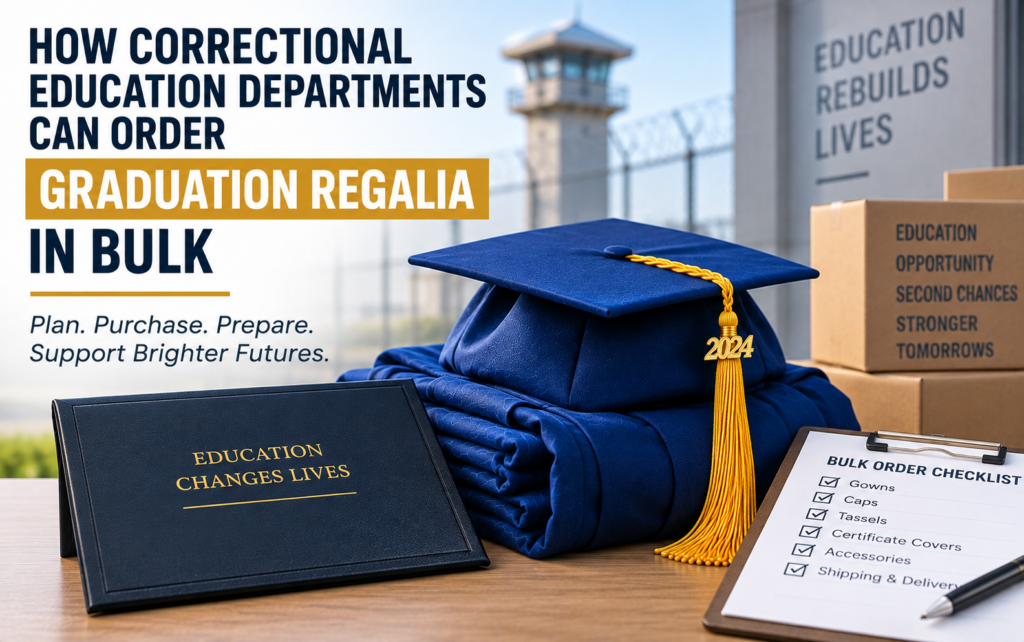
Correctional education programs purchasing graduation apparel for multiple participants need a process that is organized, credential-appropriate and compatible with institutional requirements. A large order may involve more than graduation gowns. Administrators may also need caps, tassels, certificate covers, diploma covers, stoles, cords and degree-specific academic regalia for different educational programs.
Planning bulk bachelors graduation regalia for correctional education programs works best when the purchasing team separates the order into clear stages: define the educational achievements, establish the ceremony packages, calculate quantities, collect gown sizes, complete any required institutional product review, obtain comparable supplier quotations and coordinate procurement and delivery.
This guide provides a purchasing framework that correctional education departments, government agencies, educational partners and other authorized institutional buyers can adapt for GED, vocational, certificate, workforce and college graduation ceremonies.
Begin With the Ceremony Instead of the Supplier Catalog
A common purchasing mistake is selecting merchandise before determining what the ceremony actually requires.
Start by documenting the educational achievements that will be recognized and the number of participants in each group.
Possible Ceremony Groups Include:
- GED or high school equivalency completers
- Adult education participants
- Vocational training completers
- Career and technical education graduates
- Apprenticeship completers
- Workforce-development participants
- Occupational training completers
- Educational certificate recipients
- College certificate recipients
- Associate degree graduates
- Bachelor’s degree graduates
- Master’s degree graduates
- Doctoral graduates where applicable
Actual program offerings vary among correctional systems and facilities. The order should reflect current programs rather than generic assumptions about correctional education.
Build a Ceremony Package for Each Achievement
Once participant groups are identified, determine what each group will wear or receive.
This prevents a department from buying the same academic apparel for participants completing very different types of education.
Basic GED Recognition Package
- Standard graduation gown
- Approved mortarboard
- Tassel
- Certificate cover
Vocational or Training Recognition Package
- Standard gown where appropriate
- Approved cap where appropriate
- Tassel
- Certificate cover
- Approved stole or achievement cord if used
Certificate-Focused Package
- Certificate cover
- Optional ceremonial gown
- Approved recognition accessory where appropriate
College Degree Package
- Degree-appropriate academic gown
- Required academic headwear
- Tassel
- Academic hood where required
- Diploma cover
Use the Degree-Granting College for Academic Regalia Specifications
College academic regalia should not be selected using a generic correctional education package.
The college or university awarding the degree should provide the applicable academic dress specifications.
Obtain Information About:
- Degree level
- Gown design
- Gown color
- Mortarboard, tam or other headwear
- Tassel specification
- Academic hood requirements
- College-specific commencement requirements
Do Not Automatically Add Hoods to Bachelor’s Orders
Bachelor’s graduates do not universally wear academic hoods. Practices vary among institutions.
Academic hoods should only be added when the degree-granting institution specifies them.
Create a Participant Forecast Before Finalizing Quantities
Bulk purchasing usually begins before every ceremony participant has been finalized.
It can help to maintain three different counts:
- Expected completers
- Likely ceremony participants
- Final approved order quantity
This can reduce the risk of purchasing merchandise for everyone enrolled in a program when only a portion will participate in the ceremony.
Convert Headcount Into Product Quantities
Total participant count alone is not enough for a complete institutional order.
Different products may require different quantities.
Example:
- 160 total ceremony participants
- 125 standard graduation gowns
- 125 mortarboards
- 125 tassels
- 150 certificate covers
- 10 college diploma covers
- 30 approved program stoles
- 22 achievement cords
- 10 degree-specific academic regalia packages
This method can prevent automatically ordering every accessory for every participant.
Create a Product-Level Quantity Sheet
For each merchandise category, list the exact required quantity.
Useful Categories Include:
- Graduation gowns
- Mortarboards
- Tassels
- Year charms
- Certificate covers
- Diploma covers
- Stoles
- Honor cords
- Achievement cords
- Academic hoods
- Bachelor’s apparel
- Master’s apparel
- Doctoral apparel
Standardize Non-Degree Gowns Where Practical
For GED, vocational and other non-degree recognition programs, using one standard gown can simplify bulk purchasing.
Standardization can reduce the number of product specifications administrators must manage while making future reorders easier.
When Comparing Standard Gowns, Review:
- Fabric
- Matte or shiny finish
- Color
- Closure style
- Size range
- Extended sizes
- Available quantity
- Whether caps are included
- Whether tassels are included
- Institutional pricing
Choose Gown Color Based on the Program’s Requirements
Standard graduation gowns may be offered in multiple colors depending on the supplier.
The institution can choose a color based on program preference, established ceremony tradition, educational partner requirements, availability and budget.
No commercial gown color should be presented as universally required for correctional education, GED completion or vocational education.
Matte and Shiny Gowns Can Both Be Considered
Matte gowns offer a lower-sheen appearance, while shiny gowns have a more reflective finish.
The appropriate choice depends on ceremony preference and available inventory unless an educational partner has established a specific requirement.
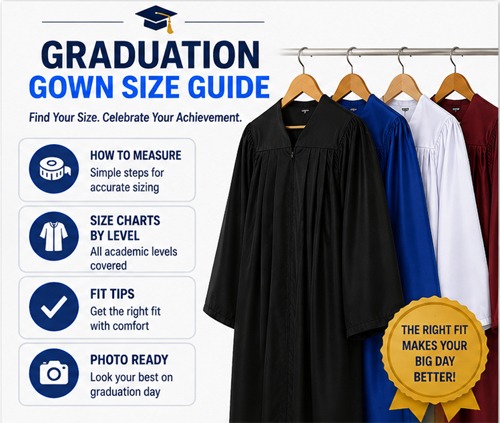
Build the Size Order Using the Actual Product Chart
Do not collect sizes using a generic masters cap and gown chart and assume they will transfer to every supplier.
Select the proposed gown first, obtain its current sizing guide and build the quantity distribution using that chart.
An Institutional Size Summary Might Include:
- Size category A — 18
- Size category B — 29
- Size category C — 37
- Size category D — 25
- Size category E — 11
- Extended sizes — 5
Include Extended Sizes in the Initial Quote
Extended-size inventory may not mirror the availability of standard gowns.
If a department waits until the last stage of purchasing to identify these quantities, it may discover that a preferred color or gown style cannot be supplied consistently for the full graduating group.
Minimize Unnecessary Participant Data
A commercial graduation supplier usually needs product specifications, quantities and sizes—not detailed correctional records.
Where organizational policy permits, a department can provide aggregate gown quantities instead of individual names, identification numbers or unrelated personal information.
Confirm Whether Caps Are Included With the Gowns
Some commercial graduation packages include a mortarboard, while others price the cap separately.
For a large order, this distinction can significantly affect the final cost.
Ask:
- Is one mortarboard included with every gown?
- Can caps be purchased separately?
- Can replacement caps be ordered?
- Does the proposed cap require institutional review?
Determine the Tassel Plan
Tassels can be purchased in standard or specialized colors depending on available products.
Specify:
- Tassel color
- Quantity
- Whether tassels are included with caps
- Whether graduation-year charms are required
- Whether different program groups use approved distinctions
Separate Dated Products From Reusable Inventory
A standard gown can potentially be used in a future ceremony if institutional policies permit. A tassel carrying a specific graduation year has much less flexibility.
When developing contingency quantities, departments can be more conservative with dated or customized products.
Make Certificate Covers a Separate Line Item
Certificate and diploma presentation products can be overlooked when administrators focus primarily on gowns.
For GED, vocational, apprenticeship and educational certificate programs, a certificate cover may be one of the most important ceremony items.
Determine the Correct Cover Size
Do not assume that all certificates or diplomas use the same dimensions.
Confirm:
- Document width
- Document height
- Portrait or landscape orientation
- Cover size
- Interior configuration
- Quantity
- Color
Blank Covers Can Be Useful for Systemwide Purchasing
Where document dimensions are compatible, blank covers may provide flexibility across different programs or facilities.
They can also reduce custom-production requirements and make unused inventory easier to use at a later ceremony.
Use Custom Covers Only When There Is a Clear Need
Custom certificate or diploma covers may include authorized wording or artwork.
Before selecting customization, consider:
- Minimum quantity
- Artwork requirements
- Production lead time
- Additional cost
- Potential unused inventory
- Branding authorization
Government seals, department-of-corrections logos, educational-provider marks and other protected branding should only be reproduced when appropriate authorization exists.
Create a Clear Policy for Stoles and Cords
Large ceremonies can become unnecessarily complicated when numerous stole and cord colors are ordered without a documented recognition purpose.
Before including these products in the bulk order, determine what each one represents.
Document:
- Product type
- Color
- Meaning
- Eligibility
- Quantity
- Customization
- Institutional approval
There Is No Universal Correctional Education Cord Color System
Commercial graduation cord colors do not carry one universal meaning across GED, vocational, workforce or correctional education programs.
The responsible educational organization should define any distinctions used during its ceremony.
Create a Master Order Table
A consolidated purchasing worksheet can serve as the central reference for education staff, procurement personnel and the supplier.
Useful Fields Include:
- Facility or program
- Credential
- Product
- Product specification
- Color
- Size
- Quantity
- Custom or standard
- Institutional approval status
- Required delivery date
- Delivery destination
Separate Standard, Conditional and Specialized Products
Standard Products
- Graduation gown
- Mortarboard
- Tassel
- Certificate cover
Conditional Products
- Stole
- Honor cord
- Achievement cord
- Year charm
- Custom cover
Specialized Academic Products
- Master’s gown
- Doctoral gown
- Academic hood
- Doctoral tam
- Institution-specific academic apparel
This structure can make budgets and supplier quotes easier to understand.
Complete Institutional Product Review Before Final Purchase
Graduation products that are routinely used in schools should not automatically be assumed to be acceptable within correctional institutions.
Authorized personnel should determine whether the proposed merchandise satisfies applicable institutional security, property, operational and receiving requirements.
Review Individual Products Instead of Approving a Package Name
A “cap and gown package” can contain several different components.
Review May Include:
- Gown
- Mortarboard
- Tassel
- Tassel charm
- Certificate cover
- Diploma cover
- Stole
- Cord
- Academic hood
- Doctoral headwear
- Custom decorations
- Packaging
Commercial Products Are Not Automatically “Prison Approved”
A supplier should not describe merchandise as “prison approved,” “DOC approved,” “correctional approved,” “facility approved” or “institution compliant” unless the applicable authority has actually established the claimed status.
Requirements can differ between correctional systems and individual facilities.
Request Product Specifications When the Institution Needs Them
Correctional personnel may need additional information about a proposed item before approving it.
Buyers can ask the supplier for available product specifications before committing to a large purchase.
Decide Whether the Order Will Be Centralized or Facility-Specific
A correctional education system serving several locations may purchase all graduation supplies through one central office or allow individual institutions to purchase separately.
If policies allow, the organization can evaluate which approach is more practical.
Central Purchasing Can Potentially Help With:
- Standard product specifications
- Consistent colors
- Combined quantities
- Volume pricing opportunities
- Central quote comparison
- Simplified future reorders
Centralized Purchasing Does Not Require Centralized Delivery
A department may place one coordinated order while requiring merchandise to reach several approved destinations.
The supplier’s ability to support split shipping should be confirmed before pricing is finalized.
Create a Facility Allocation Sheet
For a multi-location order, divide the merchandise by destination.
Example:
- Facility A — 55 gowns, caps and tassels
- Facility B — 42 gowns, caps and tassels
- Facility C — 31 gowns, caps and tassels
- Central office — 20 certificate covers and contingency inventory
Each actual shipment should follow the purchasing organization’s approved receiving plan.
Ask Whether Merchandise Can Be Packed by Facility
Receiving a large mixed shipment can create significant internal sorting work.
Where the supplier offers the capability, the department can ask about organization by:
- Facility
- Education program
- Credential group
- Gown size
- Product category
Any additional packaging service, cost or labeling requirement should be confirmed before purchase.
Prepare a Complete Institutional RFQ
A detailed request for quote is one of the most important tools in a large graduation purchase.
Include:
- Number of participating programs
- Credential groups
- Gown specification
- Gown color
- Gown finish
- Quantity by size
- Extended-size quantities
- Cap quantity
- Tassel specification
- Certificate-cover dimensions
- Diploma covers
- Stoles
- Cords
- Academic hoods
- Degree-specific regalia
- Authorized custom products
- Packaging requirements
- Number of delivery destinations
- Required delivery date
- Applicable purchasing instructions
Ask Suppliers to Quote the Same Specification
Price comparison becomes unreliable when suppliers quote different merchandise.
If possible, give each supplier the same bill of materials and specifications.
This Can Make It Easier to Compare:
- Unit pricing
- Included accessories
- Extended-size charges
- Customization costs
- Shipping
- Split-shipment charges
- Processing requirements
- Total delivered cost
Compare the Complete Package, Not the Gown Price
A supplier advertising a lower gown price may charge separately for caps, tassels or other items included in another supplier’s package.
Compare the actual ceremony requirement line by line.
Calculate Cost Per Participant by Program
Using one average across all graduates can produce misleading results if some groups receive only certificate covers while college graduates require specialized academic regalia.
Calculate Separately Where Useful:
- GED package cost per participant
- Vocational package cost per participant
- Certificate-recognition cost per participant
- Associate-degree package cost
- Bachelor’s package cost
- Master’s package cost
- Doctoral package cost
Ask About Volume and Institutional Pricing
Large coordinated orders may qualify for institutional or volume pricing depending on the supplier and products.
Discounts should never be assumed. Request current pricing based on the actual quantity and specifications.
Verify Inventory Across the Full Size Range
Do not release a large order simply because the supplier confirms that the gown is “in stock.”
Confirm Inventory For:
- Every standard gown size
- Extended sizes
- Correct colors
- Caps
- Tassels
- Certificate covers
- Diploma covers
- Stoles
- Cords
- Academic hoods
- Degree-specific apparel
Ask for Complete Inventory Confirmation
One missing size can affect the appearance and timing of the entire ceremony.
Inventory review should be completed before the department relies on a supplier’s delivery schedule.
Identify Stocked Merchandise and Made-to-Order Merchandise
Not every product in a bulk order follows the same fulfillment schedule.
Common Stock-Type Merchandise May Include:
- Standard gowns
- Mortarboards
- Standard tassels
- Some cords
- Some certificate covers
Products That May Require Additional Production Include:
- Custom stoles
- Customized certificate covers
- Institution-specific academic hoods
- Custom doctoral gowns
- Decorated specialty products
Build the Schedule Around the Longest-Lead-Time Item
If 200 standard gowns can ship quickly but 40 custom stoles require additional production, the ceremony schedule should account for the stoles.
The slowest required component can determine when the final package is truly ready.
Break the Order Timeline Into Phases
Phase 1: Program Planning
- Confirm credentials
- Estimate graduates
- Establish ceremony packages
Phase 2: Product Planning
- Select gowns
- Collect sizes
- Select accessories
- Determine custom products
Phase 3: Institutional Review
- Review proposed products
- Confirm any facility requirements
- Approve authorized customization
Phase 4: Procurement
- Issue RFQ
- Review quotations
- Complete purchasing authorization
Phase 5: Fulfillment
- Custom production
- Stock allocation
- Order processing
Phase 6: Delivery
- Carrier transit
- Institutional receiving
- Inspection
- Internal distribution
Expedited Shipping Covers Only the Transportation Stage
Expedited carrier service may reduce shipping transit for qualifying stocked merchandise.
It cannot accelerate institutional approval, government procurement, artwork approval or custom manufacturing.
Confirm the Approved Receiving Address
The public mailing address of a correctional institution should not automatically be used for a commercial shipment.
Verify:
- Purchasing organization
- Facility
- Receiving department
- Education department where applicable
- Approved delivery address
- Attention line
- Purchase reference
- Package-labeling requirements
- Carrier restrictions where applicable
- Receiving procedures
Consider the Cost of Multiple Shipments
A centralized purchase shipped to ten facilities may have a different delivered cost than one shipment to a central warehouse.
Shipping configuration should therefore be included in supplier quote comparisons.
Use Contingency Inventory Selectively
Correctional education departments may experience last-minute changes in participation or sizing.
Where permitted, a limited number of flexible standard items can provide additional coverage.
Potential Contingency Items Could Include:
- Common standard gown sizes
- Selected extended sizes
- Undated mortarboards
- Undated tassels
- Blank certificate covers
The organization should determine whether contingency inventory is appropriate based on budget, storage and inventory-management policies.
Avoid Overbuying Custom Merchandise
Custom stoles, dated tassels and personalized covers may have limited value after the ceremony.
Keep these quantities closer to confirmed participant counts whenever practical.
Determine the Legal Purchasing Organization
A correctional education department may coordinate the ceremony without being the entity that actually purchases the merchandise.
The Buyer Could Be:
- State department of corrections
- Other government agency
- Educational department
- Participating college
- School district
- Workforce organization
- Authorized nonprofit or program partner
- Another authorized institutional purchaser
Confirming the legal buyer early can make quotation, tax, billing, shipping and payment information more accurate.
Follow the Applicable Procurement Process
Government purchasing procedures vary by jurisdiction, funding source, transaction amount and agency policy.
The responsible procurement personnel should determine whether the transaction requires:
- Informal quotation
- Multiple competitive quotes
- Formal solicitation
- Existing contract use
- Purchase order
- Government purchase card where permitted
- Another authorized procurement method
Formal Quotes Can Support Institutional Review
A supplier may be able to prepare a written institutional quotation identifying:
- Product descriptions
- Quantities
- Unit prices
- Extended prices
- Shipping
- Applicable terms
Purchasers should specify any additional documentation required by their organization.
Confirm Purchase-Order Acceptance
Some institutional transactions may use purchase orders.
A supplier’s ability to provide an institutional quote does not automatically mean that it accepts POs.
Verify current PO acceptance and payment terms before the purchasing organization issues one.
Government Vendor Requirements Vary
Some public-sector transactions may require supplier registration, tax documentation or other procurement records.
The purchasing office should determine which requirements apply and verify supplier information through the appropriate official process.
Do Not Assume Government Contract Status
A commercial supplier that sells to government organizations is not automatically a state contract vendor, federal contractor, preferred supplier or approved correctional vendor.
Such claims should only be made when they are accurate and can be substantiated.
Questions to Ask Before Awarding a Bulk Graduation Order
- Can the supplier provide the full requested quantity?
- Are all gown sizes available?
- Are extended sizes available?
- Are the selected colors available across the required size range?
- Can individual replacement items be ordered?
- Are caps and tassels included or separate?
- Are certificate and diploma covers available?
- Can approved stoles and cords be supplied?
- Can degree-specific academic regalia be supplied?
- Can academic hoods be supplied to exact specifications?
- Can product information be provided for institutional review?
- Can a formal quote be prepared?
- Is institutional or volume pricing available?
- Which products are currently stocked?
- Which products require production?
- Can products be packed by facility or program?
- Can the supplier support multiple approved destinations?
- What are the processing times?
- What shipping options are available?
- Are expedited options available for qualifying stocked merchandise?
- Are purchase orders accepted for qualifying transactions?
Bulk Correctional Education Purchasing Checklist
- Identify participating programs
- Identify credentials
- Estimate participant counts
- Create the package for each credential group
- Verify college academic requirements
- Select standard gowns
- Select colors and finishes
- Collect quantities using the product-specific size chart
- Identify extended sizes
- Determine cap quantities
- Select tassels
- Identify year-specific products
- Measure certificates and diplomas
- Select presentation covers
- Define stole and cord requirements
- Identify custom merchandise
- Create the master order worksheet
- Determine facility allocations
- Complete institutional product review
- Prepare the RFQ
- Compare equivalent supplier quotations
- Calculate delivered cost by package
- Verify complete inventory
- Identify long-lead-time products
- Confirm procurement procedures
- Confirm PO or payment terms
- Confirm receiving destinations
- Build the timeline backward from the ceremony
- Inspect products after receiving
Cap and Gown Outlet for Institutional Bulk Graduation Orders
Cap and Gown Outlet is an independent commercial supplier of graduation apparel, academic regalia and educational recognition products.
Relevant merchandise can include bachelors graduation gowns, mortarboard caps, tassels, certificate covers, diploma covers, graduation stoles, honor cords, achievement cords, bachelor’s regalia, master’s regalia, doctoral regalia and academic hoods where degree-appropriate.
Correctional education departments, government agencies, educational providers, schools, colleges, vocational programs and other qualifying institutional purchasers can evaluate available products according to their ceremony specifications, required quantities, sizing, procurement procedures and approved delivery requirements.
Potential Institutional Ordering Options
- Individual graduation products
- Small institutional orders
- Large bulk graduation orders
- No minimum quantity where applicable
- Multiple gown sizes
- Extended sizes where available
- Multiple gown colors
- Matte and shiny gowns where available
- Mortarboard caps
- Graduation tassels
- Certificate covers
- Diploma covers
- Graduation stoles
- Honor cords
- Achievement cords
- Bachelor’s, master’s and doctoral regalia where appropriate
- Academic hoods where degree-appropriate
- Formal institutional quotations
- Institutional or volume pricing
- Nationwide U.S. shipping
- Fast processing for qualifying stocked merchandise
- Expedited shipping options where available
Product availability, minimum quantities, pricing, customization, institutional discounts, processing times, shipping options, purchase-order acceptance, payment terms and transaction-specific government purchasing capabilities should be confirmed before purchase.
Independent Supplier and Non-Affiliation Disclosure
Cap and Gown Outlet is an independent commercial supplier. It is not affiliated with, endorsed by, sponsored by, authorized by, or acting on behalf of any federal, state or local government; correctional agency; department of corrections; correctional facility; correctional education department; Federal Bureau of Prisons; U.S. Department of Justice; department of education; school; college; university; credentialing organization; or other government or educational entity unless a specific official relationship has actually been established.
References to correctional education, prison education programs, GED programs, vocational education, government purchasing, correctional facilities or institutional graduation supplies describe potential commercial applications for graduation merchandise. They do not establish facility approval, government endorsement, contract status, procurement award or approved-vendor designation.
Frequently Asked Questions About Bulk Graduation Regalia Purchasing
How early should a correctional education department begin planning a bulk graduation order?
Planning should begin early enough to confirm participants, collect sizes, complete institutional review, obtain quotes, follow procurement procedures and allow sufficient production and delivery time. Custom merchandise generally requires additional lead time.
Should every participant receive the same graduation package?
No. Different credentials may call for different products. GED, vocational, certificate and college-degree groups can be organized separately.
How should gown quantities be sent to a supplier?
Use the current sizing chart for the selected gown and provide the quantity required in each size category, including extended sizes.
Can one department purchase graduation supplies for several facilities?
Potentially, if the purchasing organization’s procedures permit centralized purchasing. The department should determine how products will be allocated and delivered.
Can a single bulk order ship to multiple correctional institutions?
Potentially. The supplier’s multi-destination shipping capabilities, costs and packaging requirements should be confirmed in advance.
Should departments buy extra gowns?
A limited contingency quantity of standard reusable merchandise may be useful in some programs, but the decision should be based on actual experience, budget and inventory policies.
Should extra custom stoles be ordered?
Custom merchandise generally has less reuse flexibility, so quantities should be planned carefully and kept reasonably close to confirmed need.
Can certificate covers be ordered in bulk without caps and gowns?
Yes, where available. Programs can purchase only the products required for their recognition format.
Are academic hoods appropriate for GED or vocational completion?
Academic hoods generally should follow degree-specific requirements rather than being used as generic graduation accessories.
Do all bachelor’s graduates wear academic hoods?
No. Practices vary by institution, and many bachelor’s graduates do not wear hoods.
Are bulk graduation products automatically approved for correctional facilities?
No. Commercial availability does not establish institutional approval. The responsible correctional organization determines whether the products satisfy its requirements.
Can correctional education programs request formal supplier quotes?
A supplier may be able to prepare a formal institutional quotation based on defined products, quantities and delivery requirements.
Can correctional education departments use purchase orders?
Some qualifying transactions may use purchase orders. Buyers should confirm applicable procurement requirements and the supplier’s current PO acceptance before issuing one.
Can a supplier claim to be an approved corrections vendor?
Only when that status actually exists and can be substantiated through the applicable government or institutional procurement process.
Is Cap and Gown Outlet affiliated with correctional education departments?
No affiliation should be inferred. Cap and Gown Outlet is an independent commercial supplier unless a specific official contract, award or other relationship has actually been established.
Creating an Efficient Bulk Graduation Purchasing Process
The strongest bulk-order strategy begins with accurate program information. Separate participants by credential, establish the correct ceremony package and calculate quantities by individual product rather than relying only on total headcount.
Select the gown before finalizing sizing, use the manufacturer’s current chart and include extended sizes in the first inventory inquiry. Measure certificates and diplomas before selecting covers, and document the purpose of any stoles or cords before adding them to the order.
When products will be used inside correctional institutions, complete the appropriate product review before purchasing. For systemwide orders, determine whether one central purchase or facility-level purchasing is more practical and whether the supplier needs to support multiple destinations.
Prepare a detailed RFQ so suppliers quote equivalent merchandise. Evaluate the entire delivered package rather than a gown-only price, verify all inventory and identify products requiring custom production.
Finally, follow the procurement procedures established by the purchasing organization and build enough time into the schedule for approval, purchasing, production, processing, transportation, institutional receiving and internal distribution.
Cap and Gown Outlet can be evaluated as an independent commercial source for bulk graduation gowns, caps, tassels, certificate covers, diploma covers, stoles, cords and degree-appropriate academic regalia for qualifying correctional education programs, subject to institutional approval, current product availability, transaction terms and applicable procurement requirements.