You finished your bachelor’s degree, carefully stored your graduation gown and now, a few years later, you are preparing to graduate again—this time with a master’s degree.
Opening the closet and finding your old masters cap and gown naturally raises a question:
Can you simply wear the same graduation regalia again?
Sometimes an individual component may be reusable, but you should not assume that your complete bachelor’s outfit is appropriate for a master’s commencement ceremony.
Bachelor’s and master’s regalia represent different academic levels. The gown construction can differ, particularly around the sleeves, and master’s academic dress may include a hood that was not part of your undergraduate outfit.
Your graduate institution also determines what it considers acceptable commencement attire.
Instead of deciding whether to reuse the entire outfit at once, a better approach is to inspect each piece separately.
This guide shows you how.
Start With the Graduate School’s Requirements
Before opening your old garment bag, find your current commencement instructions.
Look for information about:
- Master’s gown style
- Required gown color
- Fabric or finish requirements
- Academic hood
- Graduation cap or approved headwear
- Tassel
- Stoles and cords
- School-specific regalia
- Approved or designated ordering sources
Your previous university’s rules do not determine what your current graduate school requires.
Think in Terms of Individual Pieces
Your old graduation outfit is not necessarily an all-or-nothing proposition.
You might discover that one component remains appropriate while another needs to be replaced.
Evaluate these pieces separately:
- Graduation gown
- Graduation cap
- Tassel
- Academic hood
- Graduation stole
- Honor or recognition cords
- Other approved accessories
Reuse Check #1: Your Bachelor’s Graduation Gown
The gown deserves the closest inspection because bachelor’s and master’s gowns can use different degree-level construction.
Do not make the decision based only on color.
Your old bachelor’s gown might be black, and your required master’s gown might also be black. That does not automatically make them interchangeable.
Compare the Sleeves First
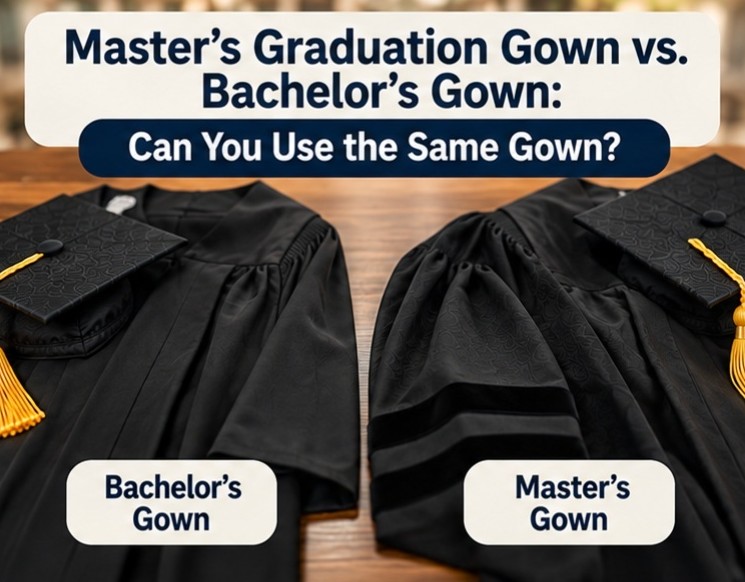
One of the most recognizable differences between many bachelor’s and master’s gowns is the sleeve construction.
A bachelor-level gown commonly has a different sleeve silhouette from a master’s-level gown.
Master’s gowns can use distinctive graduate-level sleeve construction that changes the appearance of the garment around the arms.
Exact designs vary, so do not try to identify an unknown gown solely from photographs. Instead, confirm whether your existing garment is actually designated for the academic level your institution requires.
Why Sleeve Construction Matters
The sleeve is not simply a fashion choice.
Degree-level academic dress can use different gown designs to distinguish bachelor’s, master’s and doctoral regalia.
That means altering the color, adding a hood or changing accessories does not necessarily make a bachelor’s gown into a master’s gown.
Compare the Entire Gown Specification
After checking the academic level and sleeves, compare:
- Gown color
- Fabric
- Finish
- Length
- Closure
- Trim
- Institution-specific details
- Current fit
Your graduate school may require something different from what your undergraduate institution used.
What If Both Gowns Are Black?
This is where many graduates become confused.
Two gowns can share the same color while representing different academic levels.
Imagine two black jackets: one is a blazer and one is a tuxedo jacket. Similar color does not make their construction or intended use identical.
The same basic principle applies to academic gowns.
What If Both Gowns Are Matte?
Matching fabric appearance still does not establish compatibility.
A matte bachelor’s gown and matte master’s gown can differ in degree-level design.
Check the complete specification rather than one characteristic.
What If the Old Bachelor’s Gown Looks Almost Identical?
Front-facing photographs do not always reveal sleeve construction and other garment details clearly.
If you cannot determine whether your gown meets the master’s requirement, ask the appropriate university office.
Do not rely on visual similarity alone.
Reuse Check #2: Does Your Old Gown Still Fit?
Even if the gown design is acceptable, check the fit again.
Your body measurements may have changed since your undergraduate commencement, and a different manufacturer may use another sizing system.
Put on the old gown with the clothing and shoes you expect to wear at graduation.
Check:
- Shoulder comfort
- Chest room
- Sleeve positioning
- Gown length
- Walking comfort
- Sitting comfort
Do Not Depend on the Size Label Alone
A size from one academic-regalia manufacturer may not correspond exactly to another product.
If you are buying a new master’s gown, use the size chart provided for that specific garment.
Reuse Check #3: Inspect the Condition
A gown can remain in storage for years.
Take it out well before graduation and inspect it under good lighting.
Look for:
- Discoloration
- Fading
- Stains
- Tears
- Loose seams
- Damaged zipper or closure
- Permanent creases
- Fabric deterioration
Also review the garment’s care instructions before attempting to remove wrinkles.
Reuse Check #4: Your Graduation Cap
The mortarboard may have a better chance of being reusable than the gown, depending on your institution’s requirements.
Check:
- Required headwear style
- Color
- Fabric
- Fit
- Condition
- School-specific requirements
If your master’s program requires another style of academic headwear, the undergraduate cap may not be appropriate.
Inspect an Older Mortarboard Carefully
Graduation caps can become bent or misshapen during storage.
Check whether:
- The top remains flat
- The fabric is clean
- The headband still fits
- The tassel attachment is intact
- The cap sits securely
A reusable cap should satisfy both appearance and institutional requirements.
Reuse Check #5: Your Undergraduate Tassel
Do not automatically move the old tassel to your master’s cap.
Your graduate institution may specify a different:
- Color
- Style
- Year charm
- School-specific configuration
Check the current requirements.
What About the Graduation-Year Charm?
If your previous tassel includes the year of your bachelor’s graduation, it may obviously no longer correspond to your current graduation year.
Some tassels allow the charm to be changed, while others may be easier to replace entirely.
Whether a year charm is required or optional depends on the product and institution.
Reuse Check #6: The Master’s Academic Hood
This may be the biggest addition to your new graduation outfit.
When required by your institution, the master’s hood is a distinct piece of graduate academic regalia.
If your bachelor’s ceremony did not use an academic hood, there is nothing to reuse—you will need to determine the appropriate master’s hood for your current degree.
Do Not Buy the Hood Based Only on School Colors
A master’s hood can contain several color areas associated with academic-regalia specifications.
Depending on the academic-dress system being used, the hood may include:
- An outer shell
- Institution-related lining
- Discipline-related edging
Obtain the actual hood requirements from your institution rather than matching colors visually.
Can You Add a Master’s Hood to Your Old Bachelor’s Gown?
Adding the correct hood does not automatically make an undergraduate gown appropriate for master’s-level academic dress.
Think of the gown and hood as two separate requirements.
You need to ask:
Is this the correct gown?
And separately:
Is this the correct hood?
Both answers need to satisfy your institution’s requirements.
Reuse Check #7: Your Old Graduation Stole
Graduation stoles can represent organizations, programs, achievements or other forms of recognition.
A stole that you were eligible to wear during your bachelor’s ceremony is not automatically appropriate for graduate commencement.
Before reusing it, determine whether:
- You remain eligible to wear it
- Your graduate institution permits it
- The organization authorizes its use
- The ceremony allows additional recognition accessories
Reuse Check #8: Your Honor Cords
The same caution applies to cords.
Undergraduate academic honors or organization memberships do not necessarily transfer to a graduate ceremony.
Check current eligibility rather than wearing old cords simply because you still own them.
Can You Mix Old and New Graduation Regalia?
Potentially, if each component independently meets the current requirements.
For example, a graduate might need:
- A new master’s gown
- An existing acceptable mortarboard
- A new tassel
- A new academic hood
Another graduate may need an entirely new package.
The correct combination depends on the institution and the condition and compatibility of your existing regalia.
Do the Fabrics Need to Match?
If you combine separately purchased components, consider both institutional requirements and visual compatibility.
A cap made from noticeably different fabric than the gown may look mismatched even when the colors are similar.
Black fabrics can also appear different under bright ceremony lighting and photography.
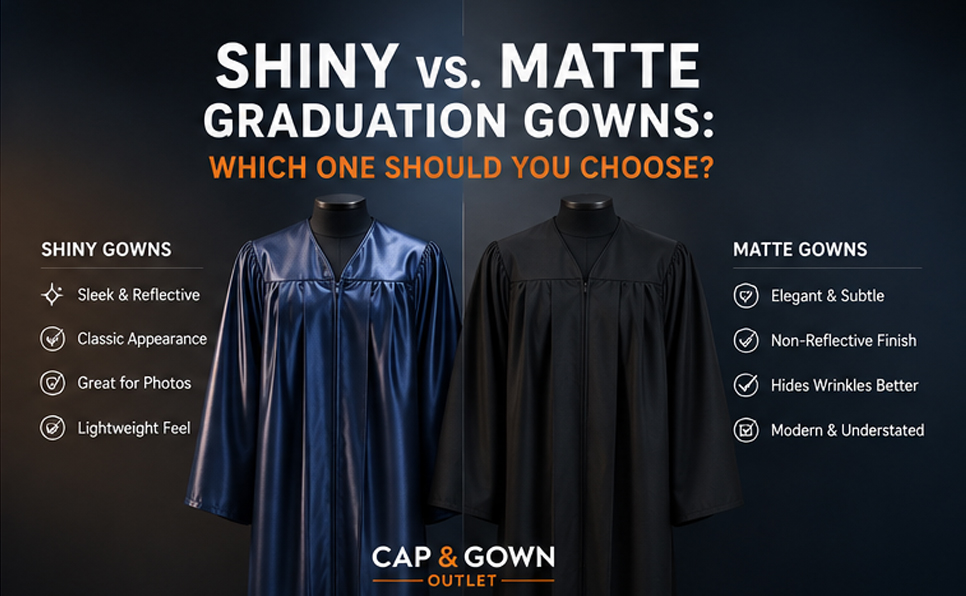
Why “Black” Does Not Always Look Like the Same Black
Different materials absorb and reflect light differently.
One black garment may appear:
- Deep matte black
- Slightly gray
- Glossy black
- Blue-black under certain lighting
If appearance matters and you are mixing pieces, compare them together before graduation.
Try the Complete Outfit Together
Do not inspect each item individually and then put everything back in storage.
Conduct a complete graduation dress rehearsal.
Wear:
- Your planned clothing
- Your master’s gown
- Your academic hood if you are expected to wear it before the ceremony
- Your authorized stole
- Your eligible cords
- Your cap
- Your tassel
Then look at the complete outfit from the front and back.
Take Photographs During Your Dress Rehearsal
Photographs can reveal issues that are difficult to notice in a mirror.
Take:
- A full-length front photo
- A full-length rear photo
- A side view
- A close view of the gown sleeves
- A close view of the hood
This is also useful if you need to ask your institution a question about your regalia.
When Reusing the Bachelor’s Gown Is Usually a Poor Assumption
You should be especially cautious when:
- The gown is clearly labeled as bachelor’s regalia
- The sleeve design differs from the required master’s gown
- Your graduate institution requires custom regalia
- The school requires a different color
- The fabric finish is different
- The old gown no longer fits
- The gown is damaged
- Your current school requires use of a designated source
When an Existing Regalia Piece May Be Worth Checking
An existing component may be worth evaluating when:
- The institution permits reuse
- It is appropriate for the current academic level
- Its specifications match
- It remains in excellent condition
- It still fits
The key word is verify.
What If You Earned Both Degrees From the Same University?
Attending the same university for both degrees does not automatically mean the same gown is used.
Bachelor’s and master’s academic dress can differ by degree level even within one institution.
Ask for the current master’s regalia specification.
What If Your Master’s Degree Is From a Different University?
Verification becomes even more important.
The new institution may have different requirements for:
- Gown design
- Color
- Fabric
- Hood
- Cap
- Tassel
- Accessories
Do not use your previous university’s regalia rules as a guide for the new institution.
What If Your Graduate Program Uses School-Specific Regalia?
Some universities use custom academic apparel rather than generic master’s regalia.
School-specific features can include special colors, trim, embroidery or gown construction.
If custom regalia is required, follow the institution’s ordering process.
Should You Alter Your Bachelor’s Gown?
Trying to modify undergraduate sleeves or other gown features is not a reliable way to create proper master’s regalia.
Alterations can also change the garment’s proportions or damage the fabric.
If your institution requires a master’s-level gown, obtaining the appropriate gown is generally the more straightforward option.
Should You Buy a Master’s Regalia Package?
A package can simplify ordering when you need several new pieces.
Depending on the seller, a master’s package may include:
- Master’s gown
- Mortarboard
- Tassel
An academic hood may or may not be included.
Always check the package contents.
When Buying Pieces Separately Makes Sense
Individual purchasing may be practical if some of your existing components are verified as acceptable.
For example, if your cap is reusable but your gown is not, you may only need the master’s gown, hood and appropriate tassel.
Compare the total delivered cost of individual pieces with a package before deciding.
Do Not Forget the Hood When Comparing Prices
A lower-priced master’s package may appear inexpensive because the academic hood is not included.
When comparing options, calculate the cost of everything you actually need:
- Gown
- Cap
- Tassel
- Academic hood
- Required accessories
- Shipping
- Applicable customization
How Early Should You Decide What to Reuse?
Do the reuse audit well before commencement.
You need enough time to:
- Confirm university requirements
- Inspect your existing regalia
- Measure yourself
- Order missing pieces
- Allow for processing
- Receive the order
- Resolve eligible size or product issues
- Practice wearing the complete outfit
Your First Graduation Event May Be Earlier Than Commencement
Remember that you may need regalia for:
- Graduation portraits
- Graduate recognition events
- Department ceremonies
- Hooding ceremonies
- Main commencement
Plan around the earliest event that requires academic dress.
The Bachelor-to-Master Regalia Audit
Use this worksheet before buying anything.
Gown
- Correct academic level? Yes / No / Verify
- Correct sleeve construction? Yes / No / Verify
- Correct color? Yes / No / Verify
- Correct fabric/finish? Yes / No / Verify
- Still fits? Yes / No
- Good condition? Yes / No
Cap
- Correct style? Yes / No / Verify
- Correct color? Yes / No / Verify
- Still fits? Yes / No
- Good condition? Yes / No
Tassel
- Correct color? Yes / No / Verify
- Correct style? Yes / No / Verify
- Current year charm if needed? Yes / No
Academic Hood
- Required? Yes / No / Verify
- Correct degree specification? Yes / No / Verify
- Correct institutional specification? Yes / No / Verify
Stoles and Cords
- Still eligible? Yes / No / Verify
- Permitted by graduate institution? Yes / No / Verify
Three Possible Outcomes
After completing the audit, you will generally fall into one of three situations.
Outcome 1: Most of Your Old Regalia Is Not Compatible
You may need a new master’s gown and other graduate-level components.
Outcome 2: Some Pieces Are Reusable
You may be able to combine verified existing items with newly purchased master’s regalia.
Outcome 3: Your Institution Requires a Specific Package
Follow the university’s instructions rather than trying to assemble an alternative set.
Buying Master’s Graduation Regalia Online
If your institution allows independently purchased regalia, compare products based on specifications rather than photographs alone.
Review:
- Degree designation
- Sleeve construction
- Color
- Fabric
- Finish
- Size chart
- Extended-size availability
- Package contents
- Hood options
- Processing time
- Shipping
- Return and exchange terms
Master’s Graduation Regalia From Cap and Gown Outlet
Cap and Gown Outlet is an independent academic regalia retailer serving individual graduates and qualifying group and institutional customers.
Depending on current product availability, graduation merchandise may include:
- Master’s graduation gowns
- Bachelor’s graduation gowns
- Graduation caps
- Graduation tassels
- Master’s academic hoods
- Graduation stoles
- Honor and recognition cords
- Diploma covers
- Graduation regalia sets
- Individual graduation accessories
Degree-level designs, sizing, colors and package contents vary by product. Students should confirm their institution’s current academic-regalia requirements before ordering or reusing previously purchased graduation apparel.
Independent Retailer Disclosure
Cap and Gown Outlet is an independent academic regalia retailer and is not affiliated with, sponsored by, endorsed by or officially authorized by any college or university unless an actual relationship has been established.
The availability of a graduation product does not mean that it is approved for a particular university, degree program or commencement ceremony.
Frequently Asked Questions About Reusing Bachelor’s Regalia for a Master’s Degree
Can I use my bachelor’s graduation gown for my master’s ceremony?
Do not assume so. Bachelor’s and master’s gowns can have different degree-level construction. Confirm whether your existing gown meets your graduate institution’s current requirements.
What is different about a master’s graduation gown?
One noticeable difference can be the sleeve construction. Other differences may include fabric, color, finish and institution-specific details.
If my bachelor’s and master’s gowns are both black, can I reuse the bachelor’s gown?
Matching color alone is not enough. The degree-level design and all other institutional specifications must also be appropriate.
Can I add a master’s hood to my bachelor’s gown?
An academic hood does not convert a bachelor-level gown into a master’s-level gown. Treat the gown and hood as separate regalia requirements.
Can I reuse my bachelor’s graduation cap?
Possibly. Verify that the style, color, fabric and other specifications meet your current institution’s requirements and make sure the cap remains in good condition.
Can I reuse my old graduation tassel?
Possibly, but master’s tassel requirements may differ. You may also need a different graduation-year charm or other configuration.
Can I reuse my bachelor’s honor cords?
Only if you remain eligible and your graduate institution permits them. Undergraduate recognition does not automatically authorize wearing the same cords at a graduate ceremony.
Do I need a hood for my master’s graduation?
Many master’s regalia traditions use academic hoods, but institutional practices vary. Check your specific commencement requirements.
Does a master’s cap and gown package include the hood?
Not always. Some packages contain the gown, cap and tassel while the hood is sold separately. Review the package contents before purchasing.
Can I use a master’s gown from another university?
Possibly only if it meets your current institution’s requirements. School-specific colors, fabrics, trim or custom designs can make another university’s gown inappropriate.
Should I buy a complete new master’s set or individual pieces?
That depends on which existing components are verified as reusable. Compare the cost and compatibility of the pieces you actually need with the contents of a complete package.
How can I tell whether my old gown is a bachelor’s or master’s gown?
Check any original product information or labels and compare the gown construction with verified degree-level specifications. Sleeve design can provide a clue, but do not rely solely on appearance.
Reuse What Fits the Requirements—not Simply What Is Still in Your Closet
Deciding whether to reuse a bachelor’s gown for master’s graduation is easier when you evaluate the outfit one component at a time.
Your old gown may still fit perfectly and look nearly new, but that does not automatically make it master’s-level academic dress. Likewise, an older cap may potentially remain useful even when the gown must be replaced.
Start with your graduate institution’s current requirements. Compare your bachelor’s gown with the required master’s design, paying particular attention to degree-level construction and sleeves. Then separately evaluate your cap, tassel, hood, stole and cords.
If an existing item satisfies the requirements, fits properly and remains in good condition, ask whether it can be reused. If it does not, replace that component with appropriate master’s regalia.
This piece-by-piece approach can help you avoid unnecessary purchases while still preparing a complete graduation outfit that meets the expectations of your master’s commencement ceremony.