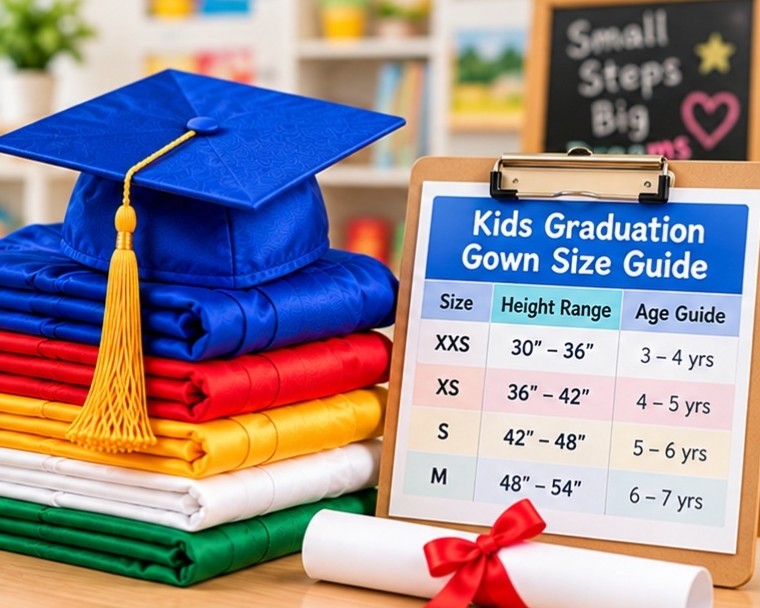
A child’s first graduation gown should look special in photographs, but appearance is only part of choosing the correct size.
A preschool or kindergarten graduate may need to walk in a procession, climb a step, sit with classmates, stand for photographs and receive a certificate while wearing the gown. A garment that is unnecessarily long, excessively loose or otherwise poorly fitted can make those simple activities harder for a young child.
That is why children’s graduation gown sizing should begin with measurements rather than age, grade or everyday clothing size.
This preschool and kindergarten graduation gown sizing guide gives parents, teachers, daycare centers and schools a practical method for selecting children’s graduation apparel and checking the fit before ceremony day.
Use the FIT-KIDS Method for Children’s Graduation Gown Sizing
Parents and schools can remember seven important sizing steps:
- F — Find the Product: Select the actual graduation gown before assigning sizes.
- I — Identify Current Measurements: Measure the child according to the product instructions.
- T — Test the Size Chart: Match the measurements to the chart for that exact gown.
- K — Keep Movement in Mind: Consider walking, sitting and ceremony activities.
- I — Inspect After Delivery: Confirm the selected size works on the actual child.
- D — Dress Rehearsal: Test the complete graduation outfit before the event.
- S — School Roster: For group orders, record every student’s measurement and assigned size.
The order of these steps matters. Selecting a size before selecting the product can create problems because children’s graduation gown size charts are not necessarily interchangeable.
F — Find the Graduation Gown Before Assigning a Size
A common school-ordering mistake is measuring students and assigning generic sizes such as small, medium and large before deciding which graduation gown will be purchased.
Instead, select the intended product first.
Then use that product’s current sizing information.
Why Graduation Gown Size Charts Can Differ
Graduation apparel manufacturers and product lines may use different:
- Size labels
- Height ranges
- Garment dimensions
- Fit categories
- Construction methods
A child assigned one size in one product should not automatically receive the same labeled size in another product.
Never Build a Universal Children’s Graduation Size Chart
A generic chart may appear convenient, but it can create inaccurate recommendations when applied to products manufactured to different specifications.
The safest reference is the size information supplied for the actual graduation gown being ordered.
I — Identify the Child’s Current Measurements
After selecting the gown, determine which measurements the product requires.
For many children’s graduation gowns, height is an important sizing factor because the garment extends down much of the body.
Some products may provide additional fit guidance.
Follow the instructions associated with the selected gown.
How to Measure a Child’s Height for a Graduation Gown
If the product calls for height, use a simple and consistent measuring process.
- Choose a flat floor and straight wall.
- Have the child stand naturally upright.
- Keep the child’s head in a normal forward-looking position.
- Follow the manufacturer’s instructions regarding shoes.
- Measure from the floor to the top of the head.
- Record the measurement immediately.
For school group orders, using the same method for every child improves consistency.
Why Current Height Matters
Preschool and kindergarten children can grow noticeably during a school year.
A measurement taken many months earlier may no longer accurately represent the child when graduation approaches.
Use a reasonably current measurement while still leaving sufficient time for ordering, delivery and fitting.
Should Parents Measure With or Without Shoes?
Follow the instructions for the specific graduation gown.
If the product says to measure without shoes, do so. If it provides a different method, follow that method.
The goal is to match the way the supplier constructed its size chart.
Why Guessing a Child’s Height Can Cause Problems
Adults who see a child every day may believe they know approximately how tall the child is.
But even a relatively small difference can matter when the child is close to the boundary between two gown sizes.
Measuring takes only a short time and provides better information than estimating.
T — Test the Measurement Against the Correct Size Chart
Once you have the child’s measurement, compare it directly with the product’s sizing information.
Do not convert it into another brand’s size first.
Do not substitute a chart found elsewhere online.
Use the chart associated with the gown you intend to order.
Age Is Not a Graduation Gown Size
Parents frequently search for phrases such as:
- Graduation gown for a 4-year-old
- Graduation gown for a 5-year-old
- Graduation gown for a 6-year-old
These searches are useful for finding children’s graduation apparel, but age should not automatically determine the final size.
Children of the same age can have substantially different heights and builds.
Graduation Gown Size for a 4-Year-Old
A four-year-old preschool graduate should be measured according to the selected product’s instructions.
There is no single gown size that is correct for every four-year-old.
Graduation Gown Size for a 5-Year-Old
Five-year-old children may fall into different size ranges even when they are in the same classroom.
Use the child’s current measurements rather than assuming a standard kindergarten size.
Graduation Gown Size for a 6-Year-Old
The same principle applies to six-year-olds.
Measure first and then use the graduation gown’s product-specific chart.
Why 4T or 5T Does Not Tell You the Graduation Gown Size
Parents are accustomed to buying children’s clothing by sizes such as 4T, 5T or 6.
Graduation gowns are different garments with different proportions and sizing systems.
A regular clothing label should not automatically be converted into a graduation gown size.
What If a Child Is Near the Edge of a Size Range?
When a measurement falls close to the boundary between two available sizes, review the supplier’s sizing instructions carefully.
Consider:
- The exact measurement
- The child’s build
- The product’s intended fit
- The time remaining before graduation
- Any manufacturer guidance for measurements between sizes
A universal “always size up” rule can create an unnecessarily long gown.
Should Parents Buy a Larger Gown So the Child Can Grow Into It?
That depends on the product specifications, the child’s current measurement and how far away the ceremony is.
Graduation apparel is different from buying an oversized winter coat for future use.
The child needs the gown to fit appropriately on one specific ceremony date.
Buying substantially larger than necessary may create excessive fabric and length.
Consider Growth Without Overestimating It
If graduation is still some time away, consider when to measure and when the order must be placed.
Schools can work backward from their required arrival date rather than measuring students extremely early simply for administrative convenience.
K — Keep Movement in Mind
A graduation gown is not worn while standing still for the entire event.
A child may need to:
- Walk into the ceremony
- Sit in a chair
- Stand when called
- Walk toward a teacher
- Step onto a stage
- Receive a certificate
- Turn for a photograph
- Return to a seat
The correct fit should support these activities.
How Long Should a Preschool Graduation Gown Be?
There is no universal hem measurement that applies to every children’s graduation gown.
Different products are constructed differently.
Use the manufacturer’s sizing guidance and then verify that the actual garment allows comfortable movement.
A Simple Gown-Length Test
After the gown arrives, have the child walk several normal steps.
Watch the feet and hem.
If the child repeatedly catches the gown under a shoe or has to hold the gown up simply to walk normally, review the fit.
Check the Gown While the Child Is Sitting
A gown can appear correct while the child is standing but become uncomfortable when seated.
Have the child sit in a chair similar to those that may be used at the ceremony.
Make sure the garment does not unnecessarily restrict normal movement.
Check the Sleeves
Ask the child to:
- Raise both arms
- Bend the elbows
- Hold a certificate
- Reach forward naturally
The child should be able to move comfortably.
Check Body Room
Graduation gowns generally have a loose ceremonial silhouette, but the child still needs adequate room through the body.
If the selected product provides additional fit options, review them when needed.
Do Not Solve a Width Problem by Creating a Length Problem
Ordering a gown intended for a significantly taller child solely to obtain additional width can result in excessive length.
Check whether the product offers another suitable fit option or consult the supplier’s sizing information.
Consider What the Child Will Wear Underneath
A fitting should account for reasonable ceremony clothing.
Depending on the event, children may wear:
- A shirt and pants
- A dress
- A school outfit
- Other comfortable clothing appropriate to the ceremony
Avoid testing the gown over unusually bulky clothing unless similar clothing will actually be worn during graduation.
Warm-Weather Ceremonies Need Special Attention
A graduation gown adds another layer of fabric.
For late-spring or early-summer ceremonies, parents and schools should consider comfort as well as appearance.
The outfit underneath the gown should be appropriate for the ceremony environment and school expectations.
I — Inspect the Graduation Gown After Delivery
Online sizing does not end when the order is placed.
The actual garment needs to be checked after it arrives.
Do Not Leave the Graduation Set Unopened
Parents should open the package with enough time before graduation to confirm:
- Correct product
- Correct size
- Correct color
- Expected package contents
- Acceptable condition
Schools should perform the same check for group shipments.
Use a Five-Movement Fit Test
Have the young graduate perform five simple movements while wearing the gown.
Movement 1: Walk
Can the child walk naturally without repeatedly stepping on the gown?
Movement 2: Sit
Can the child sit comfortably?
Movement 3: Stand
Can the child rise from the chair without becoming tangled in the garment?
Movement 4: Reach
Can the child extend the arms to receive a certificate?
Movement 5: Turn
Can the child turn naturally for photographs or to return to a seat?
If the gown performs well through these movements, the fit is much more likely to work during the ceremony.
Check the Graduation Cap at the Same Time
Even though gown sizing is the primary focus, the cap should be tested during the same fitting.
Check that:
- The cap is reasonably comfortable
- The child’s vision is not obstructed
- The tassel can be positioned away from the eyes
- The child can walk normally while wearing it
Do Not Use Unsafe Improvised Fasteners
Young children’s graduation apparel should be handled with age-appropriate safety in mind.
Parents and schools should be cautious about sharp pins, unsecured small items or other improvised methods that could create an unnecessary hazard.
D — Conduct a Dress Rehearsal
A fitting determines whether the gown fits.
A rehearsal determines whether it works during the actual graduation activities.
These are not exactly the same thing.
Why a Rehearsal Is Valuable for Young Graduates
Preschool and kindergarten children may have never worn a long ceremonial garment or mortarboard before.
A rehearsal makes the outfit familiar.
Students can practice:
- Putting on the gown
- Wearing the cap
- Walking in line
- Sitting with the gown
- Standing when called
- Walking to the presentation area
- Receiving a certificate
- Returning to their seat
Practice Stairs When the Ceremony Uses Them
If children must climb stage steps, test the route during rehearsal when practical.
Watch whether the gown interferes with the child’s feet.
Practice on the Actual Surface When Possible
A gown that works perfectly on a classroom floor may behave differently on grass or an uneven outdoor surface.
Outdoor ceremonies require additional consideration of:
- Gown length
- Footwear
- Grass
- Wind
- Temperature
S — Build a School Graduation Size Roster
For schools, daycare centers and early-learning programs, individual sizing information should become part of an organized group-order system.
Do not simply ask teachers to submit a total number of gowns.
Record the measurement and selected size for each graduate.
Sample Preschool and Kindergarten Gown Sizing Worksheet
| Student | Classroom | Measured Height | Assigned Size | Fit Checked |
|---|---|---|---|---|
| Student 1 | ________ | ________ | ________ | Yes / No |
| Student 2 | ________ | ________ | ________ | Yes / No |
| Student 3 | ________ | ________ | ________ | Yes / No |
| Student 4 | ________ | ________ | ________ | Yes / No |
Why Schools Should Record Both Height and Selected Size
If the roster contains only the assigned size, staff cannot easily review how that decision was made.
Keeping the original measurement makes it easier to:
- Verify borderline sizing decisions
- Review potential data-entry mistakes
- Recheck a student’s size before ordering
- Update a measurement when necessary
Convert the Roster Into a Purchase Quantity
After assigning every student a size, count the number needed in each size.
| Selected Gown Size | Number Required |
|---|---|
| ________ | ________ |
| ________ | ________ |
| ________ | ________ |
| ________ | ________ |
| Total | ________ |
The final total should equal the number of participating students for whom the school is purchasing regalia.
Do Not Estimate the Size Mix for a Large Class
Imagine a school has 75 kindergarten graduates.
Guessing that one-third will need one size, one-third another and the rest a third size may be administratively convenient, but it does not reflect the actual students.
Measure the children first and allow the roster to determine the order quantities.
Use One Product and One Size Chart Across the Group
If the school wants coordinated graduation gowns, using the same selected product for the class can simplify sizing and appearance.
Allowing different classrooms to independently choose products can introduce:
- Different size systems
- Different gown lengths
- Different fabric finishes
- Different shades
- Different package contents
Assign One Person to Consolidate Multiple Classroom Rosters
For a larger preschool or elementary program, individual teachers can collect measurements while one graduation coordinator combines the results.
The coordinator can verify:
- No student is listed twice
- No graduate is missing
- All classrooms used the same sizing chart
- The size totals equal the participant count
Have a Second Person Review Large Orders
A simple second review can catch mistakes before a bulk graduation order is submitted.
Check the numbers against the original student roster rather than only reviewing the final totals.
When Should a School Measure Kindergarten Students?
The best timing depends on the school’s calendar and the supplier’s current ordering timeline.
Work backward from the date when the school needs the gowns in hand.
Remember to leave time for:
- Order processing
- Shipping
- Shipment inspection
- Sorting
- Student fitting
- Rehearsal
- Permitted corrections if necessary
The Ceremony Date Is Not the Only Deadline
If graduation takes place on June 20 but the dress rehearsal occurs on June 10, the gowns need to arrive before the rehearsal.
Build the purchasing timeline around the school’s actual operational deadline.
What If a Child Grows After the School Measures Them?
Small changes may not necessarily affect the selected size, depending on the product’s size range and the child’s original measurement.
If a child was already near a size boundary or has experienced noticeable growth, remeasure before the final order when timing allows.
Should Schools Automatically Order Extra Gowns?
There is no universal backup quantity appropriate for every school.
Consider:
- Enrollment changes
- Likelihood of late additions
- Available budget
- Supplier policies
- Whether the school will reuse gowns
- Current size distribution
Backup inventory can be useful in some circumstances, but it should not replace accurate measurement and planning.
How to Organize Gowns After the School Order Arrives
Open and inspect the shipment promptly.
Then:
- Count the total number of gowns.
- Separate them by size.
- Compare quantities with the order.
- Match each student to the assigned size.
- Create individual graduation packages.
- Label each package with the student’s name or other school-approved identifier.
- Conduct fittings.
Do Not Let Students Select Random Gowns From a Box
When a school has already measured every student, distributing gowns randomly defeats much of the purpose of creating the sizing roster.
Match each student to the assigned size first.
Top 12 Graduation Gown Sizing Mistakes to Avoid
- Ordering by age instead of measurements.
- Using regular clothing size as the graduation gown size.
- Guessing the child’s height.
- Using an outdated measurement.
- Using another manufacturer’s size chart.
- Selecting a size before selecting the gown product.
- Automatically sizing up whenever a child is between sizes.
- Choosing a much taller gown only to gain body room.
- Ignoring sleeve movement.
- Never having the child try on the gown.
- Guessing the size distribution for a class.
- Waiting until graduation day to discover a fit problem.
Parent’s Quick Graduation Gown Fit Checklist
- Correct product
- Current child measurement
- Correct product-specific size chart
- Appropriate gown length
- Adequate body room
- Comfortable sleeves
- Normal walking ability
- Comfortable sitting
- Secure, comfortable cap
- Clear vision
- Tassel positioned away from eyes
- Complete outfit tested before graduation
School’s Bulk Sizing Checklist
- Select the exact gown product first.
- Obtain the current size chart.
- Finalize participating student roster.
- Use one measurement procedure.
- Measure every student.
- Record actual measurements.
- Assign sizes using the selected product chart.
- Review students near size boundaries.
- Create quantity totals by size.
- Confirm total quantity against student count.
- Review the order before submission.
- Inspect the shipment after delivery.
- Match gowns to students.
- Conduct fittings.
- Conduct a dress rehearsal.
Buying Children’s Graduation Gowns Online
Parents shopping online should examine the sizing information before becoming focused on color, photographs or price.
A useful children’s graduation gown listing should provide enough information to understand how the product is sized.
Before ordering, review:
- Available size range
- Measurement instructions
- Gown color
- Package contents
- Product specifications
- Processing information
- Shipping options
- Return or exchange conditions
Bulk Graduation Gown Sizing for Preschools and Schools
Schools ordering larger quantities should prepare their sizing information before requesting pricing or placing an order.
A useful group-order summary includes:
- Total number of graduates
- Quantity by gown size
- Gown color
- Cap requirements
- Tassel requirements
- Optional accessories
- Required arrival date
- Delivery destination
Graduation Apparel for Daycare and Early-Learning Programs
Daycare centers, nursery schools, Pre-K programs and early-learning organizations can use the same sizing process.
Young children should be measured individually, even when the group is relatively small.
A class of 15 preschool graduates can still contain several different heights and builds.
Public School and Institutional Graduation Orders
Public schools and other educational institutions may purchase children’s graduation apparel when appropriate for their programs.
Institutional buyers should prepare accurate size quantities, product specifications and delivery requirements before purchasing.
Public-sector purchasers should follow applicable procurement procedures, funding requirements, purchasing authority and internal approvals.
Commercial availability of a graduation product does not establish government endorsement, approved-vendor status or contract status.
Children’s Graduation Regalia From Cap and Gown Outlet
Cap and Gown Outlet is an independent graduation apparel supplier serving individual customers, schools and qualifying group and institutional buyers.
Depending on current inventory and product availability, graduation categories may include:
- Preschool graduation caps and gowns
- Pre-K graduation apparel
- Kindergarten graduation caps and gowns
- Children’s graduation gowns
- Graduation caps
- Graduation tassels
- Graduation stoles
- Honor and recognition cords
- Diploma and certificate covers
- Elementary and middle school graduation products
- High school graduation regalia
- College and university academic regalia
Sizes, colors, package configurations, inventory, pricing, processing and shipping options vary by product.
Parents should use the sizing information for the specific product they are considering. Schools can prepare a student-by-student measurement roster before placing larger orders.
Independent Supplier Disclosure
Cap and Gown Outlet is an independent graduation apparel supplier and is not affiliated with, sponsored by, endorsed by or officially authorized by any preschool, daycare center, kindergarten, school, school district, government agency or educational institution unless an actual relationship exists.
Individual schools and programs determine their own graduation attire, ceremony and purchasing requirements.
Frequently Asked Questions About Children’s Graduation Gown Sizing
How do I measure my child for a graduation gown?
Follow the instructions provided for the specific gown. When height is required, have the child stand upright on a level surface, measure current height according to the product instructions and compare it with the product’s size chart.
What size graduation gown should a preschool child wear?
There is no universal preschool gown size. Use the child’s measurements and the size chart for the exact product being purchased.
What size graduation gown should a kindergarten child wear?
The correct size depends on the child’s current measurements and the selected gown’s sizing system.
What size graduation gown does a four-year-old wear?
Four-year-old children vary in height and build. Measure the child rather than selecting a gown based only on age.
What size graduation gown does a five-year-old wear?
There is no single size for every five-year-old. Compare the child’s current measurements with the product-specific chart.
What size graduation gown does a six-year-old wear?
Use current measurements and the sizing instructions for the selected gown rather than age alone.
Is a 5T graduation gown the same as 5T children’s clothing?
Do not assume that graduation apparel and everyday clothing use equivalent sizing systems. Follow the gown’s own size chart.
Should I size up if my child is between sizes?
Follow the manufacturer’s guidance for measurements near a size boundary. Automatically choosing the larger size is not always appropriate because it may create excessive length.
Should I buy a larger gown because my child is growing?
Consider the child’s current measurement, time remaining until graduation and the product’s sizing recommendations. Avoid unnecessarily oversizing the garment.
How long should a preschool graduation gown be?
Intended length varies by product. Follow the manufacturer’s sizing guidance and make sure the child can walk without repeatedly stepping on the gown.
Should a kindergarten graduation gown reach the floor?
Do not rely on a universal floor-length rule. Use the product’s intended fit and make comfortable movement a priority.
What if the graduation gown is too long?
Recheck the product size against the child’s measurement and review the seller’s applicable return or exchange options before attempting alterations.
What if my child needs extra room through the gown?
Review available fit options for the selected product. Avoid automatically choosing a substantially taller size solely to gain width.
Do boys and girls use different graduation gown sizes?
Sizing should be based on the individual child’s measurements and the selected product’s sizing system rather than gender.
Should my child wear the graduation outfit before ceremony day?
Yes. A fitting helps confirm gown length, body room, sleeve movement, cap comfort and the child’s ability to walk and sit normally.
How should schools determine kindergarten graduation gown sizes?
Schools can measure each student using one standardized method, record the measurements, assign sizes using the selected gown’s chart and then total the required quantities by size.
Can a school estimate how many gowns it needs in each size?
Individual student measurements provide a more reliable basis for the size distribution than estimating the mix.
Should schools measure students again before ordering?
If the original measurements were taken far in advance or a student was close to a size boundary, an updated measurement may be useful before the final order when timing permits.
Can daycare centers order several children’s gown sizes together?
Multiple sizes may be available depending on the selected product and supplier. Prepare a quantity-by-size breakdown before ordering.
Can schools purchase children’s graduation gowns in bulk?
Group quantities may be available depending on product inventory and supplier terms. An accurate student sizing roster can simplify a larger order.
The Right Size Starts Before Checkout
The most important graduation gown sizing decision happens before the order is placed.
First, select the actual gown so you know which sizing system applies.
Second, measure the child instead of relying on age or everyday clothing size.
Third, match the measurement to the product-specific size chart.
Then confirm the decision after delivery by having the child walk, sit, stand and move in the gown.
For schools, repeat that process for every graduate and use the resulting roster to determine the exact quantity needed in each size.
A preschool or kindergarten graduation gown does not need to fit like tailored clothing. It simply needs to provide the intended graduation appearance while allowing a young child to participate comfortably.
When parents and schools find the product, identify the measurements, test the size chart, keep movement in mind, inspect the garment, conduct a dress rehearsal and organize the school roster, graduation gown sizing becomes far more manageable—and the children can concentrate on enjoying their big day.