For professors, commencement is different from attending graduation as a student.
A faculty member may spend several hours in academic dress, walk in a formal procession, sit on stage, present awards, hood doctoral candidates, represent an academic department or participate in multiple ceremonies during the same commencement weekend.
That means choosing faculty regalia involves more than finding a gown that looks appropriate.
The complete ensemble should accurately represent the academic credential being worn, satisfy the host institution’s ceremony requirements, fit comfortably and function well during the faculty member’s commencement responsibilities.
This faculty commencement regalia guide organizes the selection process into five practical areas:
- Credential accuracy
- Ceremony compatibility
- Complete academic ensemble
- Comfort and performance
- Long-term faculty use
Using these five areas can make it easier to choose an academic gown, hood, tam or mortarboard, tassel and related commencement attire without relying on guesswork.
Part 1: Credential Accuracy
The first purpose of academic regalia is not to identify a professor’s job title.
Academic dress traditionally relates to academic credentials and institutional traditions.
Before shopping, determine exactly which credential you intend to represent.
Create Your Academic Credential Profile
Write down:
- Exact earned degree
- Degree level
- Degree-granting institution
- Academic field or discipline when relevant
- Year of degree, if useful for institutional research
This becomes the foundation for choosing the rest of the ensemble.
Do Not Shop According to Faculty Job Title
Professor, associate professor, assistant professor, lecturer and instructor are employment or academic titles.
They are not separate academic-regalia degree levels.
Similarly, becoming a department chair does not automatically require a different degree-level gown.
A faculty member should therefore avoid shopping for academic dress according to perceived seniority.
Highest Degree vs. Degree Being Represented
Faculty members often have several degrees.
A professor might have:
- Bachelor’s degree from one institution
- Master’s degree from another institution
- Doctorate from a third institution
Determine which credential will be represented during the ceremony rather than attempting to combine elements from several degrees.
What If You Have More Than One Doctorate?
Some faculty members have multiple doctoral or professional degrees.
In that situation, do not assume that the academic dress for one degree is automatically appropriate for another.
Determine which credential you intend to represent and verify the relevant academic-dress specifications.
Part 2: Ceremony Compatibility
Once the credential is clear, determine what the host institution expects from participating faculty.
This is important because general academic-dress conventions do not override an institution’s own commencement procedures.
Look for a Faculty Commencement Guide
The university may provide information concerning:
- Faculty procession
- Required academic dress
- Rental arrangements
- Personally owned regalia
- Faculty arrival time
- Robing location
- Academic headwear
- Hooding responsibilities
- Platform-party procedures
- Permitted ceremonial accessories
Ask the Right Question Before Buying
Instead of asking:
“What do professors normally wear?”
Ask:
“What academic dress is appropriate for the credential I am representing at this particular ceremony?”
That question is much more useful.
Standard Regalia vs. Institution-Specific Regalia
Many faculty members wear traditional academic dress. Others wear distinctive regalia associated with the institution that granted their degree.
Institution-specific doctoral gowns can include:
- Distinctive gown colors
- Contrasting front panels
- Colored velvet or velvet-like trim
- Piping
- Embroidery
- Special sleeve treatments
- Distinctive academic headwear
Determine whether such regalia is required, permitted or simply optional before investing in a custom ensemble.
Part 3: Build the Complete Faculty Academic Ensemble
Once the credential and ceremony requirements have been established, assemble the outfit component by component.
A faculty academic ensemble can include:
- Academic gown
- Academic hood when appropriate
- Mortarboard, tam or other academic headwear
- Tassel
- Authorized ceremonial accessories
Each component should be considered separately.
Choosing a Faculty Gown
The appropriate gown generally begins with degree level.
Bachelor’s-Level Academic Dress
Bachelor’s gowns generally have simpler construction and recognizable bachelor-style sleeves.
A faculty member representing a bachelor’s credential should not automatically select a master’s or doctoral gown because it appears more elaborate.
Master’s-Level Academic Dress
Master’s gowns use distinctive sleeve construction that separates them visually from bachelor’s and doctoral gowns.
When shopping online, verify that the gown is actually identified as master’s-level academic dress.
Doctoral-Level Academic Dress
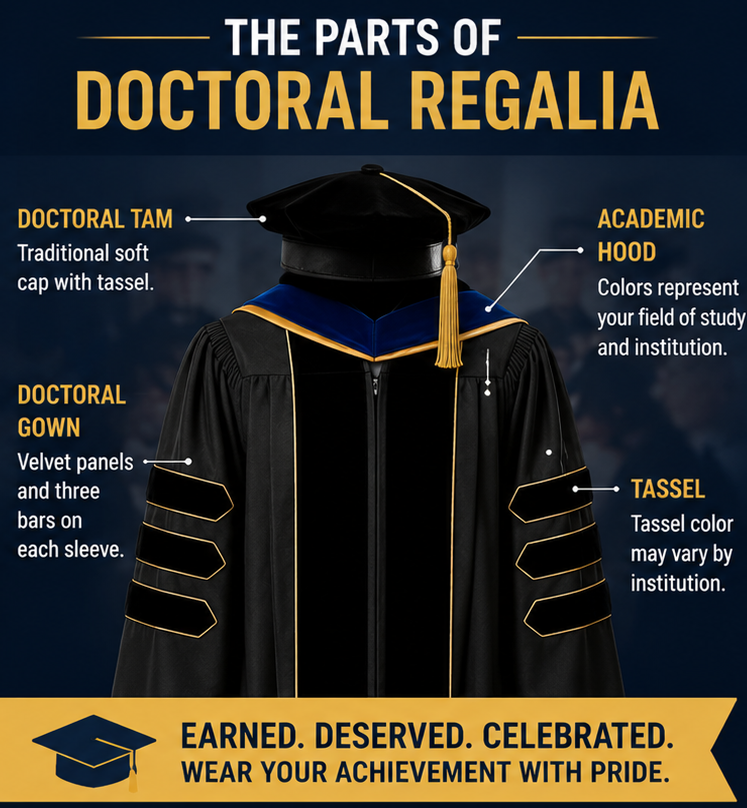
Traditional doctoral gowns commonly include:
- Full doctoral sleeves
- Velvet or velvet-like front facings
- Three velvet or velvet-like bars on each sleeve
Custom institutional designs may vary from this traditional appearance.
Do Faculty Need a Special “Professor Gown”?
Not necessarily.
The term “faculty gown” is sometimes used as a retail or institutional category, but faculty is not itself an academic degree level.
If a product is marketed as a professor or faculty gown, examine the specifications to determine whether it is actually:
- Bachelor’s-level
- Master’s-level
- Doctoral-level
- Custom institutional academic dress
Choosing the Academic Hood
The academic hood can be one of the most detailed parts of faculty regalia.
Do not choose it simply because the colors look attractive with the gown.
Verify:
- Correct degree level
- Degree-granting institution
- Institutional lining
- Correct arrangement of lining colors
- Applicable field or discipline specification
Why the Degree-Granting Institution Matters
A professor may teach at University A after earning a doctorate from University B.
Under traditional U.S. academic-dress conventions, the hood lining can represent the institution that granted the degree being represented.
Therefore, matching the hood to the professor’s current employer is not automatically correct.
Do Not Copy University Branding Colors From a Website
A university’s marketing colors and its traditional academic-hood configuration are not necessarily interchangeable.
An institution may use:
- One lining color
- Two colors
- One chevron
- Multiple chevrons
- A specific arrangement
Verify the academic-dress specification rather than recreating a hood from a university logo or athletics page.
Traditional Hood Edging Colors
Traditional U.S. academic-dress conventions associate certain colors with fields of learning.
Frequently referenced examples include:
- Arts, Letters and Humanities: White
- Business, Commerce and Accountancy: Drab
- Education: Light Blue
- Engineering: Orange
- Fine Arts: Brown
- Law: Purple
- Library Science: Lemon
- Medicine: Green
- Music: Pink
- Nursing: Apricot
- Philosophy: Dark Blue
- Physical Education: Sage Green
- Public Administration: Peacock Blue
- Public Health: Salmon Pink
- Science: Golden Yellow
- Social Science: Citron
- Theology and Divinity: Scarlet
This list is an educational reference rather than a universal ordering guide.
Academic programs and institutional practices vary. Verify the correct specification associated with the actual degree before ordering a hood.
Special Attention for PhD Faculty
PhD stands for Doctor of Philosophy, but faculty members should not reduce the entire hood selection process to choosing dark blue.
A doctoral hood can involve multiple specifications, including degree-level construction and institutional lining.
Verify the complete hood rather than focusing on one color.
Professional Doctorates Need Verification Too
Not every doctoral faculty member holds a PhD.
Faculty can hold a variety of doctoral and professional degrees.
The correct academic dress should be based on the actual credential and institutional specifications rather than the general fact that the degree is doctoral.
Choosing Faculty Headwear
Academic headwear should coordinate with the appropriate degree-level tradition and host institution’s expectations.
Possible options include:
- Mortarboard
- Four-sided tam
- Six-sided tam
- Eight-sided tam
- Institution-specific academic cap
Doctoral Tam or Mortarboard?
A velvet or velvet-like tam is commonly associated with doctoral academic dress, but it is not the only academic headwear used by doctoral faculty.
Some traditions use a mortarboard or another academic cap.
Verify before purchasing.
Does an Eight-Sided Tam Mean a Higher-Ranking Professor?
No automatic relationship should be assumed between the number of tam sides and:
- Assistant professor status
- Associate professor status
- Full professor status
- Tenure
- Years of service
- Academic prestige
The number of sides describes the tam’s construction or style.
Choose Headwear for Comfort as Well as Appearance
Faculty members may wear academic headwear much longer than a graduate posing for photographs.
Check:
- Head measurement
- Manufacturer sizing method
- Stability
- Comfort
- Tassel attachment
A tam that looks excellent but constantly shifts during a three-hour ceremony can become distracting.
Choosing the Tassel
Do not assume that every academic cap includes a tassel.
Verify:
- Whether one is included
- Appropriate color
- Material
- Attachment method
- Institutional expectations
Gold-colored tassels are commonly seen with doctoral academic dress, but practices can vary.
Part 4: Comfort and Ceremony Performance
A faculty ensemble can be academically correct and still be uncomfortable or impractical.
Professors should evaluate regalia according to what they will actually do during commencement.
What Is Your Faculty Ceremony Role?
Before selecting the final ensemble, identify your responsibilities.
You may be:
- Walking only in the faculty procession
- Sitting with an academic department
- Sitting on the platform
- Presenting graduates
- Reading names
- Hooding doctoral candidates
- Presenting awards
- Serving as a faculty marshal
Different roles can place different demands on the gown and accessories.
The Faculty Procession Test
Faculty often walk farther than expected before reaching their seats.
When trying on a gown, walk for several minutes rather than simply standing in front of a mirror.
Check:
- Hem clearance
- Shoulder comfort
- Sleeve movement
- Hood stability
- Headwear stability
The Faculty Seating Test
Commencement can involve extended periods of sitting.
Sit in the complete ensemble and determine whether:
- The gown pulls across the shoulders
- The hood becomes uncomfortable
- The sleeves interfere with the chair
- The tam remains comfortable
- The gown can be adjusted easily when standing again
The Doctoral Hooding Test
Faculty hooders need additional arm mobility.
Put on the complete ensemble and simulate raising a hood over a graduate.
Make sure:
- Your arms can rise comfortably
- Your sleeves do not restrict movement
- Your own hood remains secure
- Your academic cap remains stable
The Stage Test
Faculty may need to climb stairs, cross a stage or stand for extended periods.
Wear the same type of shoes you plan to use at commencement while testing gown length.
Academic dress should not create an avoidable tripping hazard.
Indoor vs. Outdoor Commencement
The same academic requirements can feel very different depending on the venue.
Indoor Ceremony Considerations
- Long periods of sitting
- Stage lighting
- Crowded seating
- Temperature inside the venue
Outdoor Ceremony Considerations
- Heat
- Humidity
- Wind
- Sun
- Long processional routes
- Uneven walking surfaces
When several academically appropriate fabric or headwear choices are available, venue conditions may help determine which is more practical.
Choosing Faculty Regalia Fabric
Compare gown materials according to:
- Weight
- Breathability
- Drape
- Wrinkle resistance
- Durability
- Care instructions
Do not assume heavier automatically means better or lighter automatically means lower quality.
The right choice depends on the product, ceremony environment and expected frequency of use.
Choosing the Correct Gown Size
Use the size chart provided for the specific gown.
Depending on the manufacturer, sizing may involve:
- Height
- Chest measurement
- Weight range
- Other measurements
Do not automatically reorder the same size you wore at your own graduation many years ago.
Measure With Commencement Clothing in Mind
Faculty may wear professional clothing underneath the gown.
A jacket or other layered clothing can affect the fit across the shoulders and chest.
Consider the clothing you expect to wear when evaluating gown size.
Part 5: Plan for Repeated Faculty Use
Faculty academic regalia may be worn repeatedly for many years.
This changes how professors should evaluate value.
Think in Ceremonies, Not Just Purchase Price
A professor may use academic dress at:
- Spring commencement
- Winter commencement
- Convocation
- Doctoral hooding
- Academic installations
- Special university ceremonies
- Commencement at another institution
Consider the expected lifetime use of the ensemble rather than evaluating it only for the next event.
Buying vs. Renting Faculty Academic Regalia
Neither approach is universally preferable.
Consider Renting When:
- You participate infrequently
- Your university manages the rental process
- You need a highly specialized ensemble for one ceremony
- You do not want to store academic apparel
Consider Buying When:
- You participate annually
- You attend several academic ceremonies
- You regularly participate in doctoral hooding
- You want consistent fit
- You need regalia available on short notice
- You participate at multiple institutions
Use a Cost-Per-Wear Estimate
Faculty considering ownership can estimate:
Total purchase cost ÷ expected number of ceremonies = estimated purchase cost per wear.
This is a planning calculation rather than a guarantee of savings, but it can make purchase and rental costs easier to compare.
Build a Permanent Faculty Regalia Kit
Professors who own academic dress can keep the complete ensemble together.
A faculty regalia kit may contain:
- Gown
- Academic hood
- Tam or mortarboard
- Tassel
- Authorized accessories
- Garment bag
- Regalia specification sheet
Keep a Written Regalia Record
Store a written record with the garments that includes:
- Degree represented
- Degree-granting institution
- Gown style
- Gown size
- Hood specification
- Hood lining
- Hood edging
- Headwear style
- Headwear size
- Tassel specification
This information can be useful if one component needs replacement several years later.
Inspect Regalia Before Every Commencement Season
Do not assume stored regalia is ready simply because it was in good condition last year.
Several weeks before commencement, inspect for:
- Loose stitching
- Damaged closures
- Wrinkling
- Damaged trim
- Missing tassel
- Crushed or misshapen headwear
- Hood damage
- Changes in gown fit
Complete Faculty Commencement Readiness Check
Credential Check
- Degree identified
- Degree level confirmed
- Degree-granting institution confirmed
- Academic field verified when needed
Ceremony Check
- Host institution instructions reviewed
- Faculty role confirmed
- Academic-dress requirements confirmed
- Permitted accessories confirmed
Regalia Check
- Correct gown
- Correct gown size
- Correct academic hood
- Correct hood lining
- Correct hood edging
- Appropriate academic headwear
- Correct headwear size
- Appropriate tassel
Performance Check
- Walk comfortably
- Sit comfortably
- Stand comfortably
- Raise arms comfortably
- Use stairs safely
- Headwear remains secure
- Hood remains positioned correctly
Final Preparation Check
- Regalia inspected
- Wrinkles addressed according to care instructions
- All components packed together
- Commencement clothing selected
- Shoes tested with gown length
- Ceremony instructions packed
Academic Regalia for Faculty From Cap and Gown Outlet
Cap and Gown Outlet is an independent academic regalia retailer serving graduates, professors, faculty members and qualifying group and institutional customers.
Depending on current inventory and available configurations, academic-regalia selections may include:
- Doctoral gowns
- Doctoral academic hoods
- Doctoral tams
- Master’s gowns
- Master’s academic hoods
- Bachelor’s gowns
- Mortarboards
- Academic tassels
- Faculty academic regalia packages
- Graduation stoles
- Honor and recognition cords
- Diploma covers
Products can vary by fabric, construction, sizing, color, hood configuration, headwear and package contents.
Faculty members purchasing academic regalia independently should verify the specifications associated with the degree being represented and the current requirements of the institution hosting the ceremony.
Independent Retailer Disclosure
Cap and Gown Outlet is an independent academic regalia retailer and is not affiliated with, sponsored by, endorsed by or officially authorized by any college or university unless an actual relationship has been established.
The availability of a faculty gown, doctoral gown, academic hood, tam, mortarboard, tassel or academic-regalia package does not establish that the product is approved for a particular institution, degree or commencement ceremony.
Frequently Asked Questions About Faculty Commencement Regalia
How do professors know which academic regalia to wear?
Begin with the academic credential being represented and the host institution’s current commencement requirements. Then identify the appropriate gown, hood, headwear and tassel.
Does faculty rank determine the gown?
Not automatically. Assistant professor, associate professor and professor are faculty ranks rather than academic-regalia degree levels.
Does every professor need doctoral regalia?
No. Faculty members can represent different earned degree levels.
Can faculty wear master’s academic regalia?
Yes, when master’s-level academic dress appropriately represents the credential and complies with the institution’s requirements.
Can faculty wear regalia from the university where they earned their degree?
Potentially. Many faculty members wear academic dress associated with an earned degree, subject to the host institution’s ceremony requirements.
Should a professor’s hood match the university where the professor currently works?
Not automatically. Under traditional U.S. academic-dress conventions, hood lining can represent the degree-granting institution.
What if a professor has several graduate degrees?
Determine which credential is being represented and use the appropriate academic-dress specification rather than combining unrelated components from multiple degrees.
Does every doctoral professor wear a tam?
No universal rule requires identical doctoral headwear. Tams are common, but mortarboards and institution-specific academic caps are also used.
Does an eight-sided tam mean full professor?
No automatic relationship should be assumed between the number of tam sides and faculty rank, tenure or seniority.
Can faculty wear honor cords and stoles?
Faculty should follow the host institution’s policy regarding ceremonial accessories rather than assuming student recognition items are appropriate.
What should faculty wear underneath academic regalia?
Professional clothing appropriate for the ceremony is generally practical, but the host institution’s dress expectations should be followed. Consider gown fit, weather and comfort when selecting clothing underneath.
Should professors buy or rent academic regalia?
Frequent participants may find ownership convenient, while occasional participants may prefer an appropriate rental. Frequency of use, institutional requirements, cost, storage and convenience should all be considered.
Can faculty reuse the same regalia for many years?
Potentially. Academic regalia can be reused when it remains appropriate for the credential and ceremony, fits properly and stays in suitable condition.
When should faculty check their regalia before commencement?
Inspect it well before the ceremony so there is time to address missing pieces, fit problems or damage.
What is the best way to choose faculty commencement regalia?
Use a five-part approach: verify the credential, confirm ceremony requirements, assemble the correct academic ensemble, test it for comfort and movement, and plan for future use if you expect to participate regularly.
From Academic Credential to Commencement-Ready Faculty Regalia
The most effective way to select faculty commencement regalia is to treat it as both academic dress and working ceremonial attire.
First, make the ensemble academically accurate. Identify the credential being represented, verify the degree-granting institution and confirm the correct gown and hood specifications.
Second, make it ceremony-compatible. Follow the host institution’s current faculty instructions regarding gowns, headwear and accessories.
Third, make the ensemble functional. Faculty may spend hours walking, sitting, standing, presenting graduates or participating in doctoral hooding. Fit and mobility matter.
Finally, professors who participate year after year should consider long-term use. Proper sizing, suitable fabric, comfortable headwear, careful storage and a written record of regalia specifications can make future commencement preparation considerably easier.
The right faculty regalia is not simply the most decorative gown. It is an academic ensemble that appropriately represents the credential, works for the ceremony and allows the professor to participate comfortably and confidently from the opening procession through the final recessional.