Completing a career and technical education program can represent an important transition from training to employment, apprenticeship, certification or continued education. Schools and training organizations can recognize that achievement with a ceremony designed around the credential students actually earned.
CTE bachelors graduation regalia may include traditional caps and gowns, but career education ceremonies can also incorporate tassels, certificate covers, graduation stoles and recognition cords. The right combination depends on the type of program, the credential being presented and the policies of the institution organizing the ceremony.
This guide explains how students, families, career schools, technical centers, community colleges, workforce programs and institutional purchasing teams can plan graduation apparel for career and vocational education graduates.
CTE Graduation Is Not a One-Size-Fits-All Ceremony
Career and technical education includes many different educational pathways. A graduating group might include students completing a high school career pathway, adults finishing occupational training, apprenticeship completers, certificate recipients or college students earning technical degrees.
For that reason, the first purchasing question should not be, “Which gown should we buy?”
The first question should be, “What achievement are we recognizing?”
Identify the Credential Before Choosing Graduation Apparel
Institutions should create a list of the credentials represented at the ceremony before selecting regalia.
Examples may include:
- High school diploma with CTE pathway completion
- Career training certificate
- Technical certificate
- Workforce development certificate
- Occupational program completion
- Apprenticeship completion
- Industry certification preparation
- Adult education completion
- Associate degree
- Other college degree
This distinction matters because traditional academic regalia associated with a particular degree should not automatically be assigned to a non-degree technical certificate.
Three Practical CTE Recognition Formats
Instead of requiring the same products for every program, an institution can establish several approved ceremony formats.
1. Certificate Recognition
This format works well when the credential or certificate is the primary focus.
- Certificate or completion document
- Certificate cover
- Optional institution-approved cord
- Optional institution-approved stole
2. Traditional Career Graduation
Programs that want a traditional commencement appearance may choose:
- Graduation gown
- Mortarboard cap
- Tassel
- Certificate cover
3. Career Pathway Recognition
A larger ceremony with several departments may use a common cap and gown while distinguishing programs through approved accessories.
- Graduation gown
- Mortarboard
- Tassel
- Career-pathway stole
- Recognition cord where applicable
- Certificate or diploma cover
These are planning examples rather than universal academic standards. The institution should approve the final package.
Graduation Gowns for Career and Vocational Graduates
A standard graduation gown can provide a coordinated appearance for graduates from different technical programs without suggesting that every participant has earned the same credential.
Before ordering, determine:
- Preferred gown style
- Approved color
- Matte or shiny finish
- Available sizing system
- Extended-size availability
- Whether the gown must match existing inventory
- Whether students keep or return the gowns
Should Every Career Program Use a Different Gown Color?
Not necessarily. Using one base gown color can simplify purchasing and produce a consistent ceremony appearance.
Programs can then distinguish career pathways through approved stoles, cords, certificates or other accessories.
This approach may also make unused standard gowns easier to use for future graduating classes.
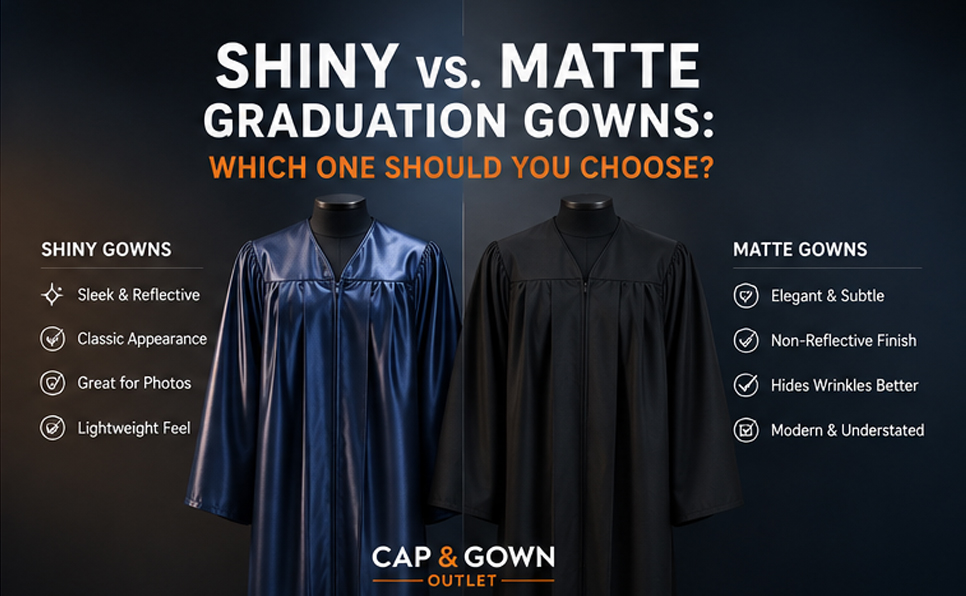
Matte or Shiny Gowns?
Both finishes may be appropriate depending on the institution’s preference.
Matte gowns have a lower-sheen appearance. Shiny gowns reflect more light and create a different visual effect. Schools replacing existing inventory should pay attention to finish because a matte gown and shiny gown in a similar color may look noticeably different when graduates stand together.
How to Size CTE Graduation Gowns
The sizing process should begin only after the institution has selected the actual gown product.
Graduation gowns do not necessarily use the same sizing system as ordinary clothing. Participants should follow the current sizing chart associated with the selected gown.
Recommended Sizing Workflow
- Select the graduation gown
- Obtain its current sizing chart
- Provide clear sizing instructions to participants
- Collect the measurements or information required by that chart
- Assign the appropriate product size
- Identify extended-size requirements
- Convert participant selections into quantities by size
- Review the complete size distribution before purchasing
Adult Learners Require Broad Size Planning
Career programs often serve a wider age and body-size range than a traditional single-grade graduating class.
A ceremony may include recent high school graduates, working adults, career changers and older learners. Programs should therefore review the complete available size range instead of building the order around only the most common sizes.
Consider Comfort and Mobility
Graduates may spend significant time walking, standing and sitting while wearing their gowns. Programs should allow enough time for participants to try on their apparel before the event.
An early fitting or distribution period can help identify:
- Incorrect gown sizes
- Length concerns
- Missing caps
- Missing tassels
- Accessory errors
- Extended-size needs
Graduation Caps for Technical Program Completers
A traditional mortarboard can be paired with a standard gown when the institution has chosen a cap-and-gown ceremony.
The cap color should coordinate with the approved gown and overall ceremony plan.
Students should also follow their institution’s policy regarding cap decoration. A program allowing decorated mortarboards should communicate its rules before graduation day.
Tassels for CTE Graduation
Tassels can be simple or can coordinate with institutional or career-program colors.
Depending on the available merchandise, institutions may consider:
- Single-color tassels
- Two-color tassels
- School-color tassels
- Program-color tassels
- Dated tassels
- Undated tassels
When Undated Tassels Can Be Useful
Programs ordering extra merchandise should consider how leftover products will be used.
An undated tassel may be easier to carry forward for future ceremonies, replacements or late completers. Dated tassels can provide a year-specific keepsake but may have limited usefulness after that graduation cycle.
Use Stoles to Identify Career Pathways
Career stoles can visually distinguish programs while preserving a common graduation gown across the graduating class.
Examples of pathways that an institution might choose to recognize include:
- Automotive and transportation
- Construction and building trades
- Electrical technology
- HVAC and refrigeration
- Welding and fabrication
- Advanced manufacturing
- Healthcare and allied health
- Information technology
- Cybersecurity
- Culinary and hospitality
- Business and entrepreneurship
- Agriculture and environmental technology
The institution should establish the meaning of each stole rather than relying on assumed universal color meanings.
Plain vs. Customized CTE Stoles
Plain stoles can provide a simple color-based recognition system and may offer greater flexibility for recurring programs.
Customized stoles may be appropriate when the organization wants authorized program wording, institutional identification or other approved artwork.
Customized products may require additional production time, minimum quantities, artwork preparation and approval.
Graduation Cords for Technical Achievement
Recognition cords can be used when an institution wants to acknowledge specific accomplishments beyond basic program completion.
Examples might include:
- Academic distinction
- Technical excellence
- Leadership
- Student organization participation
- Service
- Career pathway achievement
- Other institution-defined recognition
There is no single universal system assigning CTE meanings to every cord color. Schools should establish their own eligibility requirements and communicate them consistently.
Certificate Covers Can Be Central to CTE Recognition
For many technical and workforce programs, the certificate is the primary document being presented. A certificate cover can create a formal presentation even when the program chooses not to use full graduation regalia.
Before ordering covers, measure the actual document.
Confirm:
- Document width
- Document height
- Portrait or landscape orientation
- Required cover size
- Cover color
- Quantity
- Blank or customized format
Do Not Assume Every Career Certificate Is the Same Size
A technical school may issue several types of certificates through different departments. A community college may also have workforce certificates that differ from its degree documents.
Measure the actual documents rather than assuming that one cover automatically fits every credential.
CTE Graduation Regalia for High School Students
High school students completing career and technical pathways may already have graduation apparel established by their school or district.
Before purchasing separate CTE regalia, determine whether students will participate in:
- The regular high school commencement
- A separate CTE recognition ceremony
- Both events
For the regular commencement, students should follow their school’s graduation dress requirements. Career achievements can potentially be recognized through institution-approved stoles, cords or certificates.
CTE Regalia for Community College Programs
Community colleges frequently offer both academic degrees and non-degree workforce programs.
Purchasing teams should keep these credential categories clear. A student earning an associate degree may have institution-specific academic regalia requirements, while a short-term workforce certificate recipient may use a different recognition package.
Students should verify the requirements of the degree-granting institution before purchasing degree-specific regalia.
Graduation Apparel for Trade and Vocational Schools
Trade and vocational schools may use traditional cap-and-gown ceremonies for program completion, particularly when several occupational programs graduate together.
A common gown can create a unified appearance while approved stoles, cords or certificates identify individual career areas.
Healthcare Career Recognition
Healthcare training can include nursing, medical assisting, dental assisting, emergency medical education, phlebotomy, patient care and other allied-health pathways.
Some healthcare programs have their own pinning or professional recognition traditions. Graduation apparel should complement rather than conflict with any established institutional requirements.
Skilled-Trades Graduation
Programs in welding, construction, HVAC, electrical technology, machining, automotive repair and similar trades may choose to recognize technical completion through certificates, stoles or full graduation apparel.
The ceremony format should reflect the institution’s program structure rather than trying to imitate degree-specific academic dress where it is not applicable.
Apprenticeship Completion Ceremonies
Apprenticeship programs may involve multiple organizations, including educational institutions, employers, apprenticeship sponsors and workforce organizations.
Before purchasing regalia, identify which organization controls the ceremony requirements and which entity is responsible for purchasing.
Individual CTE Graduate Ordering
Some programs require students to purchase their own graduation apparel.
Before ordering independently, students should confirm:
- Required gown style
- Required gown color
- Required finish
- Cap requirements
- Tassel color
- Whether a year charm is required
- Permitted stoles and cords
- Any school-specific restrictions
Purchasing a similar-looking product without checking institutional requirements can result in merchandise that does not match the graduating class.
Bulk CTE Graduation Orders
Schools and organizations may choose to coordinate graduation apparel for the entire group instead of requiring every student to purchase separately.
Bulk ordering can be useful for:
- Technical high schools
- Career centers
- Vocational schools
- Community colleges
- Adult education programs
- Workforce training organizations
- Apprenticeship programs
- School districts
- Government-supported education programs
Build the Order From Product Quantities, Not Just Graduate Count
The total number of graduates is only the starting point.
Each product should be calculated separately because not every participant necessarily receives every item.
Example Institutional Order
- 480 participating graduates
- 420 graduation gowns
- 420 mortarboards
- 420 tassels
- 480 certificate covers
- 175 career stoles
- 95 recognition cords
The actual distribution should follow the institution’s approved ceremony plan.
Separate Preliminary and Final Quantities
Career-program completion numbers can change as students finish required coursework, clinical hours, examinations, apprenticeships or other program requirements.
Use preliminary quantities for early budgeting and supplier discussions. Establish a later deadline for final quantities and gown sizes.
Check Existing Inventory Before Ordering
Recurring CTE programs should count reusable graduation merchandise before creating the new purchase order.
Potentially reusable products may include:
- Standard gowns
- Mortarboards
- Undated tassels
- Blank certificate covers
- Plain stoles
- Standard recognition cords
Dated and customized products should be reviewed separately because their future usefulness may be limited.
Build a Small Replacement Inventory Strategically
A reasonable reserve can help with late participants, damaged products and size exchanges.
Rather than purchasing the same extra percentage of every product, institutions can use prior ceremony data to determine which items most often require replacements.
Standardize Products for Recurring CTE Programs
Organizations holding ceremonies every year may benefit from establishing approved product specifications.
A standard specification can identify:
- Gown style
- Gown color
- Finish
- Sizing system
- Mortarboard color
- Standard tassel
- Certificate cover
- Approved stole colors
- Approved cord configurations
Standardization can make future replacement orders and inventory planning easier.
Institutional Quote Requests Should Be Specific
Schools purchasing in quantity should provide suppliers with enough information to prepare a meaningful quotation.
Include:
- Products requested
- Gown specifications
- Gown quantities by size
- Extended-size requirements
- Cap quantity
- Tassel specifications
- Certificate-cover dimensions
- Stole requirements
- Cord requirements
- Customization
- Required delivery date
- Shipping destination
Request Line-Item Pricing
Separate pricing can help institutional buyers compare products and modify quantities without rebuilding the entire quotation.
Potential line items include:
- Gown only
- Cap only
- Tassel only
- Cap, gown and tassel set
- Certificate cover
- Diploma cover
- Plain stole
- Customized stole
- Single cord
- Double cord
- Intertwined cord
- Shipping
Compare Equivalent Graduation Products
When comparing suppliers, confirm that quoted products have similar specifications.
A lower price may represent a different gown finish, construction, size range, package configuration or accessory specification.
Evaluate the Total Delivered Cost
Institutional buyers should consider the complete transaction cost, which may include merchandise, customization, setup charges where applicable, special packing, shipping and other disclosed charges.
Ask About Institutional Pricing
Schools and organizations ordering larger quantities can ask whether institutional or volume pricing is available for their specific products and quantities.
Pricing should be evaluated using the actual order rather than assuming that every bulk purchase receives the same discount.
Large Orders Require Quantity-Specific Inventory Verification
Retail availability for one gown does not necessarily mean that hundreds of gowns are available across the required sizes.
For a group order, verify:
- Total gown quantity
- Quantity by size
- Extended sizes
- Required colors
- Caps
- Tassels
- Certificate covers
- Stoles
- Cords
Plan Customized Products Earlier
Custom stoles, custom certificate covers and other personalized merchandise may require artwork review and production before shipping.
Keep custom-product deadlines separate from deadlines for qualifying stocked merchandise.
Plan Backward From the Required Delivery Date
Graduation merchandise should normally arrive before the day students need to receive it.
A Planning Timeline Can Work Backward From:
- Graduation ceremony
- Student distribution
- Fit and exchange period
- Shipment inspection
- Required delivery date
- Carrier transit
- Supplier processing
- Custom production
- Artwork approval
- Institutional purchasing approval
- Final sizing and quantities
Processing and Shipping Are Separate
Processing occurs before an order enters the carrier network. Shipping begins after the merchandise has been released to the carrier.
Expedited shipping may shorten transit for qualifying orders, but it does not eliminate customization, institutional approval or processing requirements.
Receiving Graduation Supplies
Large institutional shipments should be sent to an approved receiving location that can accept and secure the merchandise.
For multi-campus organizations, decide whether the order will be delivered centrally or divided among individual schools or training locations.
Inspect the Order Immediately
Opening and checking graduation merchandise soon after delivery provides more time to address discrepancies.
Check:
- Number of cartons
- Gown quantities
- Gown sizes
- Gown colors
- Caps
- Tassels
- Certificate covers
- Stoles
- Cords
- Custom merchandise
- Visible damage
Hold an Early Distribution or Fitting Session
Students should ideally receive or try on their graduation apparel before ceremony day. This provides time to identify sizing issues and missing accessories.
Record What Happened After the Ceremony
Recurring programs can improve future orders by documenting actual usage.
Record:
- Number of participants
- Gown sizes used
- Extended-size usage
- Size exchanges
- Replacement orders
- Unused gowns
- Unused caps
- Unused tassels
- Unused covers
- Unused stoles and cords
This information provides a stronger starting point for the next graduating class.
Public and Government-Supported CTE Purchasing
Public school districts, state technical systems, community colleges, workforce agencies and other government-supported education programs may have formal purchasing requirements.
The responsible organization should determine the procurement method that applies to the specific transaction.
Depending on applicable rules, purchasing could involve formal quotations, competitive quotations, bids, RFQs, purchase orders, authorized purchasing cards, existing contracts or other permitted procurement methods.
Vendor Registration May Be Required
A public institution may require a supplier to complete vendor onboarding before an order can be processed.
Requirements vary and may include business documentation, tax forms, certifications, conflict disclosures, insurance documentation where applicable or other procurement forms.
Purchase Orders Should Be Confirmed Before Issuance
If an organization plans to use a purchase order, it should confirm that the supplier accepts POs for the proposed transaction and review applicable payment terms.
Acceptance of a qualifying purchase order does not automatically establish approved-vendor, awarded-contract, preferred-supplier or government-contract status.
CTE Graduation Regalia Buying Checklist
- Identify the credential being recognized
- Confirm the institution’s ceremony rules
- Separate degree and non-degree graduates where necessary
- Select the recognition format
- Choose the gown style
- Choose gown color and finish
- Obtain the correct product sizing chart
- Collect participant sizing information
- Identify extended-size needs
- Select caps and tassels
- Decide between dated and undated tassels
- Select certificate or diploma covers
- Measure the actual documents
- Determine whether stoles are needed
- Determine whether cords are needed
- Define accessory meanings internally
- Verify permission for custom branding
- Review existing inventory
- Calculate each product separately
- Establish preliminary and final quantities
- Plan reasonable replacement inventory
- Request an itemized institutional quote
- Compare equivalent products
- Review total delivered cost
- Verify inventory for the complete size distribution
- Plan custom products early
- Follow applicable purchasing procedures
- Confirm purchase-order acceptance when applicable
- Establish the required delivery date
- Inspect merchandise after arrival
- Distribute gowns before the ceremony
- Record unused inventory after graduation
Graduation Products for Career and Technical Education
Cap and Gown Outlet is an independent academic regalia supplier offering graduation and recognition products that can be considered by individual graduates, technical schools, career centers, vocational programs, community colleges, workforce education organizations and qualifying institutional purchasers.
Relevant products may include:
- Graduation gowns
- Mortarboard caps
- Graduation tassels
- Cap, gown and tassel sets
- Certificate covers
- Diploma covers
- Graduation stoles
- Honor and recognition cords
- Academic regalia where appropriate
- Related graduation accessories
Individual and Institutional Ordering
Depending on the selected products and current availability, graduation merchandise may be available for individual purchases as well as school, program and institutional quantities.
Institutional buyers can inquire about formal quotations, quantity-based pricing, available sizes and colors, extended sizing, multi-program orders and nationwide U.S. shipping.
No minimum quantity may apply to qualifying standard merchandise, while customized products can have different minimums and production requirements. Current inventory, pricing, processing time, customization, shipping options and payment terms should be confirmed for the specific order.
Independent Supplier Disclosure
Cap and Gown Outlet is an independent commercial academic regalia supplier. It is not affiliated with, endorsed by, sponsored by, authorized by or acting on behalf of any technical school, trade school, community college, school district, department of education, workforce agency, apprenticeship organization, state agency or federal, state or local government unless an actual official relationship has been established.
References to institutional purchasing, public procurement, quotations, RFQs, bids, purchase orders and vendor registration describe possible purchasing processes only. They do not establish an awarded contract, approved-vendor designation, government endorsement or preferred-supplier status.
Frequently Asked Questions About CTE Graduation Regalia
What should a career and technical education graduate wear?
The appropriate apparel depends on the credential and institution. A program may use a standard gown, mortarboard and tassel, while others may use certificate covers, stoles or cords. Graduates should follow the requirements of the organization conducting the ceremony.
Can vocational certificate graduates wear graduation gowns?
Yes, when the institution chooses to use traditional graduation apparel for its recognition ceremony. Wearing a standard graduation gown does not by itself indicate a particular academic degree.
Do all CTE graduates need the same cap and gown?
No. Requirements can differ among schools and credentials. Within one institution, however, a common gown can help create a coordinated appearance.
Can CTE programs use stoles to distinguish different trades?
Yes, if permitted by institutional policy. Approved stole colors or designs can distinguish career pathways while students wear the same base gown.
Is there an official nationwide color for each CTE program?
Institutions should not assume that a particular gown, stole or cord color has a universal CTE meaning. The school or program should define its own approved recognition system.
Can workforce certificate programs use certificate covers without gowns?
Yes. Certificate covers can provide formal presentation for programs that do not use traditional caps and gowns.
Can trade schools place their logo on graduation products?
Authorized customization may be available for certain products. The organization should have appropriate permission to reproduce school names, trademarks, logos or other protected branding.
Can schools buy individual pieces instead of complete sets?
Depending on product availability, gowns, caps, tassels and accessories may be available separately. This can be useful when an institution already owns part of its graduation inventory.
Can technical schools place bulk graduation orders?
Yes. Institutional quantities can be requested based on the products, colors, size distribution, delivery requirements and current inventory.
Can several CTE programs be included in one order?
Yes, where practical. A combined order can use common base products while maintaining separate quantities for program-specific stoles, cords or other recognition accessories.
When should CTE graduation apparel be ordered?
Programs should work backward from the required arrival date and allow time for final participant counts, sizing, institutional approvals, procurement, customization where applicable, processing, shipping, inspection and exchanges.
Celebrate Skills, Training and Career Achievement
A career education graduation ceremony can recognize the practical skills, persistence and training that graduates have completed on the way to employment, certification, apprenticeship or continued education.
The strongest regalia plan starts with the credential rather than the merchandise. Once the institution determines what is being recognized, it can select appropriate caps, gowns and accessories, build an inclusive size distribution, coordinate career-pathway recognition and organize purchasing around actual participant needs.
For recurring programs, standardized specifications, reusable inventory, historical sizing information and early institutional planning can make future CTE masters graduation regalia orders more consistent and efficient.