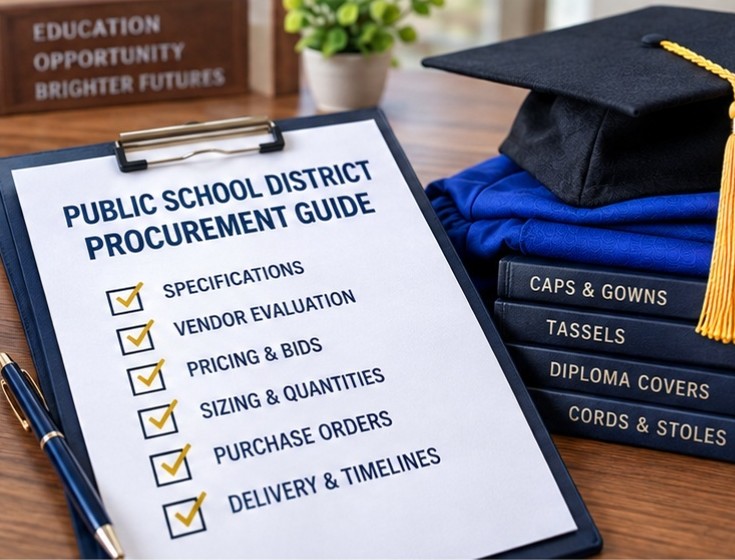
Public school districts purchasing graduation supplies must balance student needs, school traditions, public purchasing requirements, budget limits and strict commencement deadlines. A district may need hundreds or thousands of graduation elementary gowns while also coordinating caps, tassels, diploma covers, honor cords, graduation stoles, customized products and delivery to multiple schools.
A successful public school graduation supply purchasing process begins before the first supplier quote is requested. Districts should establish accurate product specifications, organize quantities, determine procurement requirements and create a realistic delivery schedule.
This guide provides a practical framework for public school purchasing departments, business offices, graduation committees and administrators evaluating institutional graduation regalia suppliers.
Begin With a Graduation Purchasing Team
Large district orders often involve several departments. Establishing responsibilities early can prevent conflicting specifications and duplicate purchasing activity.
The Team May Include:
- District purchasing staff
- Business administrators
- High school administrators
- Graduation coordinators
- School finance personnel
- Warehouse or receiving staff
- Authorized procurement personnel
One designated purchasing contact can coordinate final specifications and supplier communication while schools provide their individual graduation requirements.
Create a Graduation Procurement Calendar First
Instead of beginning with supplier pricing, work backward from the earliest commencement date in the district.
The Calendar Can Include:
- Preliminary graduate-count deadline
- Specification-development deadline
- Supplier research period
- RFQ or bid release date
- Supplier response deadline
- Evaluation period
- Award or purchasing approval
- Vendor onboarding
- Purchase-order issuance
- Final sizing deadline
- Artwork approval deadline
- Custom-production deadline
- Standard product shipment
- District receiving
- School-level distribution
- Replacement order period
- Graduation date
This approach helps identify procurement delays before they create a graduation-week emergency.
Establish a Separate Profile for Every School
District-wide purchasing works best when each participating school submits the same core information.
Each School Profile Can Include:
- School name
- Projected graduating class
- Gown color
- Gown finish
- Cap color
- Tassel specification
- Diploma-cover requirement
- Honor cord quantities
- Graduation stole quantities
- Customization requirements
- Delivery destination
- Required arrival date
This allows the district to preserve each school’s commencement traditions while still consolidating purchasing activity.
Separate Preliminary Forecasts From Final Quantities
Early in the school year, exact graduation eligibility may not yet be known. Districts can therefore work with two quantity stages.
Preliminary Quantities Can Be Used For:
- Budget preparation
- Market research
- Initial vendor discussions
- Procurement planning
- Determining whether formal bidding thresholds may apply
Final Quantities Can Be Used For:
- Purchase orders
- Final production
- School allocations
- Shipping instructions
Suppliers should be told whether a quantity is an estimate or a final committed amount.
Create a Product Specification Before Comparing Prices
Price comparisons have limited value when suppliers are quoting different merchandise.
The district should first establish what qualifies as an acceptable graduation product.
For Graduation Gowns, Consider Specifying:
- Style
- Color
- Finish
- Fabric characteristics
- Construction
- Size range
- Extended sizing
- Whether a cap is included
- Whether a tassel is included
- Packaging requirements
Use Performance-Based Specifications Where Appropriate
A district may not need to restrict every purchase to a single brand or manufacturer. Where purchasing rules allow, specifications can describe the characteristics the merchandise must meet.
Examples Can Include:
- Required color
- Required finish
- Required size coverage
- Required cap style
- Required tassel configuration
- Minimum package contents
- Required delivery date
If equivalent products are permitted, the solicitation should explain how equivalency will be evaluated.
Evaluate Existing Graduation Inventory Before Ordering
Some schools may already have usable gowns, caps, diploma covers or undated accessories remaining from a previous year.
An Inventory Review Can Identify:
- Reusable standard gowns
- Reusable mortarboards
- Undated tassels
- Blank diploma covers
- Unused cords
- Unused stoles
- Dated merchandise that cannot be reused
Subtracting usable inventory before ordering can reduce unnecessary spending.
Standardize Products Only Where It Helps
Districts may be able to standardize certain product characteristics without eliminating school identity.
Potential Standardization Areas Include:
- One gown construction
- One matte or shiny finish
- One sizing system
- One diploma-cover format
- One packaging method
- One supplier quote format
Different schools can still maintain distinct gown and tassel colors.
Choose the Graduation Gown Before Collecting Final Sizes
Graduation gown size categories differ between products. Final quantities should therefore be based on the actual sizing chart for the proposed gown.
A Better Sizing Workflow Is:
- Select the proposed product
- Obtain its current size chart
- Provide sizing instructions to schools
- Collect the required information
- Convert the information into quantities by size
- Identify extended-size requirements
- Verify availability across the entire size distribution
Do Not Depend on Ordinary Clothing Sizes
Graduation gowns may be sized using height ranges, height-and-weight combinations or another product-specific system.
Regular shirt, jacket or dress sizes should not replace the supplier’s actual graduation gown sizing guidance.
Create an Aggregate Size Matrix
For institutional purchasing, districts can organize quantities by size rather than providing unnecessary student-level information.
Example:
- Range A — 96 gowns
- Range B — 178 gowns
- Range C — 245 gowns
- Range D — 211 gowns
- Range E — 122 gowns
- Extended Sizes — 27 gowns
The actual ranges should match the selected product’s current sizing chart.
Review Extended Sizes as Part of Vendor Evaluation
Extended sizing is not simply an afterthought. A vendor should be able to explain availability across all size categories required by the district.
Ask Vendors:
- Which extended sizes are available?
- Are they available in the required colors?
- Do they cost more?
- Can replacements be ordered later?
- Are lead times different?
Protect Student Privacy During Commercial Ordering
A graduation supplier generally needs product information, sizes and quantities rather than unrelated student records.
Districts should follow their own data-handling policies and provide only information necessary for the transaction.
Decide Whether to Purchase Sets or Separate Components
A public school graduation order can be structured several ways.
Possible Purchasing Formats Include:
- Gown only
- Mortarboard only
- Tassel only
- Gown and cap
- Cap, gown and tassel package
- Individual accessories
The solicitation should define exactly what is included in a quoted “set.”
Compare Package Contents Before Comparing Unit Prices
A supplier quoting a complete cap, gown and tassel set should not be compared directly with a supplier quoting only the gown.
Confirm Whether Pricing Includes:
- Gown
- Cap
- Tassel
- Year charm
- Individual packaging
- School-specific sorting
- Shipping
Specify Graduation Gown Color Accurately
Color descriptions can vary between suppliers. If maintaining consistency with existing regalia is important, the district may want to review a sample or product reference before making a large purchase.
Consider:
- Existing school color tradition
- Color consistency across sizes
- Matching cap availability
- Future replacement availability
- Availability for multiple graduating classes
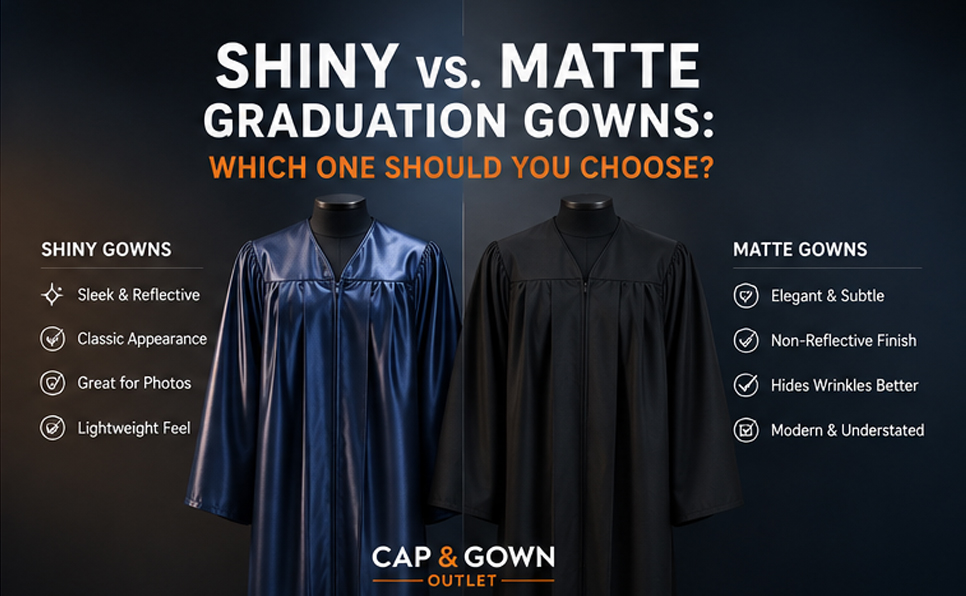
Evaluate Matte and Shiny Gowns Separately
Matte and shiny gowns have visibly different finishes. The district’s specification should state which finish is required rather than permitting suppliers to assume.
If either finish is acceptable, that should also be stated clearly in the solicitation.
Plan Cap Quantities Independently
Even when caps are packaged with gowns, purchasing records should show the required cap quantity.
This Helps With:
- Replacement ordering
- Late additions
- Lost caps
- Package verification
Build a Tassel Specification Sheet
Tassels can vary by school and year.
Record:
- School
- Tassel color
- Quantity
- Dated or undated
- Year charm
- Whether included in a set
Limit Excess Dated Inventory
A district may be able to reuse standard gowns or caps, but year-specific tassels and charms have limited future value.
Backup quantities for dated merchandise should therefore be planned carefully.
Develop Separate Diploma-Cover Specifications
Diploma covers should not automatically be treated as part of the cap-and-gown package.
Specify:
- Document dimensions
- Portrait or landscape orientation
- Cover dimensions
- Color
- Material or finish where relevant
- Interior configuration
- Blank or customized design
- Quantity
Measure the Actual Diploma Before Ordering Covers
Diploma dimensions may differ among schools, programs or credentialing organizations.
Verifying the document size before procurement reduces the risk of ordering an incompatible cover.
Consider Standard Blank Covers for Flexibility
Where appropriate, blank diploma or certificate covers may provide districts with more flexibility than highly customized merchandise.
Potential Advantages Include:
- Use across multiple schools
- Easier replacement inventory
- Potential future reuse
- Less custom-production lead time
Custom Covers Require Earlier Procurement
Customized diploma covers may require artwork, setup, proofs and production.
Allow Time For:
- Artwork submission
- Authorization
- Proof review
- Corrections
- Final approval
- Production
- Shipping
Control Use of School and District Branding
School logos, district names, mascots, seals and other protected artwork should only be reproduced when appropriate authorization has been provided.
Procurement personnel should identify who is authorized to approve custom artwork before production begins.
Specify Honor Cords by Configuration
Honor cords may be available in several configurations.
Possible Line Items Include:
- Single honor cord
- Double honor cord
- Intertwined cord
- Intertwined double cord
- Other approved styles
The district should define colors and quantities based on its own recognition policies.
Do Not Assign Universal Meanings to Cord Colors
Honor-cord meanings can vary among schools and organizations.
The responsible school should determine which students are eligible and what each color represents.
Create Separate Graduation Stole Line Items
Stoles can differ significantly in cost depending on style and customization.
Examples Include:
- Plain honor stoles
- Class-year stoles
- Trimmed honor stoles
- Program stoles
- Custom printed stoles
Separate line items make supplier pricing easier to evaluate.
Determine Which Products Need Samples
A district may want physical samples for a new gown, diploma cover or accessory before making a substantial purchase.
Sample Evaluation Can Consider:
- Color
- Fabric
- Finish
- Construction
- Fit
- Cap quality
- Diploma-cover dimensions
- Accessory appearance
If samples are mandatory, the solicitation should state that requirement explicitly.
Do Not Make Sample Requirements Ambiguous
If suppliers must provide samples, state:
- Required product
- Quantity
- Submission deadline
- Delivery location
- Identification requirements
- Whether samples will be returned
Develop a Detailed Vendor Quote Form
A standardized pricing form makes it easier to compare supplier responses.
Potential Columns Include:
- Item number
- Product description
- Estimated quantity
- Unit price
- Extended price
- Shipping
- Production lead time
- Stock status
- Minimum quantity
- Notes or exceptions
Request Individual Line-Item Prices
Line-item pricing gives purchasing teams greater visibility into the order.
Common Graduation Procurement Lines Can Include:
- Graduation gown
- Mortarboard cap
- Tassel
- Cap, gown and tassel set
- Diploma cover
- Certificate cover
- Single honor cord
- Double honor cord
- Intertwined cord
- Plain stole
- Class-year stole
- Trimmed stole
- Custom stole
State Whether Partial Bids Are Permitted
A supplier should not have to guess whether it must bid every item.
The solicitation should state whether suppliers may respond to:
- All items only
- Individual line items
- Specific product groups
- Specific schools
- Another defined portion of the procurement
Define the Basis of Award
The district should clearly communicate how responses will be evaluated under its applicable purchasing rules.
The Award Structure Might Be:
- One supplier for the entire order
- Award by product category
- Award by individual line item
- Award by school
- Another structure permitted by the solicitation
Require Vendors to Identify Exceptions
If a supplier cannot meet a requested specification exactly, the response should clearly identify the proposed alternative rather than silently substituting merchandise.
Exceptions Could Involve:
- Color
- Fabric
- Size availability
- Accessory style
- Package contents
- Lead time
- Minimum quantity
Evaluate More Than the Advertised Price
Public procurement decisions must follow the applicable solicitation and purchasing rules, but from a product-comparison standpoint, districts should understand the complete cost and fulfillment requirements associated with each response.
Relevant Commercial Factors May Include:
- Unit price
- Package contents
- Size availability
- Extended-size charges
- Customization cost
- Shipping
- Split shipment charges
- Replacement-item pricing
- Lead time
Calculate Total Delivered Cost
If one vendor quotes free shipping but higher merchandise prices while another charges freight separately, comparing only unit prices can be misleading.
Total Delivered Cost Can Include:
- Products
- Customization
- Setup charges
- Shipping
- Special packaging
- Multiple destinations
- Other disclosed charges
Clearly State How Freight Should Be Quoted
A district can require one of several freight formats.
For Example:
- Freight included in unit price
- Freight listed separately
- One total delivered price
- Shipping cost by school
The selected method should be stated in the solicitation so all suppliers quote consistently.
Ask About Institutional and Volume Pricing
District quantities may qualify for institutional pricing depending on the supplier and products selected.
Potential volume pricing should be evaluated together with specifications, availability and total delivered cost.
Verify Whether Pricing Is Fixed for the Contract Period
If the district expects to place orders throughout the year, it should determine whether pricing is:
- Fixed for a defined period
- Valid only for the initial order
- Subject to future quotation
- Controlled by the solicitation terms
Ask About Replacement Pricing
Replacement orders are common near graduation.
The District May Want Pricing For:
- One replacement gown
- One replacement cap
- One replacement tassel
- Small supplemental orders
- Late-added graduates
Knowing the process in advance can simplify last-minute ordering.
Confirm Minimum Quantities
Standard merchandise may have different minimum requirements from custom products.
Ask Whether Minimums Apply To:
- Standard gowns
- Replacement products
- Custom stoles
- Custom diploma covers
- Special-order colors
Review Current Inventory Before Final Purchase
Supplier availability can change between initial quotation and final order.
Confirm Inventory Across:
- Every required gown size
- Extended sizes
- Every school color
- Caps
- Tassels
- Diploma covers
- Honor cords
- Stoles
Ask What “In Stock” Means
A product being listed as available does not necessarily establish that the supplier has the district’s full quantity immediately ready for fulfillment.
For large orders, confirm the quantity actually available or the expected replenishment timeline.
Separate Standard Inventory From Made-to-Order Products
Stocked merchandise and custom products should have separate procurement schedules.
Potential Stocked Merchandise Includes:
- Standard gowns
- Mortarboards
- Basic tassels
- Selected diploma covers
- Selected cords
Products That May Require Production Include:
- Custom stoles
- Custom diploma covers
- Special tassels
- Special-order gown colors
- Other personalized products
Do Not Confuse Processing and Transit Time
A supplier may require time to prepare an order before the carrier receives it.
When evaluating a proposed delivery schedule, distinguish:
- Production time
- Supplier processing time
- Carrier transit time
- District receiving time
Use Expedited Shipping for Exceptions, Not as the Primary Strategy
Expedited transportation can help with qualifying in-stock products, but it cannot eliminate public procurement steps or custom manufacturing time.
Early purchasing remains the stronger strategy for large district orders.
Understand Public School Procurement Requirements
Public school districts may be subject to state statutes, board policies, purchasing thresholds and internal procedures.
Depending on the Purchase, a District May Use:
- Direct purchase where legally permitted
- Informal quote process
- Multiple written quotations
- Request for quotation
- Invitation for bid
- Request for proposal
- Cooperative purchasing
- Existing public contract
- Another authorized procurement method
The district’s authorized procurement personnel determine which method applies.
Review Vendor Registration Requirements Early
Supplier registration should not be left until the delivery deadline is approaching.
A District May Request:
- Legal business information
- Tax forms
- Vendor registration forms
- Ownership disclosures
- Conflict-of-interest certifications
- Debarment or compliance certifications
- Electronic payment information
- Insurance documents where required
- Other district-specific forms
Insurance Requirements Depend on the Procurement
Some solicitations may require proof of insurance, while others may have different requirements based on contract type or risk.
The actual solicitation or district purchasing policy should determine whether insurance must be submitted with the bid, before award, before contract execution or at another stage.
Do Not Assume Bonds Are Required
Bid bonds, performance bonds or payment bonds are not universal requirements for graduation supply contracts.
Suppliers should review the specific solicitation rather than assuming a bond is required or unnecessary.
Confirm Purchase Order Requirements
Many public school districts issue purchase orders as part of their purchasing process.
Before placing an order, verify:
- Whether the supplier accepts purchase orders
- Applicable payment terms
- Correct billing entity
- Where the PO should be submitted
- Whether a quote number must appear on the PO
A Purchase Order Is Not the Same as Supplier Approval
Purchase-order capability does not automatically make a company an approved district vendor, contracted supplier or cooperative purchasing provider.
Those statuses should only be claimed when they actually exist.
Determine the District’s Receiving Strategy
Graduation merchandise can be delivered centrally or directly to schools.
Central Receiving Can Offer:
- One delivery destination
- Central inspection
- Controlled district distribution
School-Level Delivery Can Offer:
- Less internal redistribution
- Faster access by graduation staff
- Direct school inventory control
Confirm the Actual Commercial Receiving Address
The address shown on a school’s public website may not be the preferred location for commercial deliveries.
Verify:
- District or school name
- Receiving department
- Commercial delivery address
- Attention line
- Purchase-order number
- Required carton labeling
- Delivery restrictions where applicable
Create a Separate Allocation Sheet for Each Campus
If one supplier serves several schools, a school-specific allocation sheet can reduce distribution errors.
For Each School, List:
- Gown quantities by size
- Cap quantity
- Tassel quantity
- Diploma covers
- Cords
- Stoles
- Custom merchandise
- Delivery address
- Required arrival date
Specify Carton Labeling Requirements Before Award
If cartons need to be identified by school, size, product type or purchase-order number, include those requirements in the original purchasing documents.
Special labeling should not become an unexpected requirement after pricing has been agreed upon.
Inspect Graduation Supplies Immediately After Delivery
Schools should not wait until commencement week to verify their orders.
Check:
- Number of cartons received
- Product quantities
- Gown colors
- Size quantities
- Mortarboard count
- Tassels
- Diploma covers
- Honor cords
- Stoles
- Custom artwork
- Visible damage
Create a District Process for Shortages and Replacements
Establish who can communicate a shortage to the supplier and who can authorize supplemental purchases.
Common Late Needs Include:
- Additional graduating students
- Gown-size changes
- Missing caps
- Damaged products
- Lost tassels
- Incorrect school allocations
Evaluate the Vendor After Commencement
A post-graduation evaluation can help districts make better purchasing decisions the following year.
Review:
- Product conformity
- Quality
- Color consistency
- Size availability
- Quote accuracy
- Invoice accuracy
- Communication
- Shipping performance
- School-level sorting
- Custom-product accuracy
- Replacement responsiveness
Measure Forecast Accuracy
Compare estimated quantities with what schools actually used.
Track:
- Unused gowns
- Unused caps
- Unused tassels
- Unused diploma covers
- Unused cords
- Unused stoles
- Replacement quantities
- Frequently exchanged sizes
This can improve next year’s forecasting and reduce excess inventory.
Maintain a Graduation Procurement History
An annual purchasing record can save significant administrative time.
Keep:
- Specifications
- Supplier quotes
- Bid documents where applicable
- Final quantities
- Size distribution
- Purchase price
- Shipping cost
- Custom artwork
- Delivery results
- Unused inventory
- Vendor-performance notes
Public School Graduation Purchasing Checklist
- Create the district graduation purchasing team
- Build a procurement calendar
- Identify participating schools
- Develop projected graduate counts
- Review existing inventory
- Create school-specific product profiles
- Determine centralized or school-based purchasing
- Define gown specifications
- Choose matte or shiny finish
- Specify gown colors
- Select the proposed product
- Obtain the correct size chart
- Collect final sizing information
- Create aggregate size quantities
- Identify extended sizes
- Specify caps
- Specify tassels
- Plan dated merchandise
- Measure diplomas
- Specify diploma covers
- Specify honor cords
- Specify stoles
- Identify customized products
- Confirm authorization for logos
- Determine whether samples are required
- Create supplier pricing forms
- Request line-item pricing
- Define whether partial bids are allowed
- Define the basis of award
- Require disclosure of product exceptions
- Define freight-pricing requirements
- Compare total delivered cost
- Ask about institutional pricing
- Confirm replacement pricing
- Confirm minimum quantities
- Verify inventory
- Separate standard and custom products
- Determine applicable procurement requirements
- Complete vendor registration where required
- Review insurance requirements
- Review bond requirements where applicable
- Confirm purchase-order acceptance
- Determine delivery locations
- Create school allocation sheets
- Specify carton labeling
- Inspect products upon receipt
- Resolve shortages promptly
- Evaluate vendor performance
- Preserve purchasing data for next year
Questions to Include in a Graduation Regalia Vendor Review
- Which graduation gown styles do you offer?
- Which colors are currently available?
- What sizing chart applies?
- Which extended sizes are available?
- Are gowns available individually?
- Are mortarboards available individually?
- Are tassels available individually?
- What is included in your complete graduation set?
- Are replacement products available?
- What diploma-cover sizes are offered?
- Which honor cord configurations are offered?
- Which graduation stole styles are offered?
- Can authorized custom products be produced?
- What minimum quantities apply to custom products?
- What custom-production lead times apply?
- Can product samples be supplied when requested?
- Can you provide formal institutional quotations?
- Can you quote individual line items?
- Is institutional or volume pricing available?
- How long is quoted pricing valid?
- Which products are currently stocked?
- Can you confirm availability across all required sizes?
- What processing times apply?
- Can freight be quoted separately?
- Can orders be sorted by school?
- Can cartons be labeled by school?
- Can shipments go to multiple approved locations?
- Are purchase orders accepted for qualifying transactions?
Cap and Gown Outlet for Public School Graduation Supply Purchasing
Cap and Gown Outlet is an independent academic regalia supplier that can be evaluated by public schools, public school districts, career and technical education programs, adult education organizations and other qualifying institutional purchasers.
Relevant product categories may include graduation highschool gowns, mortarboard caps, tassels, diploma covers, certificate covers, honor cords, achievement cords, graduation stoles and other commencement accessories.
Potential Institutional Ordering Capabilities
- Individual graduation products
- Small school orders
- Bulk district orders
- No minimum quantity where applicable
- Multiple gown sizes
- Extended sizes where available
- Multiple gown colors
- Matte and shiny options where available
- Mortarboard caps
- Graduation tassels
- Diploma covers
- Certificate covers
- Honor and achievement cords
- Graduation stoles
- Authorized custom merchandise where available
- Formal institutional quotations
- Institutional or volume pricing
- Nationwide U.S. shipping
- Fast processing for qualifying stocked merchandise
- Expedited shipping options where available
Current inventory, minimum quantities, exact product specifications, pricing, institutional pricing, customization, samples, processing times, shipping options, purchase-order acceptance and transaction-specific procurement capabilities should be confirmed for each order.
Independent Supplier and Non-Affiliation Disclosure
Cap and Gown Outlet is an independent commercial academic regalia supplier. It is not affiliated with, endorsed by, sponsored by, authorized by, or acting on behalf of any public school district, board of education, department of education, government agency, public school, college or university unless a specific official relationship has actually been established.
References to public school procurement, vendor evaluation, RFQs, bids, purchase orders and institutional purchasing describe potential purchasing processes. They do not establish an awarded contract, government endorsement, approved-vendor status, cooperative-contract status or preferred-supplier relationship.
Frequently Asked Questions About Public School Graduation Supply Purchasing
Should school districts purchase graduation regalia centrally?
Centralized purchasing may provide efficiencies for some districts, while others may allow individual schools to purchase independently. The correct structure depends on district policy and purchasing authority.
Can several schools use one district-wide graduation supplier?
Potentially. Individual schools can maintain different colors, quantities and accessories while the district coordinates a consolidated purchasing process.
Should a district select the gown before collecting sizes?
Yes. The product’s actual sizing chart should generally be available before final size quantities are collected.
Can school districts order graduation gowns in bulk?
Yes. Public schools can request institutional quantities based on current availability and applicable procurement requirements.
Can districts request product samples?
Potentially. Sample availability should be confirmed with the supplier. If samples are mandatory for a solicitation, the district should clearly state the submission requirements.
Can a supplier bid on only some graduation products?
Only if the solicitation allows partial bids, product-group bids or line-item responses.
Why is line-item pricing useful?
It allows the purchasing department to understand individual costs for gowns, caps, tassels, covers, cords, stoles and other products.
Should shipping be included in graduation regalia pricing?
The district should define the required pricing format. Freight can be included in unit pricing, listed separately or incorporated into a complete delivered price.
Can schools request institutional pricing?
Institutional or volume pricing may be available depending on product type, quantity, customization and delivery requirements.
Can public school districts issue purchase orders?
Many public entities use purchase orders. The supplier’s current PO acceptance and payment terms should be confirmed before issuance.
Are insurance and bonds always required?
No. Requirements depend on the particular solicitation and purchasing rules. The procurement documents should be reviewed carefully.
Can district logos be placed on graduation products?
Potentially, when customization is available and the purchaser has appropriate authorization to reproduce the applicable artwork.
Can products be shipped to multiple high schools?
Potentially. Multi-location shipping, school-level sorting, labeling and associated charges should be included in the supplier quote when required.
When should graduation merchandise be inspected?
As soon as practical after delivery. Early inspection provides more time to address shortages, incorrect products or replacement needs before commencement.
Creating a Better Annual Graduation Purchasing Program
A strong public school graduation purchasing program begins with data from the previous year and clear specifications for the upcoming ceremony.
Review usable inventory before purchasing, establish one product profile for each school and organize quantities by individual product rather than relying solely on graduating-class totals.
Provide suppliers with consistent specifications and a standardized pricing format. Clearly define package contents, sample requirements, partial-bid rules, freight requirements and school-level delivery expectations so quotations can be evaluated on an equivalent basis.
Verify inventory across all required sizes before issuing the final order, distinguish stock products from customized merchandise and build adequate time into the schedule for procurement, production, shipping and inspection.
After commencement, evaluate actual usage and supplier performance. That information can become the starting point for next year’s purchasing cycle, helping the district improve forecasts, reduce excess merchandise and make future graduation procurement more efficient.
Cap and Gown Outlet can be evaluated as an independent commercial source for graduation gowns, mortarboard caps, tassels, diploma and certificate covers, honor cords, graduation stoles and related commencement products for qualifying public school purchases, subject to current availability, district requirements and applicable procurement procedures.