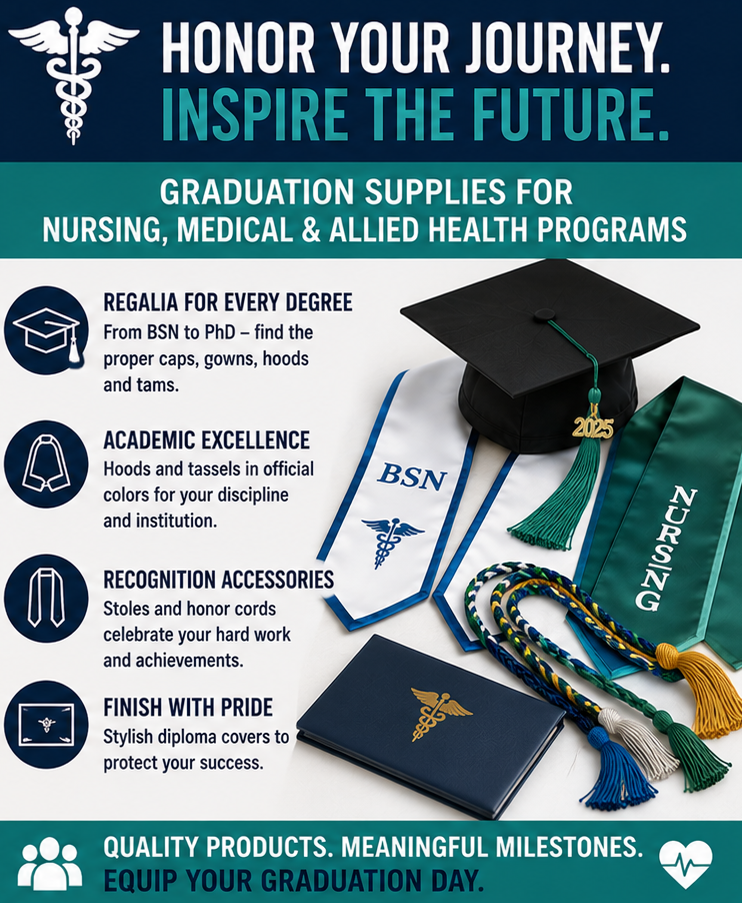
Completing a healthcare education program represents years of classroom study, laboratory work, clinical training, and professional preparation. Graduation provides an opportunity to recognize that achievement. Students, colleges, universities, and healthcare training programs may need graduation caps and gowns, academic hoods, doctoral tams, tassels, stoles, honor cords, and diploma covers for commencement and recognition ceremonies.
Graduation Regalia for Healthcare Education Programs
Healthcare education covers many academic disciplines and degree levels. Because academic attire is generally connected to the degree and institution rather than simply the student’s profession, two healthcare graduates may require completely different regalia.
Programs That May Need Graduation Supplies
- Registered nursing programs
- Practical nursing programs
- BSN programs
- MSN programs
- DNP and PhD nursing programs
- Medical programs
- Dental programs
- Pharmacy programs
- Physician assistant programs
- Physical therapy programs
- Occupational therapy programs
- Respiratory care programs
- Radiologic technology programs
- Medical laboratory programs
- Public health programs
- Healthcare administration programs
Determine the Degree Before Choosing Regalia
The first question when purchasing healthcare graduation regalia should be: What degree or credential is the student receiving?
A bachelor’s graduate should not automatically purchase the same gown as a master’s student, and a doctoral graduate may require another style entirely.
Common Degree Levels
- Certificate
- Associate degree
- Bachelor’s degree
- Master’s degree
- Professional doctorate
- Research doctorate
Bachelor’s Graduation Attire for Healthcare Students
Students completing bachelor’s-level healthcare programs commonly wear bachelor’s academic attire. Depending on institutional requirements, this may consist of a graduation gown, mortarboard, and tassel.
Students should verify the required gown color and finish before purchasing independently.
Master’s Graduation Regalia for Healthcare Professionals
Master’s academic attire normally differs visibly from bachelor’s regalia. The gown typically has distinctive sleeves, and an academic hood is generally part of the master’s graduation ensemble.
Students completing master’s programs in nursing, public health, healthcare administration, or other health disciplines should verify the exact gown and hood requirements with their institution.
Doctoral Graduation Regalia for Healthcare Graduates
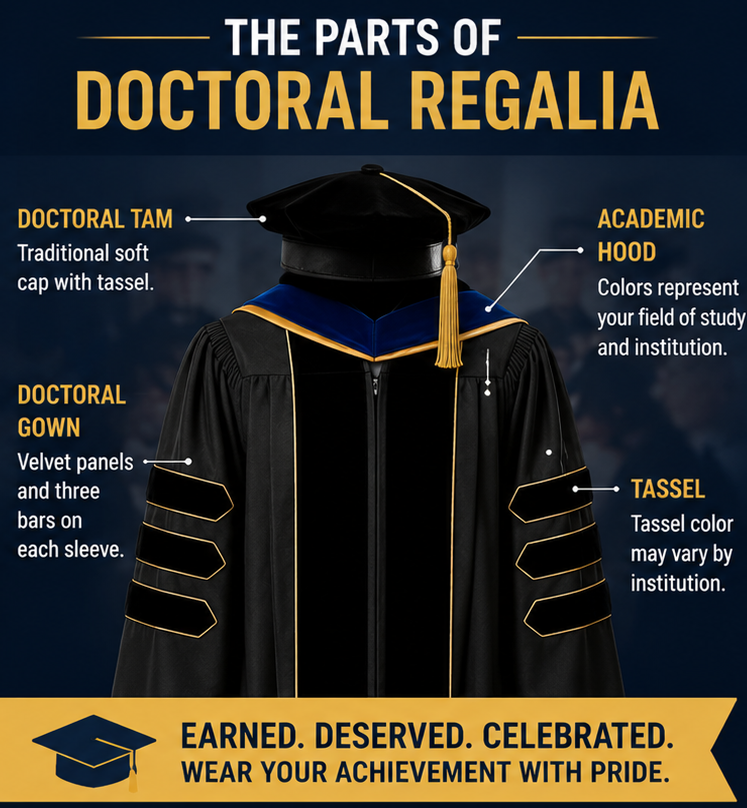
Doctoral graduates may require a doctoral gown, academic hood, and doctoral headwear. Doctoral gowns can include distinctive sleeve and velvet details that differentiate them from bachelor’s and master’s attire.
Doctoral Headwear
Depending on the institution, doctoral graduates may wear a traditional mortarboard or a doctoral tam. Tams are available in different constructions and styles, so graduates should check institutional specifications before purchasing.
Academic Hoods: One of the Most Important Details
Academic hoods are especially important when ordering master’s and doctoral regalia. A hood is not simply a decorative graduation accessory.
Its construction and colors may communicate information about academic discipline and institution under the academic dress system used by the school.
Do Not Choose a Hood by Profession Alone
A common mistake is assuming that every nursing, medical, or healthcare graduate should wear the same hood color.
The appropriate hood should be determined using the graduate’s actual degree and the requirements established by the institution.
Nursing Graduation Supplies
Nursing graduation supplies can vary considerably because nursing education ranges from certificate and associate programs through bachelor’s, master’s, DNP, and PhD programs.
Nursing Programs May Need
- Graduation gowns
- Mortarboards
- Doctoral tams when applicable
- Tassels
- Master’s or doctoral hoods
- Graduation stoles
- Honor cords
- Diploma or certificate covers
Medical School Graduation Supplies
Medical schools coordinating commencement attire should establish the exact academic regalia specifications before collecting graduate orders.
Depending on institutional requirements, graduates may need doctoral gowns, academic hoods, approved headwear, and tassels.
Allied Health Graduation Supplies
Allied health programs can include students completing very different credentials. A school might have certificate, associate, bachelor’s, master’s, and doctoral graduates participating in related ceremonies.
Administrators should organize orders by program and degree rather than treating every healthcare student as one regalia category.
Physical Therapy Graduation Regalia
Physical therapy graduates should verify academic attire according to the specific degree being awarded. Doctoral-level graduates may require doctoral academic regalia, while other programs may use different commencement attire.
Occupational Therapy Graduation Regalia
Occupational therapy programs may award different degree types depending on the institution and program. Students should verify the appropriate gown, hood, headwear, and tassel rather than purchasing based solely on the program name.
Physician Assistant Graduation Regalia
Physician assistant graduates should follow their institution’s commencement requirements for the degree awarded. Master’s-level academic attire may include a master’s gown and hood when specified by the school.
Pharmacy and Dental Graduation Regalia
Professional healthcare degrees may have specific academic dress traditions and institutional requirements. Pharmacy and dental graduates should confirm the complete regalia specifications directly with their school before ordering.
Graduation Stoles for Healthcare Programs
A graduation stole can be used for institution-approved recognition when permitted. Stoles may identify programs, organizations, leadership, service, or other recognized accomplishments.
Schools planning coordinated stoles should establish the design and eligibility requirements before ordering.
Custom Healthcare Graduation Stoles
When permitted, customized stoles may include approved program wording, graduation year, colors, or authorized artwork.
Institutional names, seals, logos, and other protected marks should only be reproduced with appropriate permission.
Honor Cords for Nursing and Healthcare Students
Honor cords may recognize academic performance, service, leadership, organization membership, or other achievements established by the school or program.
There is no universal meaning for every honor cord color. Programs should define what each cord represents and communicate eligibility requirements clearly.
Graduation Tassels and Year Charms
A tassel is normally worn with a mortarboard or other approved graduation headwear. Institutions may establish particular tassel requirements.
Some graduation tassels include a year charm. When purchasing a complete graduation set, check whether the tassel and charm are already included.
Diploma and Certificate Covers
Diploma covers can create a professional presentation during commencement and healthcare recognition ceremonies.
Programs ordering covers should verify the dimensions and orientation of the diploma, certificate, or recognition document before selecting a cover.
Nursing Pinning Ceremony Supplies
A nursing pinning ceremony and an academic commencement are not necessarily the same event. Programs may establish different attire requirements for each ceremony.
Pinning Ceremony Products May Include
- Program-approved attire
- Graduation stoles when appropriate
- Honor cords
- Certificate or diploma covers
- Recognition accessories
Students should follow their nursing program’s instructions regarding ceremony attire.
White Coat Ceremony vs. Graduation
Healthcare students may also participate in a white coat ceremony. This ceremony is distinct from commencement and may occur before completion of the degree.
The attire used for a white coat ceremony should not automatically be assumed to satisfy graduation requirements.
Planning Graduation Supplies for an Entire Healthcare Program
Schools purchasing graduation regalia in bulk should establish a centralized system for collecting graduate information.
Begin With a Graduate Roster
For every participating student, record:
- Graduate name
- Program
- Degree or credential
- Height
- Additional measurements when required
- Gown size
- Headwear requirement
- Academic hood requirement
- Tassel requirement
- Recognition accessories
Separate Orders by Degree Level
Large healthcare schools should divide the graduating class into appropriate academic regalia groups.
Example Ordering Groups
- Certificate graduates
- Associate-degree graduates
- Bachelor’s graduates
- Master’s graduates
- Doctoral graduates
Additional separation by program may be necessary when academic hoods or other specifications differ.
How to Collect Graduation Gown Sizes
Do not ask students only for their everyday clothing sizes. Academic gowns often use a separate sizing system based primarily on height, sometimes combined with weight, chest measurements, or other information.
Send students the sizing chart for the exact gown being ordered.
Create an Online Graduation Regalia Form
For a large class, administrators can use a digital form or spreadsheet to collect and organize graduate information.
Useful Fields
- Student name
- Program
- Degree
- Height
- Required gown size
- Cap or tam
- Academic hood
- Tassel
- Stole
- Honor cords
- Other approved accessories
Set an Internal Ordering Deadline
The deadline given to students should be earlier than the date when the final order must be submitted.
This provides administrators time to identify missing information, verify unusual sizes, check degree classifications, and confirm quantities.
Individual Purchasing vs. School Group Ordering
Individual Student Purchasing
Individual ordering can work when graduates are responsible for obtaining their own approved academic attire. Students should receive detailed specifications so they know exactly what to purchase.
Program or Institutional Purchasing
A centralized order may simplify coordination for programs that want consistent regalia across a graduating class. It can also make distribution and recordkeeping easier.
Should Programs Order Extra Graduation Gowns?
Depending on class size, budget, and supplier policies, programs may consider maintaining a limited number of additional gowns in commonly needed sizes.
Extra regalia may help with unexpected participation changes or sizing issues. Review applicable return and exchange terms before determining additional quantities.
When Should Graduation Regalia Be Ordered?
Healthcare programs should work backward from commencement day. Allow time to finalize the graduate roster, collect measurements, verify academic hoods, place the order, receive products, distribute regalia, and address potential sizing concerns.
Large orders and customized products may require additional preparation time, particularly during peak graduation season.
Inspect Bulk Orders Immediately
When the shipment arrives, compare it with the original order instead of waiting until graduation week.
Verify Every Product Category
- Gown quantities
- Gown sizes
- Degree-level gown styles
- Mortarboards
- Doctoral tams
- Tassels
- Academic hoods
- Graduation stoles
- Honor cords
- Diploma covers
Prepare Individual Graduate Packages
After verifying the shipment, create a labeled package for each graduate. This is particularly useful when a commencement includes multiple healthcare programs.
Each package can contain the student’s gown, headwear, tassel, academic hood, and applicable recognition accessories.
Hold a Regalia Fitting Before Commencement
A scheduled fitting gives graduates an opportunity to try on their complete academic attire before graduation day.
Students can check gown length, cap or tam fit, academic hood placement, and the arrangement of approved cords and stoles.
Graduation Regalia Photography for Healthcare Programs
Healthcare graduates often use academic regalia for professional and family photographs in addition to commencement.
Healthcare Graduation Photo Ideas
- Traditional cap and gown portrait
- Graduate wearing an academic hood
- Nursing graduate with approved recognition accessories
- Graduate holding a diploma cover
- Entire program graduating class
- Graduate with faculty members
- Clinical cohort photograph
- Family graduation portrait
Common Healthcare Regalia Ordering Errors
- Ordering according to profession instead of degree
- Using the same gown for every degree level
- Ordering an academic hood without verifying specifications
- Confusing academic hoods with decorative stoles
- Guessing gown sizes
- Ordering doctoral tams without checking institutional rules
- Using institutional branding without permission
- Failing to establish honor cord criteria
- Waiting too long to collect graduate information
- Not inspecting a bulk shipment promptly
Healthcare Graduation Supply Checklist
For Program Coordinators
- Finalize the graduate roster
- Identify every degree and credential
- Confirm institutional academic dress requirements
- Collect accurate sizing information
- Verify gown styles
- Confirm mortarboards and doctoral tams
- Verify academic hoods
- Confirm tassels
- Determine approved stoles and cords
- Determine diploma cover quantities
- Establish the ordering deadline
- Allow time for distribution and fittings
Frequently Asked Questions
What graduation supplies do nursing students need?
The required products depend on the degree and institution. They may include a gown, mortarboard or doctoral headwear, tassel, academic hood, and approved recognition accessories.
Are nursing graduation gowns different from regular college gowns?
The gown is generally selected according to the academic degree and institutional requirements. A bachelor’s nursing graduate and doctoral nursing graduate, for example, may require very different regalia.
Do allied health students wear academic hoods?
Master’s and doctoral academic regalia generally includes a hood, but graduates should verify the requirements associated with their specific degree and institution.
Can healthcare schools order caps and gowns for an entire class?
Group ordering may be available for schools and programs. Administrators should organize students by degree, collect accurate sizes, confirm regalia specifications, and allow sufficient time for processing and delivery.
Can nursing programs order graduation stoles?
Programs may be able to coordinate graduation stoles when their use is permitted. Any institutional names, logos, or protected designs should only be used with appropriate authorization.
Is a nursing pinning ceremony the same as graduation?
No. A pinning ceremony is a distinct nursing tradition, while commencement recognizes completion of an academic credential or degree. Attire requirements may differ between the two events.
Prepare Every Healthcare Graduate for Commencement
Choosing graduation supplies for nursing, medical, and allied health programs requires more than selecting a cap and gown. Degree level, institutional requirements, academic hoods, headwear, tassels, recognition accessories, sizing, and ceremony schedules all need to be considered.
For individual graduates, verifying the requirements early can prevent last-minute regalia problems. For nursing schools, medical programs, colleges, and allied health departments, a centralized ordering and distribution system can help organize an entire graduating class while ensuring each student receives the academic attire appropriate for their degree and ceremony.