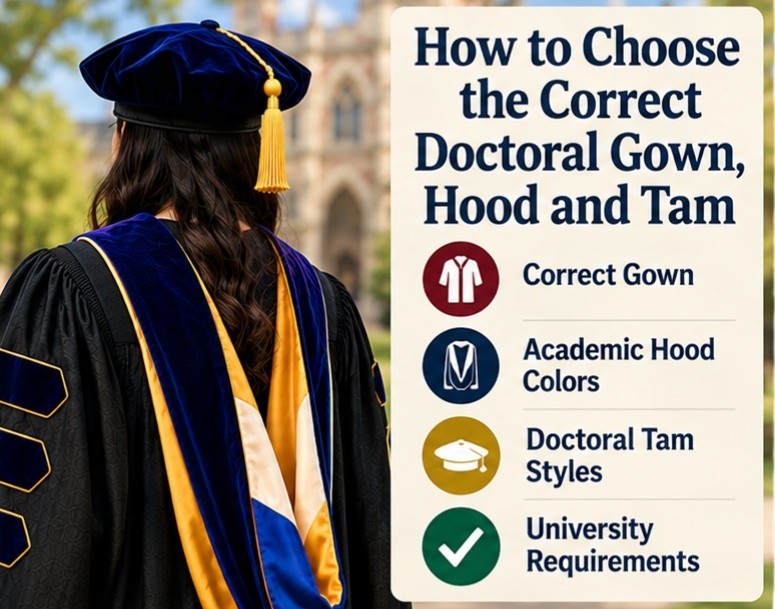
Shopping for doctoral graduation attire can become confusing quickly. One website may offer several doctoral gowns. Another may display multiple hood colors. Doctoral tams can have different numbers of sides, fabrics and sizing systems. Complete packages may include some pieces but leave others for the graduate to select.
The easiest way to avoid mistakes is to stop thinking of doctoral regalia as one generic outfit.
Instead, build your academic dress from a verified specification.
Your doctoral gown, academic hood, tam and tassel each have a separate job within the ensemble. The pieces should be selected according to the requirements of the degree-granting institution rather than simply because their colors look good together.
This doctoral regalia selection guide provides a practical process for identifying the correct PhD or doctoral gown, academic hood and tam before commencement.
Step 1: Create Your Doctoral Regalia Specification Sheet
Before opening multiple product pages, create a simple record of what your university requires.
Start with:
- University name
- Exact doctoral degree title
- Degree abbreviation
- Academic program or school
- Commencement date
- Hooding ceremony date, if separate
- Current academic-dress instructions
Then create three sections: GOWN, HOOD and HEADWEAR.
Why the Exact Degree Title Matters
“Doctorate” is a degree level, not a complete regalia specification.
Doctoral graduates may be earning degrees such as a PhD, EdD or another research or professional doctorate.
Even two graduates studying related subjects should not assume that their academic hoods or other regalia are identical.
Use the formal degree title awarded by the institution.
Step 2: Determine Whether Your University Uses Standard or Custom Regalia
This question can eliminate many incorrect options immediately.
Some universities use doctoral attire based largely on familiar academic-dress conventions. Others have distinctive institutional gowns.
A custom doctoral gown might incorporate:
- University-specific colors
- Contrasting panels
- Colored velvet
- Piping
- Embroidery
- Institution-specific sleeve details
- Distinctive headwear
Find out whether those features are required or optional.
Do Not Confuse Premium Regalia With Required Regalia
A university may display graduates or faculty members wearing elaborate custom gowns without necessarily requiring every graduating doctoral candidate to purchase that exact version.
Ask a more precise question:
What is the minimum academic-dress specification I must satisfy to participate in commencement?
Then determine whether premium or custom alternatives are available.
Step 3: Decode the Doctoral Gown
Once you know whether standard or institution-specific academic dress is expected, examine the gown.
Many doctoral gowns have visual characteristics that distinguish them from lower degree levels.
Look at the Sleeves First
Doctoral sleeves are an important visual identifier.
Many doctoral gowns feature three velvet or velvet-like bars on each sleeve.
When shopping online, inspect photographs closely enough to confirm that the product is actually doctoral-level regalia rather than a master’s or bachelor’s gown displayed under a broad graduation category.
Then Check the Front Facings
Many doctoral gowns have velvet or velvet-like panels extending down the front.
Review:
- Facing material
- Facing width
- Facing color
- Whether the treatment matches institutional specifications
Do the Sleeve Bars and Front Facings Have to Match?
Many gowns use coordinated velvet treatments, but custom institutional designs can differ.
Do not redesign the gown yourself by choosing colors independently unless the product and university requirements specifically permit those options.
Step 4: Confirm the Doctoral Gown Color
Black remains widely associated with academic dress, but doctoral gowns are not universally black.
Some institutions use highly recognizable colored doctoral gowns.
The correct question is not:
What color do doctoral graduates normally wear?
It is:
What gown color does my university specify for my doctoral ceremony?
Do Not Use the University Website Header as Your Color Guide
Institutional branding colors and academic-dress specifications are different things.
A school using red, blue or green in its branding does not automatically require a doctoral gown in that color.
Step 5: Choose the Correct Gown Size
After confirming gown construction and color, determine the correct size using the manufacturer’s sizing system.
Depending on the product, sizing may use:
- Graduate height
- Chest measurement
- Weight range
- Body measurements
- Standard garment sizes
Measure Yourself Again
Do not rely on the size of an old bachelor’s or master’s gown.
Your measurements may have changed, and doctoral gowns can use different construction and sizing systems.
Account for What You Will Wear Underneath
Doctoral gowns are outer ceremonial garments.
When checking fit, consider the clothing you expect to wear underneath, particularly if commencement will take place in a cool indoor venue or during colder weather.
Check Gown Length With Your Graduation Shoes
Footwear can affect how gown length looks and feels while walking.
Try the gown with the shoes you expect to wear at commencement.
You should be able to:
- Walk normally
- Climb steps safely
- Sit comfortably
- Stand without stepping on the gown
Step 6: Treat the Academic Hood as Its Own Specification
The doctoral hood should never be selected merely because it coordinates visually with the gown.
It can communicate information through its construction, lining and edging.
That makes the hood one of the components most likely to require careful verification.
Think of a Doctoral Hood as Three Layers of Information
Layer 1: Degree Level
First verify that you are ordering a doctoral-level academic hood rather than a master’s hood.
Layer 2: Institution
In academic-dress systems following traditional U.S. conventions, the hood lining can represent the degree-granting institution.
Layer 3: Academic Discipline
The velvet or similar edging can be associated with the academic discipline under traditional academic color conventions.
Your institution’s specification should control the actual order.
Step 7: Verify the Hood Lining Pattern, Not Just the Colors
This is an important detail that can easily be overlooked.
Suppose a university uses two colors in its academic hood lining. Knowing the two colors may still be insufficient.
The specification may also involve:
- One chevron
- Multiple chevrons
- A divided lining
- A particular color orientation
- Another institution-specific arrangement
Record both the colors and their arrangement.
Step 8: Verify the Hood Edging or Velvet
Traditional academic-dress references associate various disciplines with particular colors.
Examples commonly cited include:
- Arts, Letters and Humanities: White
- Business, Commerce and Accountancy: Drab
- Education: Light Blue
- Engineering: Orange
- Fine Arts: Brown
- Law: Purple
- Library Science: Lemon
- Medicine: Green
- Music: Pink
- Nursing: Apricot
- Philosophy: Dark Blue
- Physical Education: Sage Green
- Public Administration: Peacock Blue
- Public Health: Salmon Pink
- Science: Golden Yellow
- Social Science: Citron
- Theology and Divinity: Scarlet
These colors are provided as a general educational reference to traditional academic-dress associations. They should not be treated as a universal ordering chart.
The degree-granting institution should determine the actual hood specification.
Step 9: Be Careful With the “All PhDs Wear Dark Blue” Assumption
Dark blue has a traditional association with philosophy, and the Doctor of Philosophy degree naturally creates a connection with that color.
However, graduates should not use the letters “PhD” alone as the entire hood-ordering specification.
Universities may interpret or implement academic-dress traditions differently.
Verify the requirement for your particular degree.
Step 10: Be Extra Careful With Interdisciplinary Doctorates
An interdisciplinary doctoral program may not fit neatly into the category a graduate expects.
For example, program titles may combine:
- Technology and education
- Engineering and business
- Healthcare and administration
- Data science and social science
- Public policy and technology
Do not choose the hood edging based on whichever word in the program title seems most prominent.
Ask how the university formally classifies the degree for academic dress.
Step 11: Choose the Academic Headwear Only After the Gown and Hood Are Confirmed
The soft doctoral tam is one of the most recognizable features of modern doctoral regalia, but it is not automatically required at every institution.
Some doctoral graduates may wear:
- Four-sided tams
- Six-sided tams
- Eight-sided tams
- Mortarboards
- Custom academic headwear
What Does the Number of Tam Sides Tell You?
Primarily, it describes the construction and appearance of the tam.
It should not automatically be interpreted as indicating:
- A higher degree
- A better doctorate
- Academic honors
- Faculty status
- Professional rank
Four-Sided Tam
A four-sided tam typically has a relatively simple segmented crown.
Six-Sided Tam
A six-sided tam can provide a fuller rounded appearance and is commonly encountered in doctoral regalia selections.
Eight-Sided Tam
An eight-sided tam generally creates a fuller crown through additional sections.
If your university permits multiple styles, appearance and comfort can become factors after institutional requirements have been satisfied.
Step 12: Check Tam Material
Many doctoral tams are made with velvet or velvet-like materials.
Do not assume that every product using the word “doctoral” has the same fabric.
Compare:
- Material description
- Construction
- Interior structure
- Adjustment system
- Care instructions
Step 13: Check Tam Size
Doctoral tams may be sold as:
- Adjustable
- Elasticized
- General size ranges
- Measured sizes
If head circumference is required, follow the product’s measuring instructions.
Do Not Forget Your Graduation Hairstyle
A tam that fits perfectly during an ordinary fitting may feel different with a graduation-day hairstyle.
If your planned hairstyle significantly changes volume, test the headwear under similar conditions before commencement.
Step 14: Verify the Tassel
Doctoral tams and mortarboards typically use a tassel, but the required tassel can vary.
Gold-colored tassels are frequently seen with doctoral academic dress, but they should not be assumed to be universal.
Verify:
- Required color
- Material
- Attachment
- Year charm, if used
- Whether the tassel comes with the tam
Do Not Automatically Match the Tassel to the Hood
The hood edging and tassel serve different functions within academic dress.
The fact that your hood uses a particular discipline-related color does not necessarily mean your tassel should use that same color.
Step 15: Put the Three Main Pieces Side by Side
Before ordering, perform a three-way compatibility check.
Gown
- Correct doctoral level?
- Correct color?
- Correct velvet treatment?
- Correct sleeve construction?
- Correct size?
Hood
- Correct doctoral construction?
- Correct institution?
- Correct lining colors?
- Correct lining arrangement?
- Correct edging or velvet?
Tam or Cap
- Correct type?
- Correct number of sides if specified?
- Correct material?
- Correct color?
- Correct size?
- Correct tassel?
If any answer remains uncertain, resolve it before ordering.
Step 16: Decide Whether a Complete Doctoral Package Works
Once you know the exact specifications, you can evaluate complete doctoral regalia packages more accurately.
A package can be convenient, but the word “complete” should not replace reading the product details.
What Might Be Included in a Doctoral Regalia Package?
Depending on the seller and product, it may contain:
- Doctoral gown
- Academic hood
- Doctoral tam
- Tassel
Some packages may omit the hood. Others may offer it as a configurable option.
Verify exactly what you are purchasing.
When Individual Components Can Be Better
Building the ensemble piece by piece may make sense when:
- You already own a doctoral gown
- Your university provides the hood
- You need institution-specific hood colors
- You prefer a different approved tam
- One component needs replacement
- You are combining custom and standard regalia
Step 17: Compare Buying With Renting
Some graduates will use doctoral regalia once. Others may wear it repeatedly as faculty members or academic professionals.
That distinction can affect whether purchasing or renting makes more sense.
Rental May Be Worth Considering When:
- You anticipate one ceremony
- Your institution coordinates a convenient rental
- Highly specific custom regalia is required
- You do not want to store the gown afterward
Ownership May Be Worth Considering When:
- You anticipate repeated academic ceremonies
- You are entering a faculty career
- You want the doctoral gown as a keepsake
- You want your own fitted academic dress available for future use
Step 18: Distinguish Stock Regalia From Custom Regalia
This distinction can affect price, production time and return policies.
Stock Regalia
Stock items are generally produced in established styles, configurations and size ranges.
Custom Regalia
Custom products may involve:
- Special measurements
- Institution-specific colors
- Embroidery
- Custom velvet
- Special hood construction
- Other individualized specifications
Custom products can have different production timelines and return restrictions.
Step 19: Verify Processing Time Separately From Shipping Time
This distinction matters when ordering graduation regalia online.
Processing time is the time needed before an order is ready to ship.
Shipping time begins after the order has been dispatched.
A product offering fast shipping may still require processing beforehand.
Custom regalia can require substantially more preparation than stocked merchandise.
Step 20: Work Backward From Commencement
Instead of asking, “How late can I order?” create a safer timeline.
Start with the ceremony date and allow time for:
- University verification
- Product selection
- Production or processing
- Shipping
- Inspection
- Full fitting
- Permitted corrections or exchanges
University ordering deadlines should always take priority when applicable.
Step 21: Inspect the Gown Immediately After Delivery
Check:
- Product ordered vs. product received
- Color
- Size
- Velvet facings
- Sleeve bars
- Zipper or closure
- Seams
- Visible damage
Step 22: Inspect the Hood Separately
Do not simply look at the hood and decide that the colors “look right.”
Compare it directly with your specification sheet.
Verify:
- Degree level
- Shell
- Lining color 1
- Lining color 2, if applicable
- Chevron or lining arrangement
- Velvet or edging color
Step 23: Inspect the Tam and Tassel
Check:
- Tam style
- Number of sides
- Color
- Fabric
- Size
- Adjustment system
- Tassel color
- Tassel attachment
Step 24: Conduct a Full Doctoral Regalia Fitting
Do not stop after confirming that the gown closes.
Put on the complete graduation outfit.
Wear:
- Your planned clothing
- Your graduation shoes
- The doctoral gown
- The academic hood
- Authorized cords or stoles
- The doctoral tam or approved cap
- The tassel
Perform the Five-Minute Movement Test
Walk around for several minutes.
Then:
- Sit down
- Stand up
- Turn your head
- Look downward
- Walk up a few safe steps if available
This can reveal fit problems that are not obvious while standing still in front of a mirror.
Step 25: Photograph the Regalia From Four Angles
Take photographs from:
- Front
- Back
- Left side
- Right side
The back photograph is particularly useful for evaluating the academic hood.
Look for These Problems in the Photos
- Hood twisted incorrectly
- Lining not displayed as intended
- Tam sitting too far backward
- Gown excessively long
- Sleeves interfering with movement
- Tassel positioned awkwardly
Doctoral Regalia Order Card
Create this card before purchasing:
- University: ______________________________
- Exact degree: ______________________________
- Graduation date: ______________________________
- Standard/custom gown: ______________________________
- Gown color: ______________________________
- Velvet color: ______________________________
- Gown size: ______________________________
- Doctoral hood: ______________________________
- Hood lining: ______________________________
- Lining pattern: ______________________________
- Hood edging: ______________________________
- Tam/cap style: ______________________________
- Tam sides: ______________________________
- Tam size: ______________________________
- Tassel: ______________________________
- University specification source: ______________________________
Red Flags When Shopping for Doctoral Regalia Online
Investigate further if:
- A seller implies one hood works for every doctorate
- No gown sizing information is provided
- The hood lining cannot be specified or verified
- Package contents are unclear
- Product photographs conflict with the written description
- A tam is described as universally required for every doctoral graduate
- Discipline colors are presented as universal without institutional qualification
- Custom products have no clear production information
Common Mistake: Shopping by Appearance Instead of Specification
Doctoral academic dress is ceremonial clothing with traditions and institutional requirements.
Two combinations can look equally attractive while only one meets the graduate’s actual specification.
Use appearance as a secondary consideration after compatibility has been established.
Common Mistake: Treating Every Doctorate Like a PhD
Doctoral degrees can have different academic classifications and institutional requirements.
Do not automatically transfer a PhD regalia specification to an EdD or another professional doctorate.
Common Mistake: Treating the Hood as a Fashion Accessory
The hood should not be selected simply to coordinate with the gown, dress, suit, school logo or favorite color.
Verify the academic specification first.
Common Mistake: Assuming the Most Elaborate Tam Is the Correct One
More sides do not automatically mean higher academic status.
Choose the style required or permitted by the institution.
Common Mistake: Forgetting Package Contents
Before purchasing a doctoral package, identify every included piece in writing.
Do not rely on the product photograph alone.
Doctoral Regalia From Cap and Gown Outlet
Cap and Gown Outlet is an independent academic regalia retailer serving individual graduates and qualifying group and institutional customers.
Depending on current inventory and product configuration, available academic apparel may include:
- Doctoral graduation gowns
- Doctoral academic hoods
- Doctoral tams
- Graduation caps
- Graduation tassels
- Doctoral regalia packages
- Master’s graduation regalia
- Bachelor’s graduation regalia
- Graduation stoles
- Honor and recognition cords
- Diploma covers
Styles, fabrics, sizes, colors, hood configurations, headwear and package contents vary by product.
Graduates purchasing academic regalia independently should verify their degree-granting institution’s current requirements before ordering.
Independent Retailer Disclosure
Cap and Gown Outlet is an independent academic regalia retailer and is not affiliated with, sponsored by, endorsed by or officially authorized by any college or university unless an actual relationship has been established.
The availability of a doctoral gown, academic hood, tam, tassel or other academic-regalia product does not establish that it is approved for a particular university, doctoral program or commencement ceremony.
Frequently Asked Questions About Selecting Doctoral Regalia
What are the main pieces of doctoral regalia?
A doctoral ensemble commonly includes a doctoral gown, academic hood, approved academic headwear such as a tam or mortarboard, and a tassel. Requirements vary by institution.
How can I tell if a gown is doctoral?
Many doctoral gowns have distinctive sleeves, front velvet or velvet-like facings and three sleeve bars. Institution-specific designs can vary.
Does my doctoral gown need three velvet bars?
Three sleeve bars are a familiar feature of many doctoral gowns, but your institution’s academic-dress specification should determine the required design.
Can a doctoral gown be a color other than black?
Yes. Some universities use custom doctoral gowns in institution-specific colors.
How do I determine my doctoral hood colors?
Obtain the academic hood specification for your exact degree and institution. Verify both the lining and the velvet or edging rather than relying solely on a general color chart.
Are university colors the same as hood lining colors?
Do not assume they are. Academic hood specifications should be verified independently from general university branding.
Does every PhD use dark blue hood velvet?
Dark blue has a traditional association with philosophy, but graduates should verify the actual requirement for their degree and institution rather than treating it as universal.
Can I choose a hood based on my major?
Not safely. The institution’s formal classification of the degree should determine the specification, particularly for interdisciplinary programs.
What kind of tam should a doctoral graduate wear?
Doctoral tams are available in several constructions, commonly including four-, six- and eight-sided styles. The institution’s requirements should be checked first.
Is an eight-sided tam better than a six-sided tam?
Neither should automatically be considered academically superior. The difference primarily concerns construction and appearance.
Can a PhD graduate wear a mortarboard?
Yes, when the degree-granting institution permits or requires that style of academic headwear.
Does a doctoral tassel have to be gold?
Gold-colored tassels are commonly seen with doctoral academic dress, but institutional requirements vary.
Should I order a complete doctoral regalia package?
A package can be convenient if all included components meet your requirements. Verify the gown, hood, tam and tassel separately before ordering.
Can I purchase my doctoral hood separately?
Yes, where appropriate. You will need the correct degree-level construction, institutional lining and discipline-related specification.
Should faculty members purchase doctoral regalia?
Graduates expecting repeated participation in academic ceremonies may find ownership useful, while individual needs and institutional expectations vary.
How early should I order doctoral regalia?
Follow university deadlines and account for processing, custom production, shipping, fitting and enough time for any permitted corrections or exchanges.
Final Doctoral Regalia Selection Checklist
Before completing your order, verify these three lines:
GOWN: Correct doctoral construction + correct institutional design + correct size.
HOOD: Correct doctoral level + correct institutional lining + correct discipline specification.
TAM: Correct approved headwear + correct construction + correct fit + correct tassel.
If all three lines are verified against your institution’s current requirements, you have a much stronger foundation for selecting the correct doctoral ensemble.
The goal is not to find three academic garments that simply look good together. It is to build a doctoral regalia set in which the gown, hood and headwear each satisfy their intended purpose and the requirements of the degree-granting institution.
That specification-first approach can prevent costly ordering mistakes and help you arrive at commencement with academic dress that is appropriate, comfortable and ready for the ceremony.