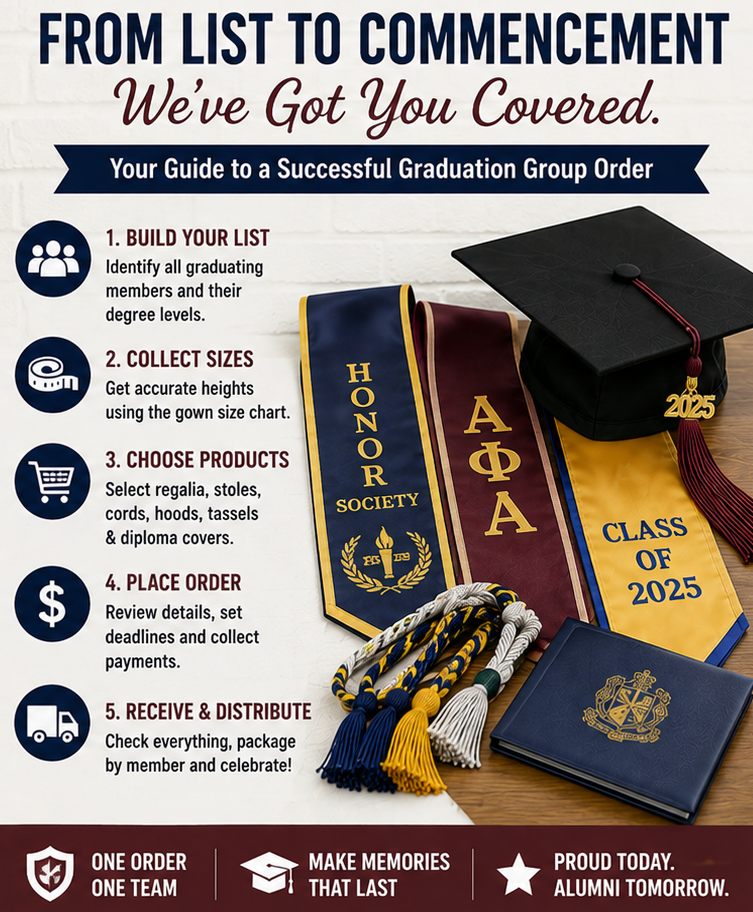
High school graduation apparel purchasing is often treated as a once-a-year administrative task. Yet for schools serving hundreds of graduating seniors, the process involves many of the same responsibilities as a formal procurement project: defining specifications, evaluating suppliers, forecasting demand, managing costs, coordinating payments, and confirming delivery performance.
A poorly structured ordering program can create unnecessary expenses, inconsistent graduation apparel, sizing problems, and last-minute pressure on school staff.
By approaching high school graduation apparel procurement as a planned purchasing operation, administrators can make better decisions while providing students with appropriate commencement apparel.
This guide examines how schools can build an efficient purchasing strategy for graduation caps, gowns, tassels, and related accessories. It also explains how to evaluate bulk suppliers, calculate total costs, manage inventory, and coordinate graduation apparel programs across schools or districts.
Why Graduation Apparel Should Be Managed as a Purchasing Program
Graduation apparel orders combine several responsibilities that extend beyond selecting a gown color.
Schools must coordinate academic dress requirements, student participation, financial arrangements, vendor communications, and delivery schedules.
When these tasks are handled separately without a central plan, mistakes can become more likely.
Five Objectives of an Effective Graduation Apparel Program
- Consistency: Ensure students receive apparel that meets the school’s approved commencement requirements.
- Affordability: Evaluate the full cost of graduation apparel rather than relying on advertised unit prices.
- Accessibility: Identify appropriate sizing and participation arrangements for all eligible graduates.
- Accountability: Maintain clear purchasing, inventory, and distribution records.
- Reliability: Allow sufficient time for supplier fulfillment, inspection, and issue resolution.
These objectives provide a practical framework for school purchasing decisions.
Step 1: Choose the Right Graduation Apparel Purchasing Model
Before requesting quotations, schools should determine how graduation apparel will be purchased and paid for.
Different purchasing models create different responsibilities for administrators, families, and suppliers.
Model A: School-Funded Graduation Apparel
Under this model, the school purchases approved graduation apparel for participating students.
The institution manages supplier selection, payment, inventory, and distribution.
This approach may simplify product consistency but requires sufficient budget authorization.
Model B: Student-Paid Graduation Apparel
Students or families purchase approved caps and gowns through an arrangement established by the school.
The school may provide specifications, approved purchasing instructions, and ordering deadlines.
Schools should communicate all mandatory costs clearly.
Model C: School-Coordinated Group Purchasing
The school collects product requirements and coordinates a consolidated order while payment responsibilities are determined separately.
This arrangement may simplify size collection and delivery coordination.
Model D: Reusable School-Owned Graduation Gowns
The school maintains a gown inventory that can be distributed, collected, cleaned, and reused for future graduating classes.
This model requires ongoing inventory management and maintenance.
Compare High School Graduation Apparel Purchasing Models
| Purchasing Model | Who Typically Pays? | Main Administrative Responsibility |
|---|---|---|
| School-Funded | School or authorized funding source | Purchasing and distribution |
| Student-Paid | Student or family | Specifications and communication |
| School-Coordinated Group | Varies by arrangement | Order coordination and tracking |
| Reusable Inventory | School initially; ongoing costs vary | Storage, cleaning, and replacement |
Schools should select a model that complies with their policies and meets student needs.
Step 2: Establish a Graduation Apparel Product Specification
One of the most effective ways to compare suppliers is to create a written product specification before requesting pricing.
Without consistent specifications, two quotations may appear comparable even though they describe different products.
Graduation Gown Specifications
- Academic level: high school
- Approved gown color
- Required gown design
- Fabric finish
- Material requirements, if applicable
- Available size range
- Closure type, if specified
- School-approved customization
Graduation Cap Specifications
- Required mortarboard design
- Approved color
- Cap sizing requirements
- Included components
Graduation Tassel Specifications
- Approved tassel color
- Single-color or multicolor design
- Graduation year charm, if required
- Quantity required
Schools should also identify any required honor cords, stoles, or diploma covers.
Products must follow the school’s approved commencement dress requirements.
Step 3: Understand the Difference Between Product Price and Total Program Cost
Graduation apparel purchasing decisions should be based on total program costs, not just the advertised gown price.
Two suppliers may quote different package prices because the included products or shipping terms differ.
Costs to Include in a Supplier Comparison
- Graduation gowns
- Graduation caps
- Tassels
- Required accessories
- Customization
- Shipping and handling
- Applicable taxes or fees
- Approved spare inventory
- Other documented purchasing costs
Example: Comparing Two Hypothetical Graduation Apparel Suppliers
| Expense | Supplier A | Supplier B |
|---|---|---|
| 300 Cap, Gown and Tassel Packages | $7,200 | $7,500 |
| Shipping | $420 | $150 |
| Required Additional Accessories | $300 | $180 |
| Total Before Applicable Taxes | $7,920 | $7,830 |
| Average Cost per Package | $26.40 | $26.10 |
These are hypothetical examples, not actual supplier prices.
Although Supplier A has a lower initial package price, Supplier B has a lower total cost in this example.
However, purchasing staff should also compare product compatibility, quality, fulfillment arrangements, and supplier terms.
Step 4: Evaluate Graduation Apparel Suppliers Using a Scorecard
School procurement teams can use a structured supplier scorecard to compare proposals.
This approach helps avoid decisions based only on price or sales presentations.
Sample Supplier Evaluation Scorecard
| Evaluation Category | Illustrative Weight |
|---|---|
| Product Compatibility and Quality | 30% |
| Total Delivered Cost | 25% |
| Fulfillment and Delivery Plan | 20% |
| Size Availability and Order Accuracy | 15% |
| Service and Purchasing Terms | 10% |
| Total | 100% |
These weights are illustrative and should be adapted to the school’s requirements.
Public institutions should follow applicable procurement evaluation rules rather than substituting an informal scorecard for required procedures.
Step 5: Forecast the Number of Graduation Packages Needed
Accurate demand forecasting begins with the number of students expected to participate in commencement.
However, not every participating student may need a package through the school purchasing program.
Example Graduation Apparel Demand Forecast
| Category | Illustrative Quantity |
|---|---|
| Expected Graduating Seniors | 525 |
| Not Participating | 20 |
| Using Approved Existing Apparel | 15 |
| Purchasing Through Another Approved Arrangement | 10 |
| Students Requiring School-Ordered Packages | 480 |
These figures are hypothetical.
Schools should verify student participation and avoid duplicate purchasing.
Step 6: Build an Accurate Graduation Gown Size Database
Large graduation apparel orders depend on accurate student measurement records.
Graduation gowns do not necessarily follow ordinary clothing sizes.
Schools should obtain the selected manufacturer’s size chart and use it throughout the measurement collection process.
Recommended Student Data Fields
- Student identifier
- Height
- Additional measurements required by the supplier
- Assigned gown size
- Required gown color
- Cap size, if applicable
- Package type
- Order status
Schools should collect only necessary information and protect student records.
Why Size Verification Matters
An incorrect size distribution can lead to shortages in popular sizes and unused inventory in others.
Before ordering, graduation coordinators should review missing submissions, duplicate entries, and measurements that require confirmation.
Step 7: Use Size Distribution Data to Prepare the Final Purchase
After student measurements are verified, the purchasing team should prepare an aggregated size report.
Illustrative Size Distribution for 480 Students
| Supplier Size | Required Quantity |
|---|---|
| Size A | 50 |
| Size B | 95 |
| Size C | 155 |
| Size D | 120 |
| Size E | 60 |
| Total | 480 |
These size labels and quantities are illustrative. Actual purchases must follow the supplier’s sizing system.
If the school requires multiple gown colors, prepare a separate quantity breakdown for each color.
Step 8: Decide How Much Spare Graduation Apparel to Maintain
Some schools purchase additional graduation apparel to address unexpected changes.
Possible needs include late ceremony participants, damaged products, lost caps, or incorrect sizes.
However, purchasing too much extra inventory increases costs.
Factors to Consider
- Historical participation changes
- Accuracy of student measurements
- Available reusable inventory
- Supplier exchange policies
- Budget limitations
- Likelihood of future use
There is no universal spare inventory percentage appropriate for every high school.
Step 9: Determine Whether Districtwide Graduation Apparel Purchasing Makes Sense
School districts with multiple high schools may consider coordinating graduation apparel procurement.
Centralized purchasing may simplify administrative processes when schools have compatible requirements.
Potential Advantages
- Coordinated quotation requests
- Consistent supplier evaluation
- Centralized purchasing documentation
- Consolidated delivery planning
- Opportunities to evaluate aggregate quantities
However, different high schools may have unique gown colors, tassel requirements, or traditions.
Districtwide procurement should preserve school-specific specifications and comply with applicable purchasing rules.
Step 10: Review School Procurement and Purchase Order Requirements
Public high schools and school districts may need to follow established purchasing procedures.
These may include:
- Budget authorization
- Competitive quotations or bidding where required
- Vendor registration
- Purchase order approval
- Documentation of supplier selection
- Authorized payment procedures
Purchasing requirements vary by jurisdiction and institution.
Schools should consult their purchasing department before committing funds.
Supplier acceptance of purchase orders or institutional payment terms must be confirmed directly.
Step 11: Establish a Graduation Apparel Purchasing Calendar
Graduation apparel procurement should be coordinated with the school’s commencement calendar.
The goal is to complete purchasing early enough to allow for delivery, inspection, and student distribution.
Example High School Purchasing Calendar
| Planning Period | Primary Activity |
|---|---|
| 5–6 Months Before Graduation | Review previous orders and confirm requirements |
| 4–5 Months Before | Collect student participation and measurement data |
| 3–4 Months Before | Request and compare supplier quotations |
| 2–3 Months Before | Complete purchasing approvals and order where lead times permit |
| 3–6 Weeks Before | Receive and inspect products according to confirmed schedules |
| 1–3 Weeks Before | Distribute apparel and resolve issues |
| Graduation Week | Confirm remaining student needs |
Actual timelines depend on supplier availability, customization, and institutional procedures.
Step 12: Create a Graduation Apparel Purchase Verification Process
Before an order is finalized, purchasing staff should compare the supplier’s confirmation with the approved requirements.
Items to Verify
- Product descriptions
- Gown colors
- Gown sizes and quantities
- Cap specifications
- Tassel specifications
- Required accessories
- Customization details
- Unit prices
- Shipping charges
- Delivery arrangements
- Payment terms
Written confirmation helps reduce misunderstandings.
Step 13: Establish Shipment Receiving Controls
Large graduation apparel shipments should be inspected systematically.
Schools can use a receiving report to document the condition and quantity of delivered products.
Receiving Report Fields
- Delivery date
- Supplier name
- Purchase order reference
- Number of cartons
- Expected quantities
- Received quantities
- Size distribution
- Missing items
- Damaged items
- Corrective actions
Any discrepancies should be reported promptly according to the supplier’s policies.
Step 14: Improve Graduation Apparel Distribution Efficiency
Once products are received and verified, schools should organize them for student pickup.
For large graduating classes, distribution can be managed by student identifier, counselor group, homeroom, or another approved method.
Distribution Controls
- Verified student package assignment
- Recorded pickup status
- Outstanding student order list
- Missing accessory reports
- Size issue documentation
- Authorized replacement procedures
Students should be encouraged to inspect and try on their graduation apparel before commencement.
Step 15: Measure the Success of the Graduation Apparel Program
After commencement, schools can review the purchasing process and identify improvements for future years.
Useful Performance Measures
- Total graduation apparel expenditure
- Average cost per participating graduate
- Percentage of orders delivered as specified
- Number of sizing issues
- Number of missing or damaged items
- Quantity of unused inventory
- Number of late student pickups
- Time spent resolving order discrepancies
These measures can help school administrators evaluate purchasing performance and prepare future budgets.
Example Graduation Apparel Cost-Per-Student Analysis
Suppose a high school purchases 480 graduation packages and incurs the following hypothetical expenses:
| Expense | Illustrative Amount |
|---|---|
| 480 Graduation Packages at $23 | $11,040 |
| Additional Required Accessories | $480 |
| Shipping | $360 |
| Total Before Applicable Taxes | $11,880 |
The illustrative average cost per purchased package is $24.75 before applicable taxes.
This calculation helps schools compare quotations and evaluate budget requirements.
Actual pricing depends on supplier quotations, product specifications, quantities, and purchasing terms.
Common Graduation Apparel Procurement Problems and How to Avoid Them
Comparing Suppliers With Different Product Specifications
Use a consistent written specification for every quotation request.
Evaluating Only Advertised Unit Prices
Compare total delivered costs.
Ordering Without Verified Student Counts
Confirm which students need apparel through the school program.
Using Incorrect Graduation Gown Measurements
Follow the selected manufacturer’s size chart.
Purchasing Excess Spare Inventory
Use historical information and realistic replacement needs.
Ignoring School Purchasing Procedures
Obtain required approvals before committing funds.
Failing to Confirm Supplier Lead Times
Verify fulfillment arrangements before placing an order.
Not Inspecting Shipments
Count and verify delivered products promptly.
Distributing Apparel Without Records
Track student pickup and outstanding issues.
Failing to Review the Program After Graduation
Document costs, problems, and improvements for future years.
Graduation Apparel Procurement for Public and Private High Schools
Public and private schools may follow different purchasing procedures, but both benefit from clear product specifications, documented quotations, and organized distribution.
Public school districts should follow applicable procurement laws and internal purchasing requirements.
Private schools should use their established approval and payment procedures.
In both settings, purchasing staff should verify supplier capabilities and terms before placing an order.
Bulk High School Graduation Apparel From Cap and Gown Outlet
Cap and Gown Outlet is an independent graduation apparel supplier serving individual graduates, families, high schools, school districts, colleges, universities, and educational organizations.
Depending on current product availability, graduation apparel categories may include:
- High school graduation cap and gown sets
- Graduation gowns in available school colors
- Matte and shiny graduation gowns
- Graduation caps
- Graduation tassels
- Graduation stoles and sashes
- Honor cords
- Diploma and certificate covers
- Bulk graduation apparel
- Preschool and kindergarten graduation apparel
- College and university academic regalia
- Master’s and doctoral graduation regalia
Schools preparing bulk graduation apparel purchases can organize their requirements into a written request that includes product specifications, sizes, quantities, accessories, and delivery expectations.
Buyers should verify current product availability, applicable quantity pricing, fulfillment estimates, shipping arrangements, customization options, and purchasing terms before ordering.
Institutional pricing and purchase order acceptance depend on current supplier policies.
Independent Supplier Disclosure
Cap and Gown Outlet is an independent graduation apparel supplier and is not affiliated with, sponsored by, endorsed by or officially authorized by any school, college, university, educational organization or government agency unless an actual relationship exists.
Frequently Asked Questions About High School Graduation Apparel Procurement
What is high school graduation apparel procurement?
It is the process of planning, selecting, purchasing, receiving, and distributing graduation caps, gowns, tassels, and related accessories for graduating students.
How do schools compare bulk graduation apparel suppliers?
Use consistent product specifications and compare total delivered costs, product compatibility, size availability, fulfillment arrangements, and supplier terms.
How can schools reduce graduation apparel expenses?
Compare complete quotations, avoid unnecessary accessories, verify quantities, and evaluate appropriate purchasing models.
What is the average cost of a high school cap and gown package?
Costs vary by supplier, product specifications, quantity, accessories, and shipping. Schools should request current quotations rather than rely on a universal average.
How do schools calculate graduation apparel cost per student?
Divide the total relevant program cost by the number of students or packages included in the calculation.
Can multiple high schools coordinate graduation apparel purchasing?
Yes, where school requirements and purchasing rules allow. Individual school colors and specifications should still be maintained.
How do schools determine graduation gown sizes?
Use the selected manufacturer’s size chart and collect the required student measurements.
Should schools purchase extra graduation gowns?
Spare inventory may be useful, but quantities should reflect actual needs, budget, and supplier policies.
Can schools use purchase orders for graduation apparel?
Some suppliers may accept purchase orders. Schools should verify supplier terms and follow applicable purchasing procedures.
How early should schools begin graduation apparel procurement?
Starting several months before commencement can provide time for planning, supplier evaluation, purchasing approvals, and distribution.
What should be included in a graduation apparel quotation?
Product descriptions, quantities, sizes, pricing, required accessories, shipping charges, fulfillment estimates, and purchasing terms.
How can schools prevent graduation gown shortages?
Verify student participation, collect accurate measurements, prepare a size-by-size quantity report, and inspect shipments promptly.
Are reusable graduation gowns cost-effective?
They may be, depending on purchase price, cleaning, storage, replacement needs, and administrative costs.
How should schools track graduation apparel inventory?
Maintain records of expected quantities, received products, size distributions, student pickup, and remaining inventory.
What should schools review after commencement?
Review total spending, order accuracy, sizing issues, unused inventory, supplier performance, and opportunities for improvement.
Final High School Graduation Apparel Procurement Checklist
- Confirm the commencement date and student participation.
- Identify the graduation apparel purchasing team.
- Select the appropriate purchasing and payment model.
- Verify official graduation apparel requirements.
- Prepare written product specifications.
- Establish the purchasing budget.
- Determine the number of students requiring apparel.
- Obtain the manufacturer’s size chart.
- Collect and verify student measurements.
- Prepare quantities by size and color.
- Determine appropriate spare inventory.
- Identify all required accessories.
- Request comparable supplier quotations.
- Evaluate total delivered costs.
- Review supplier fulfillment and service terms.
- Complete required procurement approvals.
- Verify payment and purchase order arrangements.
- Confirm the final order specifications.
- Establish a delivery schedule.
- Inspect shipments and document discrepancies.
- Organize apparel for student distribution.
- Track pickup and outstanding student needs.
- Allow time for fitting and issue resolution.
- Review program costs and supplier performance after graduation.
Build a More Efficient Graduation Apparel Purchasing Program
High school graduation apparel procurement works best when schools approach it as an organized purchasing process rather than a last-minute ceremony task.
By establishing clear specifications, comparing suppliers fairly, verifying student sizes, controlling total costs, and maintaining accurate inventory records, schools can improve purchasing efficiency and reduce avoidable problems.
Whether a school is coordinating 100 graduation packages or managing apparel for several high schools across a district, the principles remain consistent: plan carefully, document requirements, compare complete costs, and verify every stage of fulfillment.
A smarter graduation apparel procurement strategy helps schools spend responsibly while preparing students for a successful commencement ceremony.